

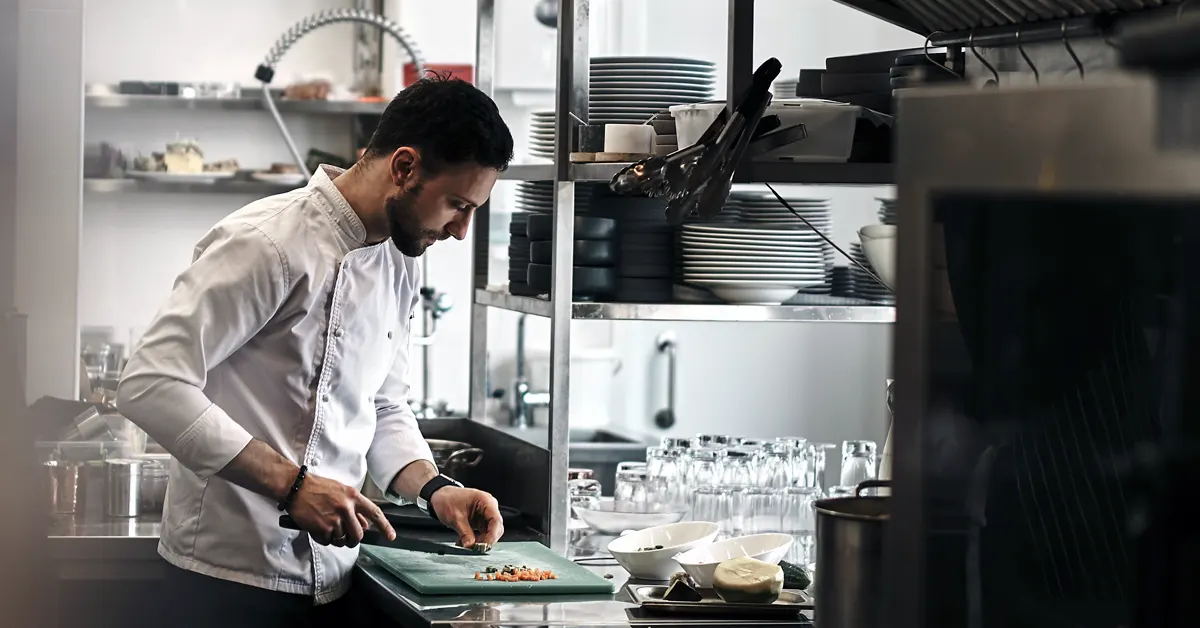
Picture a hotel restaurant on a Saturday night. Every table is seated, the bar is three deep, the kitchen printer won’t stop spitting out tickets, and the manager watching the floor feels good about the night. Then the monthly numbers come in, and the feeling curdles: revenue was strong, but the food and beverage department barely broke even. Nothing was stolen. No obvious disaster happened. The tables were full. So where did the money go?
The answer, almost always, is a slow leak rather than a single hole — a slightly-too-generous pour here, a steak trimmed a bit heavier than the recipe calls for there, a delivery invoice that never got checked against what was actually ordered, a walk-in cooler full of produce that spoiled before anyone used it. Individually, each of these is tiny. Added up over a month, they can be the difference between a profitable outlet and one that quietly drains the hotel’s bottom line.
This is the problem that food and beverage cost control exists to solve.
Table of Contents
What Food and Beverage Cost Control Actually Means
Food and beverage cost control — often written as F&B cost control in hotel operations — is the ongoing discipline of managing what it costs a hotel to produce and serve food and drinks, relative to how much revenue that food and drink generates. It is not a single task or a one-time audit. It’s a continuous cycle of purchasing, storing, preparing, portioning, pricing, selling, and measuring that hotels run every single day, in every outlet that serves food or beverage: the restaurant, the bar, room service, banquets and events, the breakfast buffet, the pool bar, the minibar, and any catering the property does.
At its simplest, cost control answers one question, asked constantly: for every dollar of food and beverage revenue we bring in, how many cents are we spending to produce it, and is that ratio where it should be?
That ratio has a name — food cost percentage (and its cousin, beverage cost percentage) — and it sits at the center of almost everything discussed below. But cost control is bigger than a single percentage. It’s the whole system of habits, procedures, and checks that keep that percentage where a hotel needs it to be, without anyone having to guess.
It’s worth being clear about what cost control is not. It is not simply “spending less” or buying cheaper ingredients. A hotel that switches to lower-quality food to cut costs may hit its target percentage on paper while damaging the guest experience and, ultimately, revenue. Real cost control is about precision — knowing exactly what something costs to make, charging the right price for it, and making sure that what actually happens in the kitchen and bar matches what was planned on paper. A well-run cost control program can just as easily justify buying a more expensive ingredient, if the menu price and portioning make it profitable.
Why Hotels Take This So Seriously
To understand why cost control gets so much attention, it helps to understand something counterintuitive about the hospitality business: food and beverage is usually the hotel’s second-largest revenue generator after rooms, but it is by far the least profitable department, percentage-wise.
Selling a hotel room has a relatively simple cost structure. Once the room is built, cleaned, and staffed, the “cost” of selling one more night is comparatively low — some housekeeping labor, some utilities, some linen. A hotel room might carry a profit margin of 60–80% on the money it brings in.
Food and beverage doesn’t work that way. Every dish sold has real, tangible costs behind it: the raw ingredients, the labor to prepare it, the energy to cook it, the packaging, the breakage, the spoilage. A restaurant that generates the same revenue as a floor of hotel rooms might keep only 20–35% of that revenue as profit, and that’s before even accounting for problems. Because the margin is naturally thin, small inefficiencies matter enormously. A rooms department can sometimes absorb a bit of waste without anyone noticing. An F&B department usually cannot — a few percentage points of lost margin can be the entire difference between the department turning a profit and losing money.
There’s a second reason cost control matters so much: food and beverage costs are genuinely hard to see. A hotel’s cash and card revenue is tracked automatically by the point-of-sale (POS) system — the till and payment terminal restaurants and bars use to ring up orders. But the cost side is scattered across dozens of small, human decisions made throughout the day: how big a portion a cook plates, how much liquor a bartender pours, whether a delivery driver actually dropped off the case of shrimp that was invoiced, whether last night’s unsold rotisserie chicken got used in today’s soup or thrown away. None of that shows up automatically on a screen. Cost control is, in large part, the set of tools and habits hotels use to make those invisible decisions visible and measurable.
Finally, cost control solves a very practical problem: without it, a hotel has no reliable way to know if its menu prices are actually right. A dish can look profitable on the menu and lose money in reality if the kitchen is over-portioning it, if the supplier price crept up without anyone noticing, or if too much of it ends up thrown away as waste. Cost control is what closes that gap between the price a hotel thinks it’s charging profitably and what’s actually happening on the ground.
The Building Blocks of a Cost Control System
Cost control isn’t one technique — it’s a set of interlocking pieces that work together. Below are the core components almost every hotel F&B cost control program is built from.
– Standardized Recipes
A standardized recipe is a written, exact formula for a dish or drink: precise ingredient quantities (not “a handful of onions” but “120 grams of diced onion”), exact preparation steps, and the final plated or poured yield. This might sound like a basic kitchen tool rather than a financial one, but it is the single foundation everything else in cost control rests on.
Without a standardized recipe, a hotel simply cannot know what a dish costs, because the dish is different every time someone makes it. One cook’s version of a Caesar salad might use twice as much cheese as another’s. With a standardized recipe, every plate of Caesar salad, made by any cook on any shift, costs (in theory) the same amount and looks the same on the plate. That consistency is what allows a hotel to calculate a reliable plate cost — the total ingredient cost of one serving — and from that, set a menu price with a known, intended margin.
– Portion Control
Portion control is the practice of serving a consistent, pre-determined amount of each ingredient every time — the exact weight of protein, the exact scoop of rice, the exact ounce count in a cocktail pour. It’s the operational twin of the standardized recipe: the recipe defines what should happen, and portion control is what makes sure it actually does happen at the pass (the kitchen counter where finished plates are checked before going to the guest) or behind the bar.
Hotels use physical tools to enforce this: portion scales, scoops and ladles sized to specific volumes, jiggers (measured pourers) for spirits, and pre-portioned packaging from suppliers for items like butter or steaks. The tools matter because they remove guesswork — and guesswork, even well-intentioned guesswork, is where cost control quietly breaks down. A bartender who free-pours “by eye” might pour a genuinely careful, consistent 1.5 ounces of vodka most of the time — but even a 10–15% average overpour across every drink sold in a busy month adds up to a meaningful, invisible loss.
– Purchasing and Receiving Procedures
Cost control starts before any food reaches the kitchen — it starts with what gets ordered, from whom, at what price, and how it’s checked when it arrives.
Purchasing involves selecting approved suppliers, negotiating and locking in prices (often through a purchase specification — a detailed description of exactly what quality, size, or grade of product the hotel wants, so a “chicken breast” order can’t quietly become a lower grade at a lower cost to the supplier and a hidden problem for the kitchen), and ordering the right quantities to match expected demand.
Receiving is the check that happens the moment a delivery truck arrives: someone on staff verifies that what’s on the invoice actually matches what’s in the boxes — correct quantity, correct weight, correct quality, correct price. This sounds almost too basic to matter, but receiving is one of the most common places money silently disappears. A case invoiced for 20 kilograms of shrimp that’s actually 18 kilograms, or a delivery priced at last month’s higher rate instead of a newly negotiated lower one, will never be caught unless someone is actively checking — and once it’s signed for, that discrepancy usually becomes the hotel’s cost to absorb.
– Inventory Management
Inventory management is how a hotel tracks and controls the food and beverage stock sitting in its walk-in coolers, freezers, dry storage rooms, and bar shelves at any given moment. Two ideas sit at the center of this:
- Par levels — the minimum and ideal quantity of an item that should be on hand at any time, based on expected usage. Par levels prevent both running out mid-service (which frustrates guests and can push a kitchen into expensive last-minute emergency purchases) and over-ordering (which ties up cash and increases the risk of spoilage).
- FIFO (First In, First Out) — a stock rotation principle where older inventory is used before newer inventory, so nothing sits on a shelf so long it spoils or expires before it’s used. In practice, this means new deliveries get stocked behind existing stock, not in front of it, so staff naturally reach for the oldest product first.
Hotels also conduct physical inventory counts — literally counting what’s on the shelves — on a regular cycle (weekly is common for high-value or fast-moving items, monthly for a full count) to compare what should be there, based on purchases and usage, against what actually is there. Any gap between those two numbers is called a variance, and it’s one of the most important diagnostic tools in cost control, discussed further below.
– Menu Pricing and Menu Engineering
Every dish and drink on a menu needs a price that covers its cost and delivers the margin the hotel needs — but pricing isn’t just “cost plus a markup.” Menu engineering is the practice of analyzing every item on a menu along two dimensions at once: how profitable it is (its margin, in actual currency, not just percentage) and how popular it is (how often guests order it).
This analysis typically sorts every menu item into four categories, often nicknamed:
- Stars — high profit, high popularity (the items a hotel wants to protect and promote)
- Plow-horses — high popularity, low profit (popular but barely profitable; often candidates for a small price increase or portion adjustment)
- Puzzles — high profit, low popularity (profitable but underordered; often candidates for better menu placement or description)
- Dogs — low profit, low popularity (candidates for removal or complete redesign)
Menu engineering is where cost control connects directly to what the guest sees on the page — it’s not just about controlling costs behind the scenes, but about deliberately designing a menu that guides guests toward dishes that are both appealing to them and healthy for the business.
– Sales and Waste Tracking
The final building block is measurement of what actually leaves the kitchen or bar and reaches a guest — versus what doesn’t. Modern POS systems track every item sold, in real time, which gives F&B managers a precise, moment-by-moment record of theoretical usage (if 40 servings of salmon were sold, the system knows exactly how much salmon, sauce, and garnish should have been used, based on the standardized recipe).
Waste tracking captures the other side: food that never made it to a paying guest at all — spoiled ingredients thrown out, dishes sent back by a guest and remade, cooking mistakes, over-preparation for a slow night, and staff meals. Hotels that take cost control seriously log this waste deliberately (often with a simple waste log sheet or a dedicated app), because waste that isn’t tracked is waste that’s invisible — and invisible waste is impossible to reduce.
What This Looks Like in a Real Hotel
These components can sound abstract in isolation, so it helps to walk through how they show up across a single hotel’s operations.
The breakfast buffet. Buffets are notoriously difficult to cost-control because portioning is left almost entirely in the guest’s hands. A well-run hotel manages this not by restricting the buffet, but by carefully forecasting how many covers (guests served) are expected each morning based on occupancy and historical patterns, preparing food in smaller, more frequent batches rather than one giant batch at 6 a.m. (so unsold food isn’t sitting out and spoiling for hours), and tracking daily waste from the buffet line specifically, so the kitchen can adjust tomorrow’s preparation quantities based on what actually got eaten versus thrown away today.
The bar. A bartender pouring a whiskey sour is, from a cost control standpoint, executing a standardized recipe just as much as a chef plating a steak. The hotel has pre-set the recipe (a specific pour of whiskey, a specific amount of lemon juice and simple syrup), trained the bartender to use a jigger rather than free-pouring, and can compare, at the end of the week, how much whiskey the POS says should have been used against how much was actually pulled from the storeroom. A consistent gap between those two numbers — more product used than sold — is one of the clearest signals in a hotel of either overpouring or, in more serious cases, theft.
Banquets and events. A wedding for 150 guests with a plated dinner is, in cost terms, wildly easier to control than a la carte dining, because the hotel knows in advance exactly how many portions of exactly which dishes it needs to prepare. The risk here shifts from portioning to forecasting accuracy — over-preparing for the guaranteed guest count wastes food, while under-preparing risks running out mid-event, which is both a cost problem and a serious guest experience failure. Banquet cost control leans heavily on the guarantee (the final confirmed guest count the client commits to, usually 48–72 hours before the event) and on final, careful headcounts on the day itself.
Room service and minibars. These are lower-volume but high-risk areas because they’re physically dispersed across the hotel rather than centralized in one kitchen. A minibar in particular requires its own inventory discipline — regular restocking checks against what a guest actually consumed and was charged for — because unlike a restaurant table, there’s no server present to catch a discrepancy in real time.
How Hotels Actually Build and Run a Cost Control Program
Understanding the pieces is one thing; making them work together, day after day, is another. Here’s how the process typically comes together in practice.
It starts with costing every recipe, precisely. Before anything else, every dish and drink on a menu needs an accurate, current cost calculated from its standardized recipe — every ingredient’s cost per gram, milliliter, or unit, added up to a total plate or pour cost. This isn’t a once-a-year task; ingredient prices move constantly, so recipe costs need to be revisited whenever a major supplier price shifts, ideally reviewed on a set schedule (monthly is common) rather than left stale for a year.
From there, target percentages get set for each category. Hotels typically set a target food cost percentage (a common range is roughly 28–35% of food revenue, though this varies significantly by concept — a steakhouse runs higher than a pizza operation) and a target beverage cost percentage (commonly 18–24%, since alcohol generally carries a much higher margin than food). These aren’t arbitrary; they’re based on what the operation needs to earn to cover its other costs — labor, rent, utilities, marketing — and still turn a profit.
Then comes the ongoing measurement — comparing what should have happened to what did. This is where the concept of variance analysis becomes central. A hotel calculates its theoretical food cost — what costs should be, based on what the POS says was sold and the standardized recipe cost of each item — and compares it against the actual food cost, calculated from real purchases and real inventory counts. Any gap between the two is a variance, and a good cost control program doesn’t just note that a variance exists — it investigates why. Common causes include over-portioning, waste, spoilage, theft, pricing errors at the register, or simply an error in the standardized recipe cost itself.
Training and clear standards matter as much as the tools. A portion scale is useless if the kitchen team doesn’t understand why using it matters or hasn’t been trained to use it under pressure during a busy dinner service. The most successful cost control programs treat training not as a one-time onboarding checklist but as an ongoing habit — regular refreshers, visible standards posted at stations, and managers who model the behavior themselves.
Common mistakes tend to repeat across properties. A few show up again and again:
- Treating cost control as a monthly paperwork exercise rather than a daily habit — by the time a month-end report flags a problem, weeks of loss have already happened.
- Focusing only on food cost percentage in isolation, without looking at the dollar amount of profit — a very low cost percentage on a cheap, unpopular dish matters far less than the actual profit generated by a hotel’s best-selling items.
- Under-investing in receiving discipline — it’s one of the least glamorous parts of the process, and the one most likely to be skipped when the team is short-staffed, which is exactly when problems tend to slip through.
- Cutting portions or ingredient quality abruptly to hit a cost target, without considering the effect on the guest experience and repeat business — a short-term fix that can create a longer-term revenue problem.
- Not closing the loop with staff. When cooks and bartenders understand why a standard exists (not just that it exists), compliance improves; when it’s presented purely as a rule handed down from above, it tends to erode over time.
Why This Matters Beyond the Kitchen and Bar
Cost control isn’t only a kitchen concern — its effects ripple across the hotel’s financial performance, staffing decisions, risk exposure, and even the guest’s experience.
On the financial side, the most immediate impact is on the F&B department’s profit margin, but the effects extend further. Hotels often track a combined metric called prime cost — the sum of total food and beverage cost plus total labor cost, expressed as a percentage of F&B revenue. Prime cost matters because food cost and labor cost are deeply connected: a kitchen that hires more skilled (and expensive) labor might reduce waste and over-portioning, actually lowering food cost even as labor cost rises — and a manager who only watches food cost in isolation can miss that trade-off entirely. A well-run F&B outlet typically aims to keep prime cost somewhere in the 60–65% range, though this varies by concept and market.
Cost control performance ultimately feeds into a hotel’s overall GOP (Gross Operating Profit) — the profit remaining after all operating expenses are deducted from total revenue, one of the most closely watched numbers by ownership and hotel management companies alike. Because F&B margins are thin to begin with, even modest improvements in cost control can move GOP meaningfully; conversely, a poorly controlled F&B operation can quietly drag down the profitability of an otherwise successful hotel.
On the risk and compliance side, cost control procedures overlap significantly with food safety. FIFO stock rotation, for instance, exists as much to prevent guests from being served expired or spoiled product as it does to reduce financial waste — the two goals reinforce each other. Rigorous receiving and inventory procedures also reduce a hotel’s exposure to theft and fraud, both external (a supplier under-delivering against an invoice) and internal (unauthorized removal of stock, or a bartender under-ringing drinks for friends). Because these risks touch legal and reputational exposure, not just cost, F&B cost control often intersects with a hotel’s broader compliance and internal audit functions.
On the guest experience side, the relationship is more nuanced than it might first appear. Done well, cost control is largely invisible to guests — they simply experience consistent portion sizes, dishes that taste the same on their third visit as their first, and a menu that doesn’t run out of advertised items. Done poorly, in either direction, guests notice: over-aggressive cost cutting shows up as shrinking portions or a decline in quality, while weak cost control (leading to a struggling F&B department) can eventually force a hotel into more disruptive fixes — menu simplification, reduced operating hours, or outlet closures — that guests notice far more directly.
A few key performance indicators (KPIs) tend to summarize how well all of this is working, and they’re worth knowing by name:
- Food cost percentage — cost of food sold divided by food revenue, the most fundamental cost control metric.
- Beverage cost percentage — the same calculation applied to drinks.
- Prime cost percentage — combined food, beverage, and labor cost as a share of revenue.
- Variance — the gap between theoretical and actual cost, used to catch problems early.
- Average check — average revenue per guest, which interacts with cost control because a menu engineered well can lift average check without raising cost percentage at all.
None of these numbers exist for their own sake. Each one is a signal — a way of catching a small problem while it’s still small, before it becomes the kind of gap that shows up as a disappointing month-end report despite a dining room that looked, every night, completely full.
The Bottom Line
Food and beverage cost control is, at its heart, the discipline of making sure a hotel actually knows — precisely, and continuously — what it costs to produce the food and drinks it sells, and making sure what happens in the kitchen and bar matches what was planned on paper. It’s built from a set of interlocking habits: standardized recipes, disciplined portioning, careful purchasing and receiving, organized inventory, thoughtful menu pricing, and honest tracking of sales and waste. None of these pieces is complicated on its own; the difficulty is in doing all of them, consistently, every single day, across every outlet a hotel operates.
Get it right, and it becomes nearly invisible — guests simply experience a consistent, well-run operation, while the hotel quietly protects one of its thinnest, most vulnerable profit margins. Get it wrong, and the losses rarely show up as one dramatic event. They show up exactly the way they did on that busy Saturday night: full tables, a lively room, and a set of numbers at month-end that don’t add up — until someone finally asks where the money went, and starts looking for the answer one recipe, one invoice, and one pour at a time.