


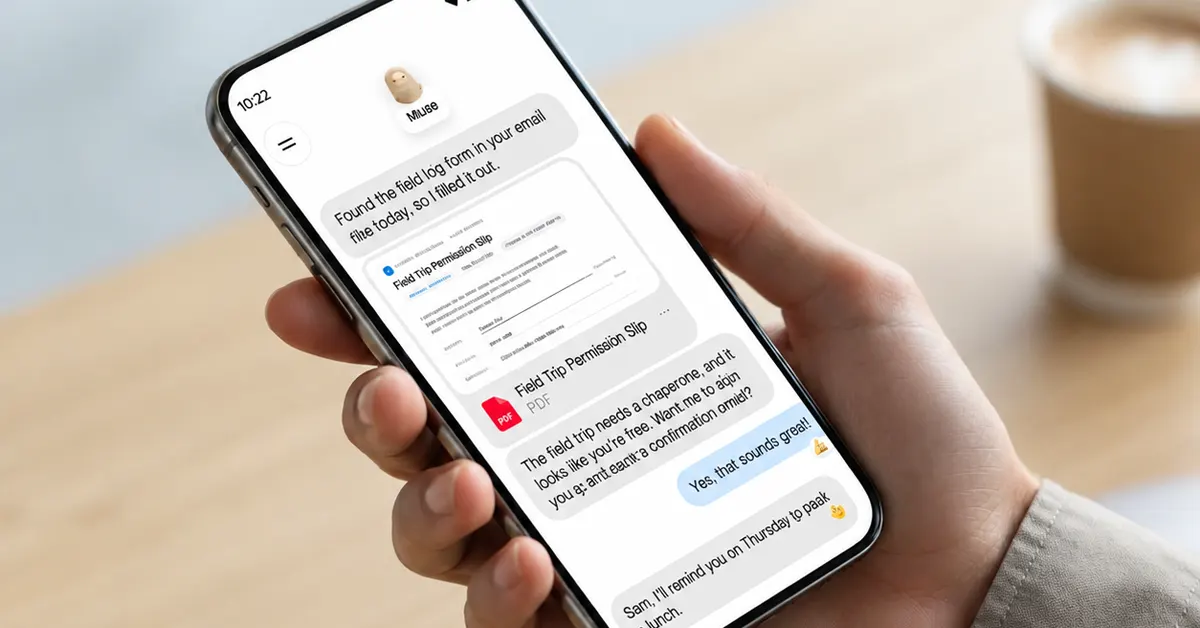
Expedia, Booking Holdings and Airbnb shares fell sharply the day after the Meta-Muse hotel tie-up was announced. The evidence suggests that reaction was larger than what the agreement’s own terms establish, while the structural question behind it is real, and is already being tested by a different company.
Expedia’s hotels are coming to Meta’s Muse, the AI agent that lets U.S. users describe a trip and have it booked without opening a browser — and the day after that was announced, Expedia, Booking Holdings and Airbnb shares all fell sharply on a reading of the news that went well beyond what Expedia had actually agreed to. Expedia says the hotel integration is coming soon for U.S. travelers, without a specific launch date. Reporting from trade press describes Expedia as remaining merchant of record on those bookings, with payment completed inside Muse. Neither of those facts, on their own, settles whether the stock reaction was a correct repricing of a genuine structural threat or an overreaction to a headline — which is the question worth answering for a GM, DOSM or revenue manager deciding how much this should change next year’s distribution planning. The evidence points to a mixed answer: the market’s reaction to this specific deal looks larger than the deal itself justifies, but the underlying threat it gestures at is real, and is currently more advanced somewhere else.
Table of Contents
1. What Expedia actually agreed to
Expedia’s own announcement, posted to its newsroom, says U.S. travelers will soon be able to describe a destination, dates and hotel preferences to Muse and have the agent surface Expedia inventory, including rates, availability and cancellation terms, with the booking experience described as “coming soon” rather than live. Expedia’s own language does not use the term “merchant of record” or describe payment mechanics in detail. Those specifics — that Expedia remains merchant of record and that payment is completed inside the Muse interface — come from trade-press reporting (TravelPulse, citing PhocusWire), not from a direct company statement using those terms. That distinction matters: merchant-of-record status typically governs who processes the transaction and handles billing and refunds, but it doesn’t by itself confirm whether Expedia’s existing hotel contracts, commission terms or customer data apply unchanged inside an AI agent’s interface. On the available public record, the safest description is: Expedia has committed to a hotel-booking integration with Muse, for U.S. travelers, without a confirmed date, and reported to route payment and post-booking responsibility through Expedia — not the fuller set of claims about customer ownership and unchanged economics that would require Expedia’s own confirmation to state as fact.
Separately, one technical detail is worth flagging rather than asserting as settled. Skift’s reporting on Muse’s design describes the agent using a live API connection to book flights (via travel-tech firm Duffel, across more than 500 airlines) but reaching hotel inventory by browser navigation — opening and reading sites like Expedia and Hotels.com rather than transacting through a dedicated connection. That’s a single trade-press account, not something Meta has confirmed publicly, so it shouldn’t be treated as a settled fact about how the Expedia integration works technically. It is, at minimum, a reason not to assume the September 22 announcement represents a deep technical integration until Meta or Expedia describes the mechanism more specifically.
2. The stock reaction, precisely
Expedia’s announcement came on September 22. On its own, per GuruFocus’s same-day coverage, Expedia shares initially firmed rather than fell. The sharp decline came the following session, September 23, when Expedia, Booking Holdings and Airbnb shares all closed down together: Expedia fell 7.72% to $259.04, Airbnb fell 7.56% to $149.58, and Booking Holdings fell 5.07%, according to closing-price data reported by TIKR and corroborated independently by 24/7 Wall St.’s same-day coverage of the three stocks. That’s a one-day, company-specific decline across all three names — not a three-day drift, and not confined to Expedia despite Expedia being the only one of the three with an actual Muse agreement.
What moved the stocks that day wasn’t new information about Expedia’s terms; multiple outlets, including Simply Wall St and Yahoo Finance, traced the broader sell-off to a Barron’s piece (by reporter Anita Hamilton) reframing Expedia, Booking Holdings, Tripadvisor and Airbnb as a group newly exposed to AI-agent disintermediation, which is a interpretation of the news rather than a new fact about it. In other words: the specific terms Expedia agreed to on September 22 didn’t change between that day and the next; what changed was how the press and, by extension, the market chose to read them.
3. A comparable episode from six months earlier
This isn’t the first time OTA share prices have moved sharply on an AI-checkout headline rather than a measured business result. In March 2026, when OpenAI was reported — first by The Information, then widely by Skift and other outlets — to be scaling back plans for in-app transactions inside ChatGPT and routing checkout to partner apps instead, Expedia shares rose more than 12% in a single session and Booking Holdings gained around 8%, figures reported consistently across Skift, TS2.tech and several financial news outlets, with Bernstein analyst Richard Clarke describing the shift as “incrementally positive” for online travel agencies. That was a rally built on the same underlying uncertainty — how much of travel booking AI agents will eventually control — moving in the opposite direction, also without an earnings report or other hard business data in between to justify the size of the move.
Read together, the two episodes don’t prove that the market is simply wrong about AI’s effect on travel distribution. They do illustrate how sensitive OTA valuations have become to shifts in expectations around AI-mediated booking, in either direction, relative to how little hard evidence has actually arrived about bookings, revenue or margin in either case.
4. Where a genuine threat is already being tested
The more useful comparison for a hotel executive isn’t the market’s reaction — it’s a different company’s product. On August 27, Google began rolling out agentic hotel booking inside AI Mode for U.S. users, a launch confirmed independently by Search Engine Journal, PhocusWire and several other outlets, with ten named partners: five booking platforms (Booking.com, Expedia, Hotels.com, Priceline, Trip.com) and five hotel chains (Choice Hotels, Hilton, IHG, Marriott, Wyndham). Travelers can select a room, review cancellation terms and pay with Google Pay without leaving the conversation; Google has said consistently, including to PhocusWire’s James Byers, that the hotel or booking platform involved remains merchant of record and handles customer service afterward.
The detail that matters here is the partner list, not just the payment mechanics. Because Hilton, Marriott and IHG are named as partners in their own right, alongside OTAs rather than only through them, this rollout can create a more direct supplier route for chain-affiliated hotels in at least some cases — a booking made through the Hilton partner integration, for instance, plausibly doesn’t run through an OTA’s commission structure the way a booking made through the Expedia or Booking.com partner integration would. Google’s own public documentation doesn’t spell out exactly how every partner’s inventory is sourced or confirm that every hotel-brand booking bypasses an OTA relationship, so this should be read as a meaningfully different structure from Muse’s current one, not as proof that every chain booking through Google now skips commission entirely. One hotel-industry outlet covering the same rollout also noted that independent and boutique properties, without a chain’s negotiating position, were absent from the initial partner list — meaning a smaller hotel can appear in an AI Mode answer and still have the booking routed through whichever OTA partner the system is wired into.
That structural split — chains with a direct route into at least one live AI agent, independents without one, and OTAs still handling the booking either way for non-partner inventory — is closer to a genuine, evidenced threat to OTA-mediated commission than anything in the Expedia-Muse deal, which currently reaches Expedia’s inventory through Expedia’s own site rather than through any new direct connection to individual hotels.
This is also the exact fork Phocuswright’s research team flagged as unresolved for the industry: will autonomous agents favor OTAs, whose distribution infrastructure they can tap easily, or suppliers, who can in principle be reached directly? Lennert de Jong, CEO of citizenM Hotels, put the pre-AI baseline plainly at last year’s Phocuswright Conference: “everybody runs over 50% OTA penetration” already. Kalibri Labs reported in 2025 that U.S. hotels saw a $1.5 billion decline in aggregate revenue capture in 2024 — an estimated $18.6 billion reduction in hotel asset value — attributed to OTA and GDS channel costs running several times higher than direct channels. That data predates Muse and Google’s rollout alike; it’s the commercial backdrop the AI question is being layered onto, not a result of it.
Internationally, the same slow drift shows up in Phocuswright’s UK data: OTA gross bookings reached a record £10.3 billion in 2025 even as OTA market share fell for a third consecutive year, with supplier-direct share projected to rise from 78% to 81% by 2029. Major groups have been building toward this independently of any single AI deal — Accor rolled its ALL Concierge assistant out globally this year, and Hilton, Marriott and IHG each launched proprietary AI concierge tools before joining Google’s rollout.
5. What hasn’t moved, and what would change the answer
Expedia’s, Booking Holdings’ and Airbnb’s most recent full-year results — reported in February 2026, seven months before the Muse deal existed — showed continued growth across all three: Expedia’s revenue rose 8% to $14.7 billion and gross bookings rose 8% to $119.6 billion; Booking Holdings’ revenue rose 13% to $26.9 billion; Airbnb’s revenue rose 10% to $12.2 billion. None of that tells you anything about Muse’s effect, because there hasn’t been time for one — the deal is days old and the hotel function it describes hasn’t launched. That absence isn’t evidence the concern is overblown, and it isn’t evidence it’s real. It’s simply too early, and should be read as exactly that.
So: real threat or overreaction? Both, in different places. The market’s reaction to the Expedia-Muse announcement specifically looks disproportionate to what that agreement’s own terms establish — a hotel-search integration with no confirmed launch date, reaching Expedia’s existing inventory through Expedia’s existing website. The broader question the reaction gestures at — whether AI agents end up defaulting to OTA inventory or connecting straight to hotel brands — is genuine, and Google’s already-live rollout with Hilton, Marriott and IHG as named partners is a more advanced test of it than anything Meta and Expedia have announced so far. What would firm up either side of that: Muse’s hotel function actually launching, and on what technical basis; whether more chains or any independent hotels join Google’s partner list; and whether Expedia’s, Booking Holdings’ or Airbnb’s next earnings calls — Expedia has typically reported third-quarter results in early November — contain any management commentary tying agent-mediated traffic to a measurable change in bookings, rather than the speculative framing currently doing the rounds in press coverage.
Data Source
- Expedia Group newsroom, “Find your next stay with the help of your personal AI agent, Muse,” September 2026
- TravelPulse, “Expedia to Offer Hotel Bookings Through Meta’s Muse AI Agent,” September 2026
- Skift, “Meta Says Its Muse Agent Books Travel. Here’s What That Means,” September 9, 2026
- GuruFocus, “EXPE Looks 22.2% Overvalued on GF Value as Travel AI Partnership Sparks Optimism,” September 2026
- TIKR, “Expedia Stock Closed Down Nearly 8% the Day After Its Meta Muse Tie-Up,” September 2026
- 24/7 Wall St., “Travel Booking Stocks Tumble as Muse Threatens to Bypass Them,” September 23, 2026
- Simply Wall St, “Expedia Stock Faces New AI Booking Threat From Muse,” September 2026
- Skift, “ChatGPT Bails on Transactions — Good News for Expedia and Booking,” March 2026
- ts2.tech, “Expedia stock jumps as OpenAI pulls back ChatGPT checkout plans,” March 2026
- Search Engine Journal, “Google Starts Rolling Out Hotel Booking In AI Mode,” August 27, 2026
- PhocusWire, “Hotel booking goes live in Google’s AI Mode, flights still waiting,” August 2026
- Hotel Online, “Google Just Started Booking Hotels Inside AI. Independent Hotels Were Not on the List,” August 2026
- Phocuswright, “Travel Forward: Data, Insights and Trends for 2026,” December 2025
- PhocusWire, “The hotel perspective: OTA’s AI partnerships,” December 2025
- Kalibri Labs, “Inflation Proofing Your Hotel Budget,” September 2025
- Expedia Group, “Reports Fourth Quarter and Full Year 2025 Results,” February 12, 2026
- Booking Holdings, “Reports Fourth Quarter 2025 Financial Results,” February 18, 2026
- Airbnb, “Q4 2025 Shareholder Letter,” February 12, 2026