Description
A Comprehensive Framework for Financial Excellence and Waste Mitigation
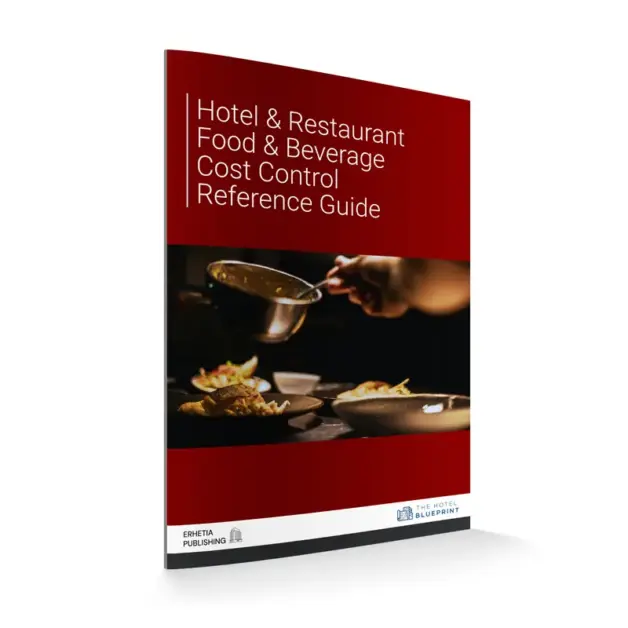
The Hotel & Restaurant Food & Beverage Cost Control – Reference Guide serves as a practical blueprint for protecting hospitality profit margins through systematic inventory and expense management. Designed for hotel controllers, food and beverage directors, and general managers, this reference manual outlines the specific operational controls required to stabilize food and beverage margins across multiple outlets and banqueting departments.
The text outlines a clear strategy for managing the entire lifecycle of food and beverage inventory, starting with target benchmarking and menu planning, moving through procurement and receipt auditing, and concluding with strict back-of-house storage and production rules. By focusing on practical mechanics, the guide helps properties isolate exactly where financial losses happen—whether through unmonitored waste, variable kitchen yields, or imprecise beverage pouring.
Managers can use the included mathematical formulas and foundational templates to transition their properties from reactive financial tracking to a proactive model. The documentation assists teams in analyzing the gap between theoretical and actual costs, running accurate weekly and monthly stocktakes, and building stable internal reporting structures that keep daily operations aligned with corporate financial targets
Preview
PART V — PRODUCTION AND SERVICE CONTROLS
Chapter 13: Kitchen Production Control
Everything covered so far — recipe costing, yield management, purchasing, receiving, storage, issuing, and waste recording — converges at the point of production. The kitchen is where the cost commitments made upstream are either honored or eroded. A perfectly costed recipe, a correctly specified purchase, a well-controlled receiving process, and a disciplined issuing system can all be undone in the thirty minutes before service if production is not managed with the same rigor that was applied at every earlier stage.
This chapter covers the cost control disciplines that operate within the kitchen itself: production planning tied to forecasting, prep list management, batch costing, portioning discipline, and the specific cost implications of over and under-production. It is not a chapter about culinary technique — it is about the operational decisions that determine whether what the kitchen produces reflects the cost structure that was designed into the menu.
The Kitchen as a Cost Center
A kitchen is a cost center — a defined area of the operation that incurs cost and generates output that is measured against that cost. Managing it as a cost center, rather than purely as a production environment, requires a specific mindset: that every decision made in the kitchen has a financial consequence, and that the cumulative effect of those decisions is what appears in the food cost report at the end of the week.
This framing is not about reducing kitchen management to a financial function. It is about ensuring that the people making production decisions — the head chef, the sous chef, the section chefs — understand the cost implications of those decisions and have the information they need to make them well. A chef who knows that the day’s protein issue represents $840 of committed cost against a forecast of $3,200 in food revenue is making production decisions with financial context. A chef who knows only that the delivery arrived and the mise en place needs to be done is making the same decisions in a financial vacuum.
The cost controller’s role in kitchen production control is not to stand at the pass with a calculator. It is to ensure that the kitchen has accurate cost information, that production planning is connected to revenue forecasting, and that the outputs of the kitchen — portions served, waste generated, product consumed — are measured against the inputs committed.
Cover Forecasting and Its Role in Production
Production planning begins with a forecast of how many covers the kitchen will serve — broken down by meal period, by day, and where relevant by section or menu. The forecast is the input that drives every production decision: how much to prep, how much to issue, what batch sizes to use, and how to staff the production schedule.
An accurate cover forecast reduces over-production waste, prevents stock-outs during service, and allows the kitchen to operate at the production volume that the revenue justifies — neither over-committing cost to a quiet service nor under-preparing for a busy one. The financial value of good forecasting is direct and measurable: a kitchen that consistently prepares for the covers that arrive, rather than the covers it fears might arrive, will run a structurally lower waste cost than one that over-prepares as a routine buffer.
Cover forecasting draws on several data sources:
Reservation data is the most reliable input for forecast accuracy. A restaurant with 80 confirmed reservations for Friday dinner, historically running at a 92% show rate with an average of 12% walk-ins, can forecast approximately 85–88 covers with reasonable confidence. The reservation system is the starting point; the historical conversion and walk-in data refines it.
Historical trading patterns provide the baseline for days and periods without reservation data. A hotel restaurant that consistently serves 55–65 covers on Tuesday lunch regardless of reservation levels can plan production to that range with confidence drawn from the pattern. Historical data should be reviewed by day of week, by season, and adjusted for known events — a trade fair in the city, a local public holiday, a major event at a nearby venue — that consistently affect trading volume.
Event and function information is critical in a hotel F&B environment. A kitchen serving both à la carte and banqueting must plan production across both demands simultaneously, and the banqueting forecast — confirmed by event orders — is typically more precise than the restaurant forecast. The interaction between banqueting production and restaurant production — shared kitchen resources, shared ingredient stocks, potential for shared prep — must be factored into the production plan.
Weather and local context are soft variables that experienced operators factor in informally. A wet Monday in a city-center restaurant may run 20% below a dry Monday. A major sporting event nearby may drive a surge in bar covers without a corresponding increase in restaurant dining. These inputs are not precise, but in an experienced operation they are used to adjust the forecast at the margins.
| A forecast is a commitment, not a guess: The value of a cover forecast depends entirely on whether the kitchen uses it to make production decisions. A forecast that is produced by the front-of-house manager and delivered to the kitchen, where it is noted and then ignored in favor of the chef’s intuition, is not a production planning tool — it is a document. The production plan should be explicitly derived from the forecast: this many covers, this menu mix estimate, therefore this quantity of each component to prepare. When the forecast is wrong — and it will sometimes be wrong — the learning from the variance improves the next forecast. A kitchen that never uses the forecast never improves its accuracy. |