

Picture a housekeeping supervisor on a Tuesday morning, staring at a supply closet with three bottles of shampoo left and forty rooms still to service that week. Or an engineer standing next to a broken pool pump, holding a part number that costs $400 and can’t wait for next month’s budget meeting. Or a chef who needs a specific cut of beef delivered by Friday for a wedding banquet. In every one of these moments, someone in the hotel needs to buy something — and none of them can simply walk to a store, hand over the hotel’s money, and bring the item back. There’s a process in between. That process is the purchase request and purchase order system, and it exists in some form in nearly every hotel on earth, from a 20-room boutique property to an 800-room resort.
This article explains how that system works, why it exists, and — importantly — how it changes shape depending on the size, ownership structure, and category of the hotel you’re working in. The underlying logic is remarkably consistent across the industry. What changes is how formal, how automated, and how many layers of approval sit between “I need this” and “it arrives at the loading dock.”
Table of Contents
1. What a Purchase Request and Purchase Order Actually Are
A purchase request (often abbreviated PR, and sometimes called a purchase requisition) is an internal document created by someone in a hotel department to ask permission to buy something. It is not an order to a supplier — it never leaves the building, at least not yet. It’s a formal way of saying: “My department needs this item, in this quantity, for this reason, and it will cost approximately this much.” A PR typically specifies what is needed, how many units, which department and cost center it belongs to, why it’s needed, and how urgently.
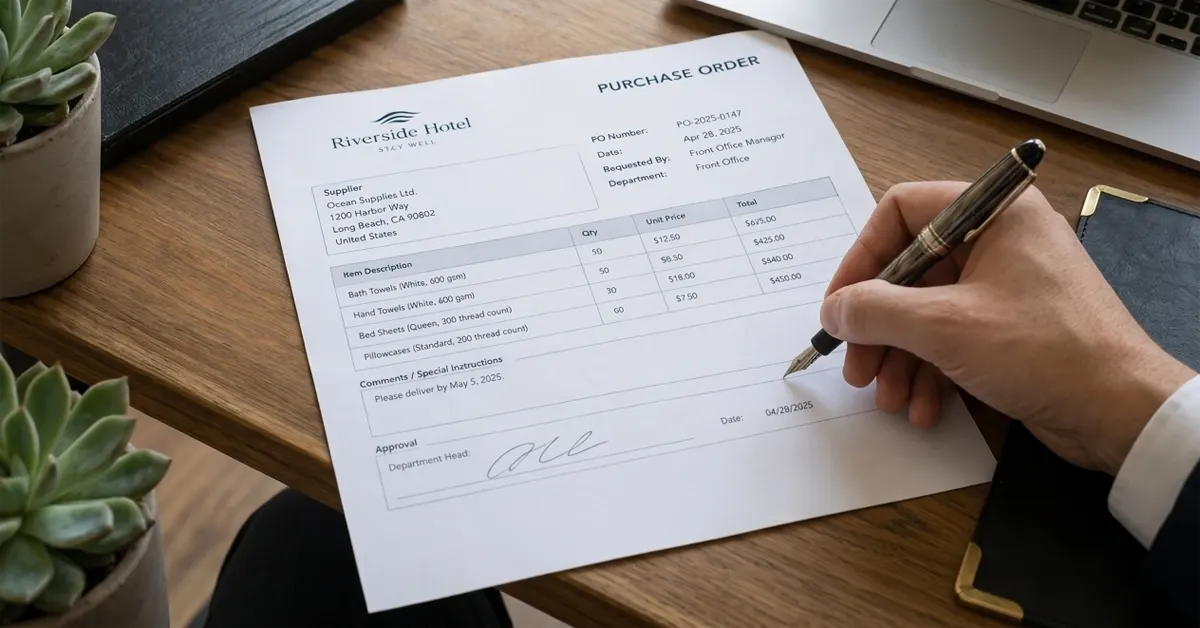
A purchase order (PO) is what happens after that request has been approved. It’s the formal, numbered document the hotel sends to an outside vendor, committing the hotel to buy specific goods or services at an agreed price, under agreed terms. Once a supplier accepts a PO, it functions almost like a contract for that transaction — it states the item, quantity, unit price, delivery date, delivery location, and payment terms.
The distance between those two documents — request and order — is where most of the actual “system” lives. In between, someone has to say yes. That approval step, and everything wrapped around it, is what turns purchasing from “spending money” into “controlled spending,” and it’s worth understanding even if you’ll never personally approve a PO in your career.
This whole sequence is often referred to in finance circles as the procure-to-pay cycle — everything from identifying a need, through requesting, approving, ordering, receiving, and finally paying the vendor. You don’t need to memorize that term, but you’ll likely hear it used by finance colleagues, and it’s simply shorthand for the full chain this article walks through.
2. Why Hotels Don’t Just Let Anyone Buy What They Need
It might seem like unnecessary bureaucracy to require paperwork before someone can buy a $30 case of glass cleaner. But the system exists to solve several real problems that hotels run into constantly, and understanding these problems is the fastest way to understand why the process looks the way it does.
Budget control. A hotel operates on an annual budget that’s broken down by department and by expense category. Housekeeping has a supplies budget; engineering has a maintenance and repair budget; food and beverage has a food cost budget tied directly to menu pricing and profitability targets. If any staff member could buy whatever they judged necessary, in whatever quantity, whenever they wanted, those budgets would become meaningless within weeks. The PR/PO system forces every purchase to be checked against what’s actually been planned and approved for that period, which is the only way a Director of Finance (the person overseeing the hotel’s accounting and financial controls) can keep the property’s financial performance on track.
Preventing “maverick spending.” This is the term the industry uses for purchases made outside the proper channel — someone buying something without approval, often from whichever supplier is most convenient rather than the one offering the best price or contract terms. It’s not usually malicious; it’s often just someone trying to solve a problem quickly. But left unchecked, it erodes negotiated pricing, creates duplicate purchases across departments, and makes it very hard to know, at any given moment, what the hotel has actually committed to spend.
Fraud prevention through separation of duties. This is one of the most important reasons the system exists, and it’s worth sitting with for a moment. In a well-run purchasing process, the person who requests an item is not the same person who approves the spending, who is not the same person who selects the vendor, who is not the same person who confirms the goods arrived, who is not the same person who authorizes payment to the supplier. This deliberate splitting of responsibilities is called segregation of duties. If one person controlled the entire chain — requesting, approving, and paying — they could, in theory, set up a fake vendor and pay themselves. Spreading these responsibilities across different people (or at minimum, requiring a second set of eyes at key steps) is one of the simplest and most effective fraud controls that exists in any business, and hotels rely on it heavily because they handle large volumes of small, frequent transactions across many departments.
Getting the right price and the right quality. A formal system also gives the hotel leverage. Instead of each department buying paper towels from whichever local shop is closest, a centralized purchasing process can negotiate volume pricing with a single supplier, lock in a fixed cost for a season, and ensure that what arrives actually matches the quality and brand specifications the hotel expects — this matters enormously for anything guest-facing, from bathroom amenities to bed linens.
Creating an audit trail. Owners, auditors, tax authorities, and — in the case of hotels operating under an international brand — the brand’s own compliance teams, periodically need to verify that money was spent appropriately and that records match reality. A documented chain from request to approval to order to receipt to payment gives everyone involved a clear, checkable trail. Without it, a hotel’s finances become effectively unauditable.
3. The Building Blocks: From Request to Payment
Now that the “why” is clear, here’s the actual mechanics — the chain of steps that a purchase typically moves through, and the documents attached to each link.
1. Identifying the need. Somewhere in the hotel, a need arises. This might be triggered automatically — many hotels track par levels for recurring supplies, meaning a pre-set minimum quantity that should always be on hand (for example, “always keep at least 200 bars of guest soap in stock”). When stock dips below that level, it triggers a reorder, sometimes automatically through software, sometimes by a staff member noticing and flagging it. Other needs are one-off: a broken piece of equipment, a special event requiring extra rental chairs, a renovation requiring new carpet.
2. Creating the purchase request. Whoever identifies the need — a department supervisor, a manager, occasionally a line-level employee depending on the hotel’s policy — fills out a PR. In smaller or older-fashioned operations this might genuinely be a paper form or a simple email; in most mid-size and large hotels today it’s entered into a piece of software, which might be a dedicated procurement platform or a module built into the hotel’s property management system (PMS, the core software hotels use to manage reservations, guests, and increasingly, back-of-house operations) or a broader enterprise resource planning (ERP) system. The PR specifies the item description, quantity, estimated cost, the department and cost center it should be charged to (a cost center is simply an accounting label that tells the finance system which department or area is responsible for that expense — “Housekeeping,” “Engineering — Pool,” “Banquets,” and so on), and often a brief justification, especially for anything unusual or costly.
3. Approval routing. This is where the request travels up a chain of people whose job is to say yes or no, and this chain is almost always defined by an approval matrix — a table, set by hotel or company policy, that says who can approve spending up to what dollar amount. A department head might be able to approve routine purchases up to a few hundred dollars. Above that, it might need the Director of Finance or a Purchasing Manager. Above a higher threshold — often anything related to capital expenditure (capex, meaning purchases of long-lasting assets like furniture, major equipment, or renovation work, as opposed to operating expenditure, or opex, which covers everyday consumable costs) — it might require the General Manager’s sign-off, and above that, approval from the ownership group or an asset management company that oversees the hotel’s investments. This tiered structure means a $15 mop doesn’t need the same scrutiny as a $50,000 kitchen renovation, while still ensuring nothing of real financial significance happens without the right person’s knowledge.
4. Vendor selection and conversion to a Purchase Order. Once a PR is approved, it becomes eligible to be converted into a formal PO. This step is often handled by a dedicated Purchasing Manager or Procurement department in larger hotels, or by the Director of Finance’s team in smaller ones. Their job is to select or confirm the vendor — ideally from an approved vendor list, a pre-vetted roster of suppliers the hotel already has agreements with — and to lock in the price and terms. For significant or non-routine purchases, this stage might involve a formal RFQ (request for quotation) or RFP (request for proposal), where multiple suppliers are asked to bid, and the hotel compares at least two or three quotes before committing. This is sometimes referred to informally as the “three quotes rule,” though the exact threshold varies by property. The resulting PO is a numbered, dated document sent to the chosen vendor.
5. Receiving. When the goods physically arrive — at the loading dock, the receiving office, or wherever deliveries are processed — a staff member (ideally not the same person who created the original request) checks what actually arrived against what the PO said should arrive: correct item, correct quantity, correct condition. This is documented in a Goods Receipt Note (GRN, also called a receiving report). If a supplier delivers eight cases of tomatoes when the PO specified ten, or delivers a damaged shipment, this is where the discrepancy gets caught and flagged before payment is ever authorized.
6. Invoice matching and payment. The vendor sends an invoice requesting payment. Before that invoice is paid, the Accounts Payable team compares three documents: the original PO, the GRN, and the invoice itself. This comparison is called a three-way match, and it’s one of the most important control points in the entire chain — it confirms that what was ordered, what arrived, and what’s being billed are all the same thing. If everything lines up, the invoice is approved for payment. If it doesn’t — say, the invoice charges a higher unit price than the PO specified — the discrepancy is investigated before a single dollar moves.
Laid end to end, that’s the full chain: need, request, approval, order, receipt, and payment — with a documented record, and usually a different person’s eyes, at every step.
4. What This Looks Like Across Different Departments
The framework above is fairly abstract, so it helps to see how it plays out in the day-to-day reality of a few different hotel departments.
Housekeeping is probably the most routine example. Guest amenities, cleaning chemicals, linens, and paper products are almost always managed through par levels. A hotel might set a par of 500 units for guest shampoo bottles. Once inventory drops to, say, 150, a reorder is triggered — sometimes automatically by inventory software, sometimes manually by the Executive Housekeeper. Because this is a recurring, predictable purchase from an established vendor, many hotels set up what’s called a standing order or blanket PO — essentially a pre-approved PO covering a set period (say, a quarter) up to a set dollar amount, so the department doesn’t have to generate a brand-new PR every single time it needs more soap. This is a good example of the system adapting itself to reduce friction for genuinely routine, low-risk purchases while still keeping everything documented and within budget.
Engineering (maintenance) tends to involve more one-off, sometimes urgent, purchases: a replacement motor for an HVAC unit, a part for an elevator, materials for a guestroom repair. Because equipment failures don’t wait for a weekly purchasing meeting, most hotels build an emergency purchase exception into their policy — allowing the Chief Engineer or Director of Engineering to authorize an urgent purchase on the spot, with the formal PR/PO paperwork completed retroactively, often within 24 to 48 hours, so the audit trail is still intact even though the sequence of steps was compressed.
Food and beverage sits somewhere in between. Daily fresh produce, meat, and seafood orders are often handled through a simplified daily ordering process directly with established local suppliers, governed by pre-negotiated pricing and specifications rather than a fresh RFQ every time — again, a form of standing agreement. But a banquet department preparing for a 300-person conference might generate a specific PR for rental equipment, specialty ingredients, or additional linens tied directly to that one event’s budget, separate from the day-to-day kitchen ordering.
Capital projects — replacing lobby furniture, renovating a ballroom, installing new guestroom televisions — sit at the far end of the spectrum. These typically involve the most extended chain: a detailed PR with supporting justification (often including a return-on-investment case or guest-satisfaction rationale), multiple competitive bids, GM approval, and very often sign-off from ownership or an asset management company that isn’t even physically present at the hotel, since capital spending directly affects the property’s long-term asset value.
5. Putting the System to Work: How Hotels Actually Build This
Understanding the theory is one thing; seeing how it’s actually implemented on property is another, and this is also where common mistakes tend to show up.
Most mid-size and large hotels today run this process through dedicated procurement software — platforms such as Birchstreet, Adaco (now part of Infor), or M3, among others, which allow PRs to be submitted electronically, routed automatically to the right approver based on dollar thresholds, converted into POs, and matched against invoices, all with a searchable digital record. Smaller, independent properties may run a lighter version of the same logic through spreadsheets, email approval chains, or the purchasing module built into their existing accounting or PMS software. The technology varies enormously; the underlying logic — request, approve, order, receive, match, pay — stays largely the same.
A few mistakes come up repeatedly across the industry, and they’re worth naming because recognizing them is often the first step toward avoiding them:
- Splitting purchases to dodge approval thresholds. If a department head can approve up to $500 without escalation, and someone needs an $800 item, splitting it into two $400 purchase requests to avoid a higher-level sign-off defeats the entire purpose of the approval matrix. Most well-run finance teams watch for this pattern specifically.
- Skipping the PR entirely and buying first, documenting later. This is the maverick spending problem in action, and it tends to happen most often when someone feels the process is too slow for a genuinely urgent situation. The fix isn’t to ignore the process — it’s to make sure the hotel has a clearly defined emergency purchase exception, so urgency doesn’t have to mean skipping controls altogether.
- Not obtaining comparative quotes for larger purchases. Sticking with a familiar vendor out of habit, without checking whether a better price or better terms exist elsewhere, quietly erodes profitability over time even though no individual purchase looks unreasonable.
- Poor or vague documentation on the PR itself. A request that simply says “cleaning supplies” rather than itemizing quantities and unit costs makes it far harder for an approver to make an informed decision, and it weakens the audit trail down the line.
The best-run hotels tend to share a few habits: clear, written approval thresholds that everyone actually knows (not just finance); an approved vendor list that’s kept current rather than left to go stale; genuine use of the emergency-purchase exception rather than routine workarounds; and regular training so that new supervisors understand not just how to fill out a PR, but why the process exists in the first place.
6. How the System Changes by Property Type
Here is where it’s worth being explicit, because the core mechanics described above stay largely constant, but the amount of formality, staffing, and technology wrapped around them varies a great deal depending on three factors: the hotel’s size, its ownership and management structure, and — to a lesser extent — its market positioning.
Size (number of keys and facilities) is the biggest driver of complexity. A small, limited-service hotel with 40 to 80 rooms and minimal food and beverage outlets often doesn’t have a dedicated Purchasing Manager at all. The General Manager or the Director of Finance — sometimes the same overworked person wearing both hats — handles vendor relationships and PO issuance directly, often using simple spreadsheets or the purchasing feature built into their accounting software rather than a dedicated procurement platform. The approval chain might be as short as two people: the department head requesting, and the GM or DOF approving.
A large full-service hotel or resort — 300, 500, 800-plus rooms, multiple restaurants, banquet and conference facilities, a spa, maybe golf or other amenities — is a different operation entirely. These properties typically employ a dedicated Purchasing Manager or Director of Procurement, run on enterprise-grade procurement software, and maintain a formal, multi-tier approval matrix involving department heads, the Director of Finance, and the GM, with capital items escalating further still. The sheer volume and variety of purchases — a resort might process hundreds of individual POs in a single month across a dozen departments — makes a dedicated, systematized process not just useful but necessary; without it, the property would lose track of its own spending almost immediately.
Ownership and management structure matters just as much as size, and is sometimes the more decisive factor. A hotel that’s part of an international brand but independently owned and operated under a franchise agreement will typically follow the brand’s required quality and vendor specifications for guest-facing items (certain amenity suppliers, certain bed linen thread counts, certain uniform standards) but otherwise runs its own purchasing process and approval matrix. A hotel operated by a third-party management company on behalf of an owner often follows that management company’s standardized procurement policies and, in many cases, its centrally negotiated vendor contracts — meaning an individual property may have relatively little discretion over which supplier to use for major categories like linens, cleaning chemicals, or furniture, because pricing has already been locked in at a corporate or regional level to get better volume rates. And for capital expenditure specifically, it’s very often the ownership group or an asset management company overseeing the investment — not on-property management at all — that holds final approval authority, since capex purchases directly affect the building’s long-term value.
Star rating and market positioning play a smaller role than people sometimes assume. A five-star luxury property doesn’t necessarily have more layers of financial control than a well-run three-star hotel of similar size — segregation of duties, approval thresholds, and three-way matching are standard controls regardless of how many stars a property carries. What does change at the luxury end is the specification and quality standard attached to what’s being purchased: a five-star hotel’s approved vendor list will demand a particular caliber of linen, amenity brand, or furniture finish that a budget property simply wouldn’t need or afford, and its purchasing team may spend considerably more time vetting a supplier’s ability to consistently deliver that standard. But the mechanical process — request, approve, order, receive, match, pay — looks fundamentally the same whether the hotel is charging $90 a night or $900.
7. Why Getting This Right Matters Beyond the Purchasing Office
It’s tempting to think of the PR/PO system as purely an accounting concern, but its effects ripple into nearly every part of hotel operations.
Operational efficiency is the most immediate impact. A well-functioning system means departments have what they need, when they need it — housekeeping never runs out of amenities mid-shift, engineering has spare parts on hand for common repairs, and kitchens receive fresh product on schedule. When the system breaks down — approvals sit too long, vendors aren’t paid on time and stop prioritizing the hotel’s orders, or par levels aren’t properly maintained — the first thing guests and staff notice is shortages and delays, even if they never see the paperwork behind it.
Financial implications show up in several measurable ways that hotel finance teams track closely, and it’s worth understanding what these actually mean rather than just recognizing the terms. Budget variance simply means the difference between what a department planned to spend and what it actually spent — a large, unexplained variance is often the first sign that the purchasing process isn’t being followed properly somewhere. Purchase price variance tracks whether the hotel is actually paying the negotiated contract price for an item, or whether staff are buying it elsewhere at a higher cost — a rising variance usually points to maverick spending. Days payable outstanding measures, on average, how long it takes the hotel to pay its vendors after receiving an invoice; paying too slowly damages vendor relationships and can lead to worse pricing or service over time, while paying too fast can strain the hotel’s own cash flow. None of these numbers exist in a vacuum — they’re a direct readout of how well the underlying PR/PO chain is functioning day to day.
Risk and compliance considerations are significant, too. Beyond the fraud-prevention role already discussed, a documented purchasing trail is often exactly what’s requested during an external financial audit, an insurance claim following property damage, or — for hotels handling food service — a health and safety inspection needing to trace where a particular ingredient came from. Brand-affiliated hotels also face compliance checks from the brand itself, verifying that approved suppliers and quality specifications are actually being used, since guest experience consistency across a brand’s global portfolio depends on it.
HR implications are easy to overlook but genuinely important: the approval matrix effectively defines who is accountable for what level of spending, which means it also defines a layer of responsibility and, in some cases, personal liability if policy is deliberately circumvented. Clear purchasing policy, properly trained into every supervisor and manager, protects individual staff members just as much as it protects the hotel — nobody wants to be the person who unknowingly approved a purchase they didn’t have authority to approve.
Guest experience, finally, connects back to nearly everything above. A stocked amenity closet, a working pool pump, a kitchen with the ingredients the menu promises — all of it depends on a purchasing system that functions quietly and reliably in the background. Guests never see a purchase order. They only see, or fail to see, its consequences.
8. The Takeaway
Every hotel, regardless of its size or star rating, runs on a constant stream of small and large purchases, and every one of those purchases needs to be requested, approved, ordered, received, and paid for in a way that’s documented and accountable. The purchase request is how a need gets formally raised. The purchase order is how that need becomes a commitment to a supplier. Between the two sits an approval process whose entire purpose is to protect the hotel’s budget, prevent fraud through separation of duties, ensure fair and competitive pricing, and leave a clear trail that anyone — an auditor, an owner, a brand compliance team — can follow later.
The exact shape of that process — how many approval layers exist, whether it runs on dedicated software or a shared spreadsheet, who exactly holds sign-off authority — will look different at a 40-room independent inn than it does at an 800-room branded resort, and different again depending on whether the property is independently owned or managed by a larger company. But the underlying logic doesn’t change: identify the need, get the right approval, commit to the right supplier, confirm what actually arrives, and only then release payment. Once you can see that chain, the paperwork stops looking like bureaucracy and starts looking like what it actually is — the hotel’s way of making sure that thousands of small decisions, made every single day across dozens of departments, add up to something the business can actually afford, defend, and trust.