Description
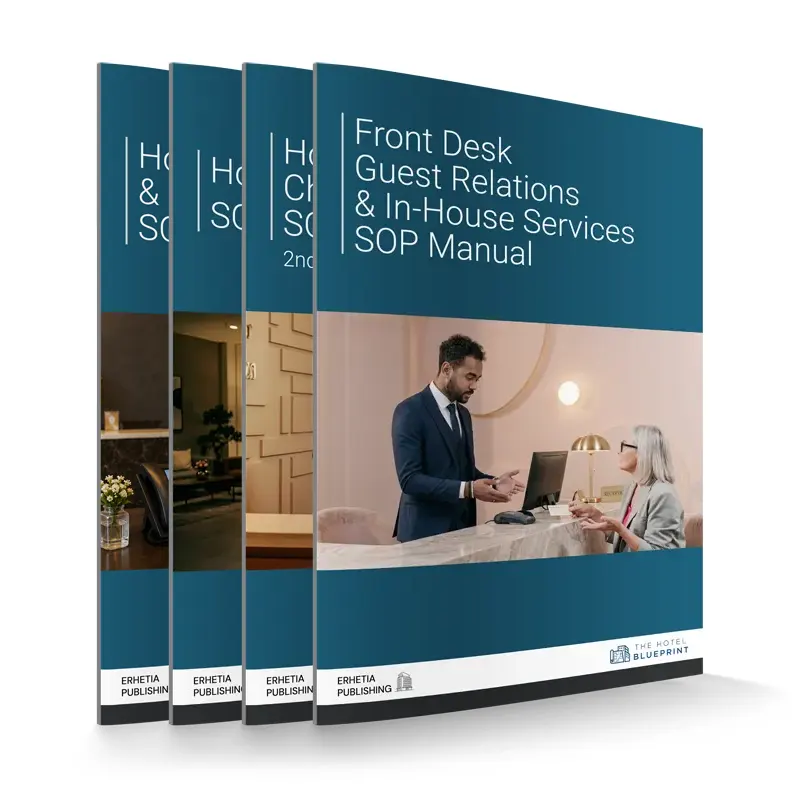
This 122-page standard operating procedures (SOP) manual provides 48 standardized procedures and 7 practical templates designed to govern front desk workflows during the active guest stay. Written from an internal audit perspective, the document establishes clear boundaries for daily front-office routines, ensuring that guest inquiries, concierge bookings, and special room setups follow a repeatable, controlled process.
The publication focuses heavily on the mechanics of interdepartmental coordination. It details how the front desk interacts with housekeeping, maintenance, and food and beverage divisions to execute mid-stay room changes, log property faults, and track guest preferences without administrative data loss. Additionally, the manual outlines specific protocols for handling sensitive scenarios—such as medical emergencies, noise disputes, and guest complaints—defining the exact limits of desk-level authority and clear escalation paths to management. By replacing informal staff habits with documented routines, hospitality operators can stabilize service delivery, minimize administrative errors, and maintain accurate internal logs for service tracking.
Measure your performance: Take the free Front Office Department Operational Audit →
Preview
Shift Handover & Active Guest Log – Standard Operating Procedure (SOP)
| Department/Division: Front Office | Code: GR 1.3 | Total Pages: 2 |
Purpose
To ensure that every open guest matter, pending request, active special arrangement, and relevant guest sensitivity is passed accurately from one shift to the next, maintaining uninterrupted service continuity throughout the guest’s stay.
Scope
Applies at every shift transition. Both the outgoing and incoming agent are responsible for the quality of the handover. Template GR-T1 is the working document for this procedure.
Responsible Party
Outgoing Front Desk Agent/Supervisor for preparing the handover; Incoming Agent/Supervisor for acknowledging and taking ownership.
Procedure
- Begin compiling the handover log at least 30 minutes before shift end. Do not leave log preparation to the final five minutes of the shift — active guest matters often require context that is better communicated while the outgoing agent still has full situational awareness.
- Record every open matter on Template GR-T1. An open matter is any guest request, complaint, maintenance issue, or special arrangement that has not been fully resolved and confirmed with the guest. For each item, record: the guest name and room number, the nature of the matter, the current status, what action has been taken, what action is still pending, and any commitment made to the guest including timing.
- Flag VIP, loyalty, or specially noted guests. Any guest who has been identified as a VIP, a repeat guest, a loyalty tier member, or who has a sensitivity or personal note on file must be explicitly flagged in the handover. The incoming agent must be aware of these guests before the shift begins.
- Flag any guest with an active complaint or unresolved dissatisfaction. If a guest raised a complaint during the outgoing shift — even if it appears to have been resolved — this must be noted so the incoming team can monitor whether follow-up contact is warranted.
- Confirm any outstanding interdepartmental requests. If a request has been sent to Housekeeping, Maintenance, or F&B but not yet confirmed as completed, this must appear on the handover log with the expected completion time and the contact name in the relevant department.
- Conduct the verbal handover face to face wherever possible. The log is a record, not a substitute for a brief verbal summary. The outgoing agent should walk the incoming agent through the active matters, highlight anything time-sensitive, and be available for questions for a short period after handover if the shift pattern allows.
- The incoming agent signs or acknowledges receipt of the handover log. Once the incoming agent is satisfied, they have a clear picture of the active situation, they accept ownership. From this point, any open matter on the log becomes their responsibility.
- File completed handover logs. Completed GR-T1 logs should be retained at the desk for a period determined by property policy (a minimum of 14 days is recommended) so that any guest concern that surfaces after the fact can be traced.
Notes
The quality of shift handover directly determines whether a guest experience feels consistent or fragmented. Guests who have to repeat themselves to a new agent — or who discover that a request has been forgotten because it was not passed across — are among the most common sources of negative feedback. The handover log is the mechanism that prevents this. Where a property uses a digital front desk management tool or PMS task module, the GR-T1 template should be adapted into that system. The physical template is provided for properties without digital task management in place.