


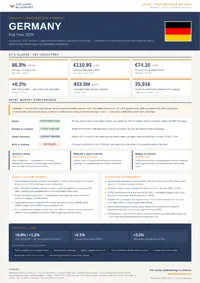
Full year 2025 Germany hotel performance review. Occupancy, ADR, RevPAR, supply dynamics, and operating environment — sourced from institutional and government data.
This review draws exclusively on data published by government statistical offices, official tourism bodies, and major hospitality associations. All sources are cited at the point of reference.
Available to registered members – Create an account here
Table of Contents
1. Economic and Tourism Context
Germany’s economic output recorded a marginal recovery in 2025, terminating a two-year period of stagnation and technical recession. According to the first calculations released by the German Federal Statistical Office (Statistisches Bundesamt – Destatis) in January 2026, price-adjusted Gross Domestic Product (GDP) increased by 0.2% compared to the previous year. This performance was characterized by a severe structural divergence; while the service sector showed resilience, the gross value added in manufacturing contracted by 1.2% year-on-year. The Deutsche Bundesbank noted in its late 2025 bulletins that the industrial sector’s contribution to the national economy has been hampered by persistent high energy costs and weakened global demand for capital goods.
Domestic demand acted as the primary stabilizer for the economy during the period. Final consumption expenditure by households rose by a price-adjusted 1.4%, supported by a robust labor market and declining headline inflation. Government final consumption also grew by 1.5%. In contrast, gross fixed capital formation remained a significant drag on growth, contracting by 0.5% (Destatis, 2026). This decline was particularly acute in the construction and machinery sectors, where high interest rates maintained by the European Central Bank (ECB) throughout the first half of the year restricted investment appetite. The external sector remained weak, with exports declining by 0.3% due to ongoing trade tensions and the structural transformation of the automotive industry.
Key Economic Indicators: Germany Performance Review 2025
| Indicator | 2025 Nominal Value (€ Billion) | Real % Change vs 2024 |
| Gross Domestic Product (GDP) | 4,321.4 | +0.2% |
| Private Household Consumption | 2,247.1 | +1.4% |
| Public Government Consumption | 912.8 | +1.5% |
| Capital Investment (Fixed Assets) | 950.7 | -0.5% |
| Export Balance | 210.8 | -0.3% |
The tourism and hospitality sector outperformed the broader economy in terms of volume. Destatis reported that overnight stays in the period from January to October 2025 reached 433.5 million, a 0.1% increase over the record levels of 2024. Domestic travel remained the bedrock of the industry, with German guests accounting for 362.0 million overnight stays, a 0.6% increase (Destatis, 2025). International inbound demand, however, showed signs of cooling following the conclusion of major 2024 events. Overnight stays by foreign visitors declined by 2.3% to 71.5 million. The German National Tourist Board (GNTB) attributed this to a normalization of travel patterns and the lack of a singular large-scale sporting catalyst in the 2025 calendar.
Operating sentiment remained defensive throughout the year. The ifo Institute’s Business Climate Index for the service sector indicated that while current business situations were rated positively, expectations for the first half of 2026 remained muted. This caution is echoed by the Federal Ministry for Economic Affairs and Climate Action (BMWK), which highlighted that the reintroduction of the standard 19% VAT rate on restaurant services has placed additional pressure on hospitality margins. Despite the return to GDP growth, the high cost of energy for non-household consumers—which the Bundesnetzagentur confirmed remains significantly above 2019 levels—continues to compress the disposable income of small and medium-sized hospitality enterprises.
2. Hotel Market Performance
The German hotel market experienced a period of structural stabilization in 2025, characterized by a return to volume-driven growth amidst a contraction in real-term yields. According to Destatis, nominal turnover in the accommodation sector recorded a marginal increase of 0.4% through the end of 2025. However, adjusted for inflation, real turnover declined by 1.9% compared to 2024. This performance gap indicates that while demand remained consistent, the industry faced an inability to fully offset rising operational overheads through pricing, primarily due to the absence of the high-compression demand peaks observed during the 2024 UEFA European Championship.
Nationwide occupancy rates for the full year 2025 reached an average of 66.8%, according to data compiled by the German Hotel and Restaurant Association (DEHOGA Bundesverband). This represents a decline of 0.4 percentage points from the previous year. Revenue Per Available Room (RevPAR) across the national market concluded at €74.10, a 1.7% decrease versus 2024. This trend was largely dictated by a softening in Average Daily Rate (ADR), which retreated to €110.93. Industry benchmarks from CoStar (STR) confirm that while the midscale segment struggled with price sensitivity, the luxury and upscale tiers maintained higher pricing integrity, albeit with stagnant occupancy growth.
Hotel Performance Indicators: Germany National Averages, 2025 vs 2024
| Performance Metric | Full Year 2025 | Full Year 2024 | Percentage Change (%) |
| Average Occupancy Rate | 66.8% | 67.2% | -0.6% |
| Average Daily Rate (ADR) | €110.93 | €112.16 | -1.1% |
| Revenue Per Available Room (RevPAR) | €74.10 | €75.37 | -1.7% |
Performance divergence by segment was pronounced. The upscale and luxury categories proved the most resilient; analysis by PKF hospitality group suggests that the top-tier segment recorded a marginal ADR growth of 0.8% driven by the recovery of international business travel and high-spending inbound markets from the Gulf and North America. In contrast, the budget and economy segments experienced a RevPAR contraction of 2.4%. This shift reflects the direct impact of reduced household purchasing power on the German domestic leisure traveler, who increasingly traded down to non-serviced accommodation or shortened stay durations.
Regional performance was dominated by the “Big 7” markets, which collectively stabilized the national average. Berlin maintained its position as the primary investment and performance hub, accounting for 19% of national hotel transaction volume as reported by CBRE Germany. Munich and Cologne recorded stable RevPAR figures during the fourth quarter, supported by a dense trade fair schedule including K 2025 and Anuga. Conversely, secondary markets in industrial regions, such as the Ruhr area and parts of Saxony, saw occupancy declines of up to 3.0% as the contraction in the manufacturing sector—documented in Chapter 1—reduced corporate transient demand.
DEHOGA Bundesverband maintains that while the sector has achieved a volume of approximately 496 million overnight stays, profitability remains at risk. The transition from a post-pandemic recovery phase to a mature, price-sensitive market environment has heightened the importance of RevPAR management. As the market enters the 2026 cycle, the stabilization of demand at pre-2020 levels, coupled with the erosion of real-term pricing power, suggests a more competitive landscape for operators managing high-leverage assets.
3. Supply and Development
The German hotel supply landscape in 2025 was characterized by moderate net growth and a strategic pivot toward brand conversions and value-add repositioning. According to the Q4 2025 Europe Hotel Construction Pipeline Trend Report from Lodging Econometrics (LE), Germany maintained the second-largest pipeline in Europe, concluding the year with 147 projects representing 25,616 rooms. Despite the scale of the pipeline, the pace of new supply entering the market remained controlled, as developers contended with elevated construction costs and a restrictive financing environment that prioritized institutional-grade assets in primary urban hubs.
New hotel openings in 2025 were dominated by global brand expansions, with a notable concentration in the midscale and upper-midscale segments. These categories accounted for 47.2% of the total hospitality market share by type, as recorded in the Germany Hospitality Market Analysis by Mordor Intelligence. A significant driver of supply growth was the strategic partnership between IHG Hotels & Resorts and NOVUM Hospitality, which contributed to a pipeline of 108 hotels across nearly 100 German cities. This partnership exemplifies the broader market trend of brand conversions, where independent properties are integrated into global distribution systems to mitigate operational risk. IHG reported that Germany now accounts for 20% of its total European room count, with over 8,300 rooms currently in its national pipeline.
Hotel Development Pipeline: Germany, Year-End 2025
| Pipeline Status | Number of Projects | Number of Guest Rooms |
| Currently Under Construction | 64 | 11,218 |
| Scheduled to Start (Next 12 Months) | 32 | 5,842 |
| Early Planning Stage | 51 | 8,556 |
| Total Construction Pipeline | 147 | 25,616 |
Renovation and repositioning activity gained significant traction during the period, as asset managers focused on ESG compliance and operational optimization. CBRE Germany’s 2025 investment analysis highlighted that value-add transactions, which frequently involve comprehensive refurbishments, constituted 44% of the total transaction volume. Investment in green-certified hotel capital expenditure (CAPEX) surged, driven by the Corporate Sustainability Reporting Directive (CSRD) requirements. This shift led to a record high in “Early Planning” projects across the region, as owners sought to modernize existing stock rather than initiate high-risk greenfield developments.
Geographically, supply expansion remained concentrated in the “Big 7” cities, with Berlin, Munich, and Cologne collectively accounting for over 50% of the total investment and development interest. South Germany remained the strongest regional market, holding a 30.1% share of the national hospitality market. Looking toward the 2026–2027 cycle, LE analysts forecast a continued acceleration in openings, with approximately 44,600 rooms expected to enter the European market annually, of which Germany remains a primary recipient. The forward pipeline indicates a record high for upper-upscale and luxury developments, signaling a long-term strategic bet on high-margin segments despite the prevailing short-term economic stagnation.
4. Operating Environment
The operating environment for the German hotel industry in 2025 was defined by acute structural labor shortages and the continued upward trajectory of personnel costs. According to the German Federal Statistical Office, the index of agreed hourly earnings in the “Accommodation and Food Service Activities” sector rose by 5.8% year-on-year, significantly outstripping the general economy’s average wage growth of 4.1%. This increase was driven by collective bargaining agreements and the statutory minimum wage adjustment, which reached €12.82 on January 1, 2025. Data from the Federal Employment Agency (Bundesagentur für Arbeit – BA) indicated that despite these wage hikes, the sector reported 34,500 unfilled positions at the close of Q3 2025, a condition that has forced many operators to limit occupancy or reduce food and beverage service hours.
Inflationary pressures began to decelerate but remained a significant burden on margins. The Consumer Price Index (CPI) for Germany averaged 2.3% for the full year 2025, down from 5.9% in 2023. However, specific hospitality cost drivers remained volatile. While headline inflation cooled, Destatis reported that food prices remained 4.2% higher than the 2024 average, and service-related maintenance costs rose by 5.1%. This “sticky” inflation in the supply chain prevented operators from realizing the full benefits of the broader macroeconomic stabilization.
Labor and Price Indices: Germany Hospitality Sector, 2025 vs 2024
| Economic Indicator | 2025 Average Value | Change vs 2024 (%) |
| Index of Agreed Hourly Earnings (Hospitality) | 124.6 | +5.8% |
| Statutory Minimum Wage (per hour) | €12.82 | +3.3% |
| Consumer Price Index (CPI) – All Items | 119.8 | +2.3% |
| CPI – Food and Non-Alcoholic Beverages | 134.2 | +4.2% |
| Unemployment Rate (National) | 6.0% | +0.3 pts |
Energy costs, which surged during the 2022-2023 crisis, showed signs of stabilization at a high plateau. The Bundesnetzagentur (Federal Network Agency) reported that while wholesale electricity and gas prices declined compared to the 2024 peak, the end-user prices for non-household consumers remained 25% higher than the 2019 baseline. This sustained high-cost environment has accelerated capital expenditure into energy-efficient building systems, as noted in Chapter 3. The reintroduction of the standard 19% VAT rate for restaurant services, which had been reduced during the pandemic, also fully impacted the 2025 fiscal year, contributing to a 1.2% real-term contraction in food and beverage margins across the hotel sector.
Labor productivity remained a critical concern for asset managers. The Destatis “Productivity per Employee” index for the accommodation sector showed a marginal decline of 0.7%, suggesting that wage increases are not being met with equivalent output gains. This imbalance has led to an increased adoption of self-service technologies and automated check-in systems to mitigate the impact of the rising cost of human capital. By the end of 2025, the BA noted that the hospitality sector had the highest rate of job vacancies relative to the total workforce among all service sectors in Germany, cementing labor as the primary operational risk to the industry’s recovery.
5. Outlook and Risk Factors
The outlook for the German hotel industry in 2026 is defined by a gradual macroeconomic recovery and a return to positive inbound growth. According to the IMF World Economic Outlook (April 2026 update), Germany’s real GDP is projected to expand by 0.8%, an improvement over the 0.2% recorded in 2025. The European Commission’s Spring 2026 Economic Forecast provides a more optimistic baseline of 1.2% growth, citing a ramp-up in public spending and the stabilization of real household incomes as inflation normalizes toward 2.1%. For hotel operators, this macro environment suggests a moderate strengthening of domestic leisure demand, although the Federal Ministry for Economic Affairs and Climate Action (BMWK) notes that retail and hospitality turnover in early 2026 remained sensitive to seasonal and cyclical volatility.
Demand catalysts for 2026 are primarily driven by the recovery of international arrivals. The German National Tourist Board (GNTB) forecasts a 3.2% increase in international overnight stays for the full year 2026, supported by Germany’s position as the 8th most popular global destination. Early 2026 data from the European Travel Commission (ETC) indicates that international arrivals in Germany have already risen by 2.7% year-to-date. Key demand drivers include a robust trade fair calendar in major hubs like Munich and Berlin, alongside secondary catalysts such as the International Cricket Council (ICC) fixtures in May 2026. However, the absence of a large-scale itinerant event, such as the 2024 UEFA Championship, means that growth will be incremental rather than transformative.
Institutional Growth Forecasts: Germany, 2026
| Indicator | Source | 2026 Forecast Value |
| Real GDP Growth | International Monetary Fund (IMF) | +0.8% |
| Real GDP Growth | European Commission (EC) | +1.2% |
| Consumer Price Inflation (CPI) | Federal Ministry for Economic Affairs (BMWK) | +2.1% |
| International Overnight Stays | German National Tourist Board (GNTB) | +3.2% |
| Intra-European Travel Intention | European Travel Commission (ETC) | 73.0% |
The principal risk factors documented by institutional sources center on structural labor imbalances and geopolitical uncertainty. The German Hotel and Restaurant Association identifies rising operating costs and falling profit margins as the primary threat to sector stability in 2026. This is compounded by a persistent labor shortage; the Federal Employment Agency (BA) warns that aging demographics will lead to a stagnant labor force, keeping upward pressure on wages despite slowing inflation. Furthermore, the ETC highlights that while Europe remains a safe-haven destination, ongoing conflicts in the Middle East pose a downside risk to long-haul travel corridors and could increase jet fuel costs, potentially tempering the recovery of high-yield overseas markets.
Profitability remains the central challenge for 2026. While demand volume is expected to rise, the BMWK’s Annual Economic Report 2026 cautions that the hospitality sector recorded a 4% turnover decline in January 2026 compared to the previous month, illustrating the fragility of the recovery. Asset managers must contend with a “new reality” where record-high travel frequency—as noted in the 42nd German Tourism Analysis—does not automatically translate into margin expansion due to the high plateau of energy and personnel expenses. Consequently, institutional forecasts suggest that 2026 will be a year of volume recovery with continued yield compression, requiring rigorous cost management and a strategic focus on the midscale and luxury segments which show higher resilience to current economic pressures.
Available to registered members – Create an account here