Description
Technical Controls at the Point of Receipt
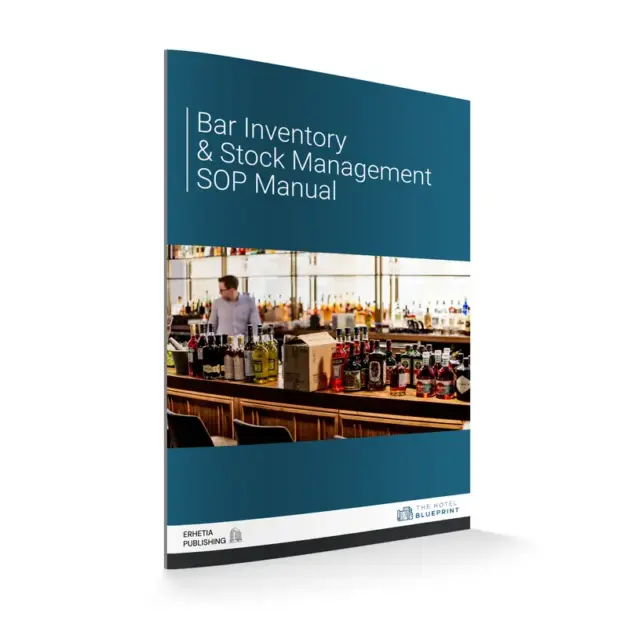
This 41-page manual establishes standard operating procedures for controlling beverage inventory, receiving protocols, and stockroom administration. Designed for food and beverage managers and bar managers, the document delivers a structured framework to regulate the physical movement and accounting of stock. It provides systematic instructions for verifying supplier deliveries, maintaining first-in, first-out (FIFO) rotation, and calculating accurate par levels to prevent over-purchasing or stockouts.
The manual details daily and weekly counting routines to ensure mathematical reconciliation matches physical inventory. It includes clear protocols for identifying, logging, and analyzing product variance, spillage, and shrinkage, allowing management to locate and rectify discrepancies quickly. Accompanying working templates—including receiving logs, count sheets, and breakage forms—provide the tools necessary to standardize documentation across all shifts, protect beverage profit margins, and lower cost-of-goods-sold (COGS) metrics.
Preview
Beverage Receiving Procedure – Standard Operating Procedure (SOP)
| Department/Division: Food & Beverage / Bar | Code: BST 1.1 | Total Pages: 3 |
PURPOSE
To ensure that all beverage deliveries are verified accurately against the purchase order before acceptance, that non-conforming items are identified and rejected correctly, and that every delivery is documented in full at the point of receipt.
SCOPE
Applies to all beverage deliveries received at the property, regardless of supplier, delivery size, or beverage category. Applies to all staff authorized to receive deliveries on behalf of the bar.
RESPONSIBLE PARTY
Bar supervisor or the staff member designated by the Bar Manager to receive deliveries. The Bar Manager is responsible for ensuring that only authorized and trained staff receive beverage deliveries.
PROCEDURE
- Before the delivery arrives, retrieve the corresponding purchase order and confirm that a delivery is expected from the supplier on the current date. Do not accept a delivery for which no purchase order exists without authorization from the Bar Manager or F&B Manager.
- When the delivery arrives, do not allow the supplier’s driver to move stock into the storage area unaccompanied. The receiving staff member should be present and in control of the receiving area throughout the entire delivery process.
- Check the delivery vehicle and all delivered items for visible signs of damage, temperature compromise, or poor handling before accepting any stock into the property:
- Refrigerated products should arrive at the correct temperature. Where a temperature check is required by the property’s receiving standard, conduct it before signing any delivery documentation
- Boxes and cases should be intact and free of visible moisture damage, crushing, or signs of prior opening
- Any delivery arriving in a condition that raises a hygiene or quality concern should be queried with the driver before acceptance and escalated to the Bar Manager if the concern cannot be resolved at the point of delivery
- Verify each item in the delivery against the purchase order line by line:
- Confirm that the product description matches — brand, variety, size, and unit type
- Confirm that the quantity delivered matches the quantity ordered
- Confirm that the unit price on the delivery note matches the agreed purchase order price where pricing is visible on the delivery documentation
- Inspect a representative sample of bottles and cans from each case for the following:
- Intact seals and closures — no open, resealed, or visibly tampered bottles
- Correct fill level — bottles that appear significantly underfilled should be set aside and queried
- Undamaged labels — a damaged label is not a rejection reason on its own, but labels that are missing or obscured to the point where the product cannot be identified should be noted
- No visible leakage, breakage, or contamination within the case
- For any item where the delivered quantity is short of the purchase order quantity, note the shortfall on the delivery documentation before signing. Do not accept a short delivery as complete — record the actual quantity received and ensure the delivery note reflects the discrepancy before the driver leaves the property.
- For any item that does not meet the acceptance standard — wrong product, damaged goods, temperature-compromised items, or quantity discrepancy that cannot be resolved at the point of delivery — set the item aside and reject it formally:
- Note the rejection clearly on the delivery documentation with a brief description of the reason
- Request that the driver sign or acknowledge the rejection note before leaving
- Retain a copy of the rejection documentation and notify the Bar Manager immediately
- Do not incorporate rejected items into bar stock under any circumstances, even temporarily
- Upon completing the verification, sign the delivery note only when the delivered quantity and condition have been confirmed. Where discrepancies have been noted, ensure they are recorded on the delivery note before signing.
- Complete the Beverage Receiving Log — Template A1 in Appendix A — for every delivery received, regardless of size. Record the following for each delivery:
- Date and time of receipt
- Supplier name
- Purchase order reference number
- Each item received, with quantity and unit type
- Any discrepancies, rejections, or notes arising from the delivery
- Name and signature of the receiving staff member
- Transfer accepted stock to the storage area promptly after the receiving process is complete. Do not leave delivered stock in the receiving area unattended or unsecured. Apply the storage standards in BST-1.2 and the FIFO rotation procedure in BST-1.3 immediately upon transfer.
| NOTES: The receiving procedure is the first and most important control point in the bar’s inventory chain. Stock that enters the property incorrectly — wrong quantity, wrong product, or compromised condition — creates discrepancies that are difficult to trace and costly to resolve after the fact. The discipline of verifying every delivery line by line, regardless of the supplier relationship or delivery frequency, is the single most effective receiving control available to the property. Where the property uses a digital receiving or inventory system, the Beverage Receiving Log should be completed in that system in addition to or in place of the paper template, in accordance with the property’s system configuration. |