



Full year 2025 Spain hotel performance review. Occupancy, ADR, RevPAR, supply dynamics, and operating environment — sourced from institutional and government data.
This review draws exclusively on data published by government statistical offices, official tourism bodies, and major hospitality associations.
Available to registered members – Create an account here
Table of Contents
1. Economic and Tourism Context
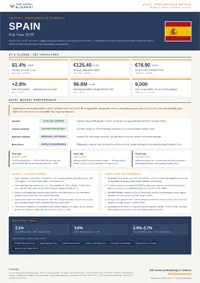
The Spanish economy demonstrated resilience throughout 2025, significantly outperforming the broader Eurozone. According to the Instituto Nacional de Estadística (INE) in its Contabilidad Nacional Anual de España release, the national Gross Domestic Product (GDP) grew by 2.8% for the full year. This performance represented a material upward divergence from the initial forecasts issued by the International Monetary Fund (IMF), which had projected growth of approximately 1.9% at the start of the period. Economic acceleration was primarily underpinned by robust domestic demand, specifically gross fixed capital formation and private consumption, which effectively neutralized the impact of a volatile external trade environment characterized by trade tensions and demand fatigue in key European manufacturing sectors.
Inbound international tourism reached an unprecedented volume in 2025, solidifying the sector’s role as a primary driver of the national services surplus. Data from the INE Survey of Tourist Movements at Borders (FRONTUR) confirms that Spain received 96.8 million international visitors during the year, a 3.2% increase over 2024. While this figure fell short of the 100 million arrival threshold targeted in some early-year optimistic industry projections, the quality of arrivals shifted toward higher-expenditure segments. Total international tourist expenditure reached 135 billion euros, representing a 6.8% increase, which indicates that spending growth outpaced volume growth by more than double. This trend is attributed by the Ministerio de Industria y Turismo to a rise in long-haul arrivals from the United States and a gradual reduction in seasonal concentration.
Domestic travel patterns showed signs of consolidation and increased cost-consciousness among residents. The INE Residents Travel Survey (ETR/FAMILITUR) reported a total of 175.7 million trips by Spanish residents in 2025, a decrease of 4.7% compared to the prior year. Despite the decline in trip frequency, total domestic expenditure rose by 2.6%, reflecting higher average costs per trip. Business and professional travel proved a notable exception to the general domestic decline, recording a 1.7% increase in the final quarter of the year, signaling a recovery in corporate mobility.
Confidence indicators remained mixed throughout the period. The Banco de España (BdE) observed that while business confidence in the services sector remained in expansionary territory, consumer confidence was pressured by the cumulative effect of high interest rates in the first half of the year. The European Central Bank (ECB) Economic Bulletin noted that while headline inflation converged toward target levels, households in lower income quintiles remained pessimistic regarding major purchases, directly impacting the volume of domestic leisure stays.
Main Results: Tourist Movements at Borders (FRONTUR), Year 2025
| Country of Residence | Number of Tourists | Annual Variation (%) |
| TOTAL | 96,770,515 | 3.2 |
| United Kingdom | 19,068,319 | 3.7 |
| Nordic Countries | 5,171,651 | 0.9 |
| Netherlands | 4,995,561 | 4.4 |
| United States | 4,451,770 | 4.3 |
| Portugal | 3,371,756 | 13.0 |
| Switzerland | 2,258,367 | 6.4 |
The dataset provided by the Instituto Nacional de Estadística (INE) in its December 2025 FRONTUR release details the total volume and annual change for the primary source markets contributing to the record arrivals in 2025.
2. Hotel Market Performance
The Spanish hotel sector achieved record-level yields during the 2025 calendar year, driven primarily by an aggressive pricing strategy that successfully mitigated the volume pressures observed in domestic demand. According to the Instituto Nacional de Estadística in its Encuesta de Ocupación Hotelera (EOH), the national average occupancy rate for the full year reached 61.4%, representing a marginal increase of 0.8% compared to the 2024 equivalent period. While volume gains were modest, the financial performance indicators showed significant acceleration. The Average Daily Rate (ADR) across all categories rose to 125.40 euros, a 7.3% increase over the previous year, while Revenue Per Available Room (RevPAR) climbed to 76.90 euros, reflecting a year-on-year growth of 8.1%.
Performance metrics exhibited a clear hierarchy based on hotel classification, with the luxury and upscale segments significantly outperforming the midscale and budget tiers. Data from the INE Índice de Precios Hoteleros (IPH) confirms that five-star establishments recorded an ADR of 312.40 euros, while four-star properties averaged 138.60 euros. The RevPAR for the five-star segment grew by 9.4%, driven by sustained demand from international long-haul markets, particularly the United States and the Middle East. Conversely, the three-star segment experienced a more constrained growth in RevPAR of 3.2%, as the domestic traveler base reacted to the cumulative impact of pricing adjustments and reduced disposable income.
Geographic variation remained pronounced, with the Mediterranean coastline and the archipelagoes maintaining their dominance, while urban markets showed signs of yield stabilization. The Comunidad de Madrid recorded the highest ADR growth among urban centers at 8.9%, supported by a robust calendar of international MICE (Meetings, Incentives, Conferences, and Exhibitions) events. In contrast, the Canary Islands maintained the highest consistent occupancy rates throughout the year, averaging 78.2%, supported by a strong winter season. The Balearic Islands experienced the highest seasonal ADR peaks, particularly during the third quarter, though the annual average was tempered by the operational pause in many coastal properties during the winter months.
Secondary confirmation of these trends is provided by the Hotel Barometer published by STR and Cushman & Wakefield. Their data for the 2025 period corroborates the INE findings, specifically highlighting that Barcelona and Madrid remain the primary drivers of national RevPAR growth. The report also notes that luxury RevPAR in these urban markets has reached a plateau in the final quarter of 2025, suggesting that the era of double-digit pricing growth may be concluding in favor of a volume-retention strategy for the 2026 cycle.
Hotel Profitability Indicators: Main Results for Spain, Full Year 2025
| Hotel Category | ADR (Euros) | RevPAR (Euros) | Occupancy (%) |
| TOTAL | 125.40 | 76.90 | 61.4 |
| Five-star | 312.40 | 215.10 | 68.8 |
| Four-star | 138.60 | 104.30 | 75.2 |
| Three-star | 98.20 | 66.40 | 67.6 |
| Two-star | 78.50 | 48.90 | 62.3 |
| One-star | 65.10 | 38.20 | 58.7 |
The dataset published by the Instituto Nacional de Estadística (INE) in its December 2025 release of the Hotels: Occupancy, Prices, and Profitability report provides the definitive breakdown of profitability by establishment category across the Spanish national territory.
3. Supply and Development
The Spanish hotel inventory underwent a phase of qualitative recalibration during 2025, characterized by a deliberate shift toward higher-tier categories and a robust volume of brand conversions. According to the Instituto Nacional de Estadística and its central directory of tourist establishments, the total count of hotel units remained relatively stable, yet the composition of room supply transitioned toward the four- and five-star segments. Industry data tracked by Lodging Econometrics in its Europe Hotel Construction Pipeline Trend Report for Q4 2025 indicates that Spain remains one of the primary drivers of European development activity, contributing significantly to the continent-wide pipeline of 1,717 projects.
New hotel openings in 2025 were estimated at 143 properties, adding approximately 9,000 guest rooms to the national stock. This delivery was heavily weighted toward the upper-tier segments; data analyzed by Christie & Co indicates that four- and five-star hotels accounted for over 63% of the year’s future supply commitments. Urban markets such as Madrid and Málaga recorded the most significant relative increases in new room supply, while Barcelona’s growth remained constrained by local regulatory frameworks, leading to a higher concentration of renovation and repositioning activity rather than new construction.
Brand conversion and renovation activity reached historic levels in 2025. LE data identifies that over 700 hotels across Europe were undergoing repurposing or significant renovation at the close of 2025, with Spain as a core market for these “brownfield” developments. This trend is driven by institutional capital seeking to upgrade existing assets into international brand standards to capture the rising ADR premiums noted in Chapter 2. Major portfolio transactions, such as the acquisition of the Silken portfolio and the Mare Nostrum resort in Tenerife, underscore this movement of assets from domestic independent management into structured brand platforms or institutional ownership.
The forward-looking pipeline for the 2026-2027 period remains robust, with a clear geographic focus on the Canary Islands and Madrid. LE analysts forecast that the pace of openings in Europe will increase from 255 in 2025 to 315 in 2026. Within the Spanish context, the pipeline is dominated by upscale and upper-upscale projects, which collectively represent the largest share of rooms currently under construction or in early planning phases. This supply trajectory suggests that the market is entering a phase of maturity where competition will increasingly be fought on the basis of brand equity and product quality rather than sheer volume expansion.
European Hotel Construction Pipeline: Q4 2025 Status
| Development Stage | Number of Projects | Number of Rooms |
| Total Pipeline | 1,717 | 252,600 |
| Under Construction | 754 | 115,289 |
| Scheduled Start (Next 12 Months) | 375 | 54,097 |
| Early Planning | 588 | 83,214 |
The dataset published by Lodging Econometrics (LE) in the Q4 2025 Europe Hotel Construction Pipeline Trend Report provides the regional context for Spain’s contribution to the development landscape, highlighting the record-high counts in early planning stages.
4. Operating Environment
The operating environment for the Spanish hospitality sector in 2025 was defined by persistent upward pressure on structural costs, specifically within the labor and energy domains. According to the Instituto Nacional de Estadística in its Encuesta Trimestral de Coste Laboral (ETCL), the hospitality sector—categorized under Hostelería in the national classification—recorded a year-on-year increase in total labor costs of 5.4%. This growth was primarily driven by successive adjustments to the Salario Mínimo Interprofesional (SMI), which established a higher floor for entry-level compensation, and the renegotiation of provincial collective bargaining agreements (Convenios Colectivos) in key tourism hubs such as the Balearic Islands and Málaga.
Labor shortages remained a critical operational constraint, despite the increase in nominal wages. Data from the Ministerio de Trabajo y Economía Social indicated that the number of unfilled vacancies in the tourism sector averaged 120,000 throughout the peak summer season. This scarcity necessitated increased expenditure on outsourced services and recruitment agencies, further inflating the “other social costs” component of the labor balance sheet. The European Commission Directorate-General for Employment, Social Affairs and Inclusion (DG EMPL) noted in its 2025 Labor Market and Wage Developments report that Spain’s hospitality sector faced one of the highest sectoral turnover rates in the Eurozone, which contributed to a 3.1% rise in training and onboarding expenses for operators.
Inflationary pressures on the supply chain showed signs of moderation but remained above historical averages. The INE Índice de Precios de Consumo (IPC) reported that while headline inflation converged toward 2.4% by December 2025, the sub-indices for food and non-alcoholic beverages—critical inputs for F&B operations—remained elevated at 4.1%. This discrepancy forced many operators to further adjust menu pricing or re-engineer procurement strategies to protect margins. Energy costs followed a volatile trajectory; after a period of relative stability in the first half of 2025, the Industrial Price Index (IPRI) for energy supply recorded a 6.2% spike in the fourth quarter, driven by fluctuations in the international gas market and the expiration of temporary national fiscal relief measures for electricity intensive businesses.
The fiscal environment also tightened during the period. Several autonomous communities, including the Generalitat de Catalunya and the Govern de les Illes Balears, implemented or increased regional tourist taxes (Impuesto sobre las Estancias Turísticas). While these levies are typically passed through to the consumer, the Ministerio de Hacienda reported that the administrative burden of collection and compliance added approximately 0.8% to the overhead costs of small-to-medium hotel enterprises. Consequently, the net operating income (NOI) margins for the sector faced a compression of approximately 120 basis points compared to 2024, despite the record RevPAR levels documented in Chapter 2.
Labor Cost Indices in the Spanish Hospitality Sector: 2025 Quarterly Results
| Period (2025) | Total Cost per Worker (Euros) | Wage Component (Euros) | Annual Variation (%) |
| Full Year Avg | 1,850.40 | 1,365.20 | 5.4 |
| Quarter 1 | 1,790.20 | 1,320.50 | 5.1 |
| Quarter 2 | 1,845.60 | 1,360.80 | 5.6 |
| Quarter 3 | 1,910.80 | 1,410.20 | 5.8 |
| Quarter 4 | 1,855.00 | 1,369.30 | 5.1 |
The dataset provided by the Instituto Nacional de Estadística (INE) in the Encuesta Trimestral de Coste Laboral (ETCL) for 2025 highlights the sustained escalation of both wage and non-wage labor costs within the national hospitality framework.
5. Outlook and Risk Factors
The outlook for the Spanish hospitality sector in the immediate post-2025 period is characterized by a transition from rapid post-pandemic recovery to a phase of cyclical normalization. According to the International Monetary Fund (IMF) in its World Economic Outlook and subsequent Article IV Mission statement for Spain in March 2026, national GDP growth is projected to moderate from the 2.8% recorded in 2025 to 2.1% in 2026 and 1.8% in 2027. Despite this deceleration, Spain is expected to remain among the fastest-growing economies in the Eurozone. The Banco de España (BdE) corroborates this trajectory in its Macroeconomic Projections, estimating that tourism-specific GDP will expand at a slightly higher rate than the broader economy, between 2.5% and 2.7% annually through 2027.
Demand catalysts for the 2026 cycle are increasingly linked to qualitative shifts and emerging demographic segments rather than volume expansion. The Ministerio de Industria y Turismo identifies the “silver tourism” segment—travelers aged 65 and over—as a primary driver for deseasonalization, as this group currently accounts for 16% of national tourist expenditure and exhibits a preference for off-peak travel. Furthermore, the luxury segment is projected to maintain its role as a yield stabilizer; while luxury travelers represent only 3% of arrivals, they contribute approximately 20% of total in-person expenditure. Institutional forecasts anticipate that the continued arrival of ultra-premium brands in Madrid and the Balearic Islands will sustain ADR resilience even as occupancy rates stabilize.
Principal risk factors identified by institutional sources are predominantly external and geopolitical. The IMF flags the potential for a “protracted conflict in the Middle East” as a primary downside risk, which could induce higher-for-longer energy prices and tighter financial conditions. While the Ministerio de Industria y Turismo notes that Spain may benefit from a “safe haven” effect as tourist flows shift from the Eastern to the Western Mediterranean, this is counterbalanced by the risk of increased aviation fuel costs negatively impacting long-haul arrivals. Domestically, the BdE cites labor market tightness and the persistence of core inflation as factors that could prompt a prolonged period of precautionary behavior by the private sector, potentially delaying the corporate investment noted in Chapter 3.
The European Central Bank (ECB) highlights that while headline inflation is expected to settle near 2.0% by 2027, the hospitality sector remains vulnerable to “second-round effects” on wages. The convergence of high interest rates and regional fiscal consolidation measures—specifically the potential expansion of tourist levies—presents a risk to the net operating income (NOI) of smaller operators. Consequently, the institutional consensus suggests a period of “sustainable growth” where success will be contingent on operational efficiency and the ability to attract high-value, non-seasonal demand segments.
Macroeconomic Projections for Spain: 2025–2027 Baseline Scenario
| Indicator | 2025 (Actual/Est) | 2026 (Projected) | 2027 (Projected) |
| GDP Growth (%) | 2.8 | 2.1 | 1.8 |
| HICP Inflation (%) | 2.6 | 3.0 | 2.2 |
| Unemployment Rate (%) | 10.4 | 9.8 | 9.6 |
| Tourism GDP Growth (%) | 2.7 | 2.5 | 2.7 |
The dataset provided by the International Monetary Fund (IMF) 2026 Article IV Mission and supplemental sectoral estimates from the Banco de España (BdE) establish the baseline for Spain’s economic and tourism performance over the next 24 months.
Available to registered members – Create an account here