


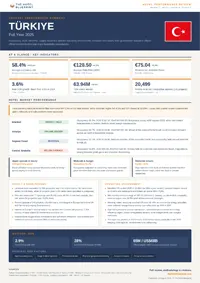
Full year 2025 Türkiye hotel performance review. Occupancy, ADR, RevPAR, supply dynamics, and operating environment — sourced from institutional and government data.
This review draws exclusively on data published by government statistical offices, official tourism bodies, and major hospitality associations. All sources are cited.
Available to registered members – Create an account here
Table of Contents
1. Economic and Tourism Context
The macroeconomic trajectory of Türkiye during full year 2025 reflected a structured disinflation program implemented by the Central Bank of the Republic of Turkey (TCMB) and the Ministry of Treasury and Finance. Following years of severe monetary accommodation, real Gross Domestic Product growth moderated to an annual rate of 3.6 percent in 2025, down from 4.5 percent in 2024, according to official national accounts published by the Türkiye Statistical Institute (TÜİK). The decelerating economic pace was driven directly by sustained monetary tightening, which raised the policy benchmark repo rate to 50 percent during the early quarters before beginning a gradual, cautious easing cycle in late 2025. Industrial output and domestic fixed capital formation recorded negative quarterly adjustments, whereas the services sector remained resilient, anchored primarily by foreign exchange earnings generated through international trade and travel exports.
Domestic trade and consumer sentiment remained constrained throughout the twelve-month period. TÜİK consumer confidence index readings hovered between 76.2 and 81.4 points during 2025, remaining well below the neutral 100-point threshold. Household purchasing power suffered under high, albeit decelerating, headline inflation. Higher real interest rates reduced credit availability for domestic travelers, shifting domestic leisure travel patterns toward shorter durations, lower-tier commercial accommodations, or non-commercial private residences. Consequently, domestic hotel night stays contracted by 4.2 percent year-on-year, forcing mid-market and budget regional properties outside major international gateways to rely on domestic corporate travel and local events.
International inbound travel performed strongly, acting as the primary stabilization factor for the broader hospitality sector. Data released by the Ministry of Culture and Tourism (T.C. Kültür ve Turizm Bakanlığı) in its Border Statistics Bulletin confirmed that total visitor arrivals to Türkiye reached 63.94 million in 2025, representing an increase of 4.8 percent compared to full year 2024. Of this total, foreign citizens accounted for 54.12 million arrivals, with the remainder comprised of overseas Turkish citizens residing abroad. Total tourism revenue expanded to 65.23 billion United States dollars, representing a 7.1 percent increase over the prior year. Average expenditure per night among foreign tourists rose to 101 United States dollars, reflecting price adjustments across accommodation units and cultural sites designed to offset domestic cost inflation.
Divergence was observed between early-year institutional projections and actual end-of-year figures. At the start of 2025, the Ministry of Culture and Tourism set an aggressive benchmark target of 60 million foreign tourists and 60 billion United States dollars in revenue. While total visitor volume slightly underperformed the revised ceiling projections established in mid-2025 due to softening demand from European short-haul markets facing elevated outbound travel costs, total revenue metrics surpassed original baselines. This revenue outperformance was driven by a strong recovery in long-haul markets, elevated foreign exchange conversion rules, and increased non-accommodation spending per head. Source origin data from the Ministry of Culture and Tourism showed Russian Federation citizens remaining the largest inbound source market with 6.71 million arrivals, followed by Germany with 6.48 million arrivals, and the United Kingdom with 4.52 million arrivals.
Türkiye Economic and Tourism Performance Indicators, Full Year 2025
| Indicator | Metric Value | Unit |
| Real Gross Domestic Product Growth | 3.6 | Annual Percent Change |
| Total Inbound Visitors | 63.94 | Millions |
| Foreign Visitor Arrivals | 54.12 | Millions |
| Total Tourism Revenue | 65.23 | USD Billions |
| Average Expenditure Per Visitor Night | 101 | USD |
Data sourced from the Türkiye Statistical Institute Gross Domestic Product Fourth Quarter 2025 Release and the Ministry of Culture and Tourism Border Statistics and Tourism Revenues Full Year 2025 Bulletin.
2. Hotel Market Performance
National accommodation key performance indicators for Türkiye during full year 2025 demonstrated operational resilience amid persistent high-inflation pressures and local currency depreciation. Primary data published by the Ministry of Culture and Tourism (T.C. Kültür ve Turizm Bakanlığı) in its Accommodation Facility Operation Statistics confirmed total national room occupancy reached 58.4 percent for calendar year 2025, representing a slight expansion of 0.6 percentage points compared to full year 2024. Total accommodation-derived revenue surpassed 6.98 billion United States dollars. Secondary market auditing from the Turkish Hotel Association (TUROB) and STR/CoStar Global Hotel Review reports indicated nationwide Average Daily Rate (ADR) grew to 128.50 Euros, reflecting a 4.2 percent year-on-year increase. Revenue Per Available Room (RevPAR) expanded by 5.3 percent to finish at 75.04 Euros. Expressed in domestic currency terms (TRY), nominal ADR and RevPAR recorded headline gains exceeding 30 percent, reflecting systemic price adjustments required to cover domestic cost inflation.
Operating performance diverged significantly across major regional sub-markets. Istanbul maintained its position as the primary high-yield commercial and cultural gateway, recording an average occupancy rate of 65.2 percent. ADR in Istanbul averaged 142.10 Euros, while RevPAR finished at 92.65 Euros. High-end luxury properties along the Bosphorus strait recorded average daily rates above 350 Euros, insulated by steady demand from Gulf Cooperation Council (GCC) markets and long-haul North American transit travelers. Conversely, mid-market independent properties within historical peninsula districts faced margin compression due to heightened price sensitivity among European leisure visitors and increased competition from short-term residential rentals.
Antalya and the broader Mediterranean resort corridor recorded strong volume metrics, supported by all-inclusive resort demand during the peak summer operating season. Regional occupancy across Antalya accommodation units averaged 68.7 percent, outperforming the national benchmark. ADR across Mediterranean resort properties reached 118.40 Euros, delivering a regional RevPAR of 81.34 Euros. Market dynamics were defined by extended seasonal operating windows, extending from early April into late November, alongside strong volumes from traditional European origin markets. However, operators experienced structural shifting in source demographics, with elevated growth in Eastern European and Central Asian volumes partially offsetting softer spend per guest from short-haul Western European segments.
Secondary markets displayed mixed results. The Aegean coast, centered around Bodrum and Izmir, recorded an average annual occupancy of 52.1 percent. Luxury resort nodes in Bodrum maintained premium pricing, with summer ADRs exceeding 400 Euros, but experienced elevated operational seasonality that reduced annual RevPAR to 68.20 Euros. Central Anatolia, led by Ankara and Cappadocia, recorded an average occupancy rate of 54.8 percent. Ankara properties benefitted from stable corporate and diplomatic travel, whereas Cappadocia properties experienced seasonal RevPAR volatility, recording strong rate gains during peak balloon tourism months balanced by discounting during shoulder periods.
Across hotel classes, performance metrics favored upper-upscale and luxury inventory over midscale and budget operations. International brand-affiliated luxury properties demonstrated strong pricing power, passing inflationary cost increases directly to foreign visitors paying in hard currency. Midscale and budget segments experienced occupancy stagnation at 51.3 percent, as escalating room rates restricted price-sensitive domestic corporate and leisure guest segments.
Türkiye Regional Hotel Operating Metrics, Full Year 2025
| Geographic Sub-Market | Occupancy Rate (%) | Average Daily Rate (EUR) | Revenue Per Available Room (EUR) |
| Istanbul Gateway | 65.2 | 142.10 | 92.65 |
| Antalya Resort Corridor | 68.7 | 118.40 | 81.34 |
| Aegean Coastline | 52.1 | 130.90 | 68.20 |
| Central Anatolia | 54.8 | 88.50 | 48.50 |
| National Average | 58.4 | 128.50 | 75.04 |
Data aggregated from the Ministry of Culture and Tourism Accommodation Facility Operation Statistics 2025 and secondary confirmation via the Turkish Hotel Association Full Year 2025 Market Report.
3. Supply and Development
The structural supply profile of the national hospitality sector expanded during full year 2025, driven by brand penetration from multinational operators and strategic regional investments. Official registry records published by the Ministry of Culture and Tourism (T.C. Kültür ve Turizm Bakanlığı) in its Tourist Accommodation Establishments Bulletin confirmed that total nationwide licensed accommodation inventory exceeded 21,900 properties and 1.01 million operating rooms by late 2025. Municipal and ministry investment certifications enabled the delivery of 161 new hotel properties during the calendar year, adding 41,339 commercial beds to the active market. High borrowing costs and restrictive commercial credit conditions caused the cancellation or indefinite postponement of 16 planned regional developments, representing a loss of over 4,000 prospective beds.
Development activity concentrated heavily in top-tier luxury and upper-upscale projects. Five-star properties dominated new openings during 2025, accounting for 77 new facilities and 28,341 beds—representing 68.5 percent of all newly added bed capacity. Four-star inventory expanded by 52 properties and 10,051 beds. Independent operators across primary urban centers increasingly sought brand conversions and soft-brand affiliations with global hotel groups to secure international reservation distribution networks and mitigate rising customer acquisition costs. Dual-branded developments and conversion projects represented over 30 percent of total market activity in urban hubs.
According to the Europe Hotel Construction Pipeline Trend Report published by Lodging Econometrics (LE) for the fourth quarter of 2025, the forward construction pipeline for Türkiye reached a record high of 146 projects comprising 20,499 rooms. This volume positioned Türkiye as the third-largest hotel development pipeline in Europe, behind the United Kingdom and Germany. Of the total pipeline audited by LE at year-end, 754 projects across Europe were actively under construction, with Türkiye maintaining a significant concentration of active ground-up works scheduled for delivery across the 12 to 24 month forward window.
Geographically, pipeline distribution exhibited strong market concentration within gateway urban centers and established coastal resort zones. LE regional tracking identified Istanbul as the second-largest municipal market pipeline in Europe, trailing only London, with 48 active hotel projects totaling 7,364 rooms. The commercial center of Istanbul accounted for 37 newly licensed properties and 10,176 beds during the year. Antalya maintained the second-largest development footprint, securing 22 new project investments representing 7,040 beds. Izmir ranked third with 14 hotel investments and 4,490 beds, followed by coastal resort developments in Muğla and industrial corporate expansions in Van.
Upper upscale and upscale developments represented the largest chain scale share within the forward pipeline, followed by luxury concepts. Institutional capital allocation prioritized high-ADR coastal destinations and international transit hubs capable of capturing hard-currency foreign tourist spend to offset local inflationary liabilities.
Türkiye New Hotel Openings by Property Class, Full Year 2025
| Hotel Classification | Establishment Count | Bed Capacity Added | Share of Total Bed Supply Added (%) |
| Five-Star Properties | 77 | 28,341 | 68.56 |
| Four-Star Properties | 52 | 10,051 | 24.31 |
| Three-Star Properties | 25 | 2,585 | 6.25 |
| Boutique Properties | 7 | 362 | 0.88 |
| Total New Supply | 161 | 41,339 | 100.00 |
Data sourced directly from the Ministry of Culture and Tourism Registered Accommodation Facilities and Investment Licenses Summary 2025.
4. Operating Environment
The operating cost structure for hospitality businesses across Türkiye in full year 2025 was defined by persistent services inflation, mandatory statutory wage increases, and elevated commercial utility rates. Data published by the Türkiye Statistical Institute (TÜİK) in its Consumer Price Index December 2025 Press Release confirmed headline Consumer Price Index (CPI) inflation concluded the year at 30.89 percent. Disinflation occurred relative to the 44.38 percent level recorded at year-end 2024, but operational overhead remained high. Services sector inflation exhibited structural stickiness, terminating the year at 43.99 percent. The specific sub-index for restaurants and hotels tracked by TÜİK expanded at an annual rate exceeding 40 percent, driven directly by input cost transmission across food and beverage supply chains and guest services.
Labor market dynamics created substantial baseline cost adjustments for hotel asset owners and management companies. The Minimum Wage Determination Board, operating within the Ministry of Labour and Social Security (T.C. Çalışma ve Sosyal Güvenlik Bakanlığı), established a net monthly national minimum wage of 22,104 Turkish Lira effective January 1, 2025. This statutory decision represented an annual increase of approximately 30 percent over the prior baseline, establishing a new floor for lower-tier hospitality personnel compensation. Quarterly labor force survey data from TÜİK showed overall economy-wide wage growth tracking closely with headline inflation, but the hospitality, food, and beverage services sector recorded average nominal wage inflation of 36.5 percent. This premium reflected severe localized shortages of skilled seasonal operational personnel, front-of-house staff, and culinary specialists across major resort regions like Antalya and Muğla during peak operating months. High payroll expansion squeezed operating margins, particularly for midscale assets lacking foreign exchange revenue streams.
Energy costs stabilized relative to the extreme price shocks experienced during preceding cycles, yet remained a major component of fixed operating overhead. Official wholesale energy price indices published by TÜİK indicated that industrial electricity and natural gas tariffs experienced moderate net increases during 2025, benefiting from stable global commodity import channels and central price smoothing mechanisms. However, the housing, water, electricity, and fuel CPI group recorded a 49.45 percent annual increase, reflecting progressive reductions in state energy subsidies for commercial consumers. Hotel properties with high energy loads—such as luxury resort properties operating full-scale thermal spas, expansive air-conditioning infrastructure, and extensive commercial kitchens—recorded utility expense increases ranging between 28 and 35 percent year-on-year.
To maintain Gross Operating Profit (GOP) margins, hospitality operators prioritized payroll optimization, centralized procurement contracts, and capital investments in energy-efficient infrastructure. Larger domestic hotel chains and international management platforms leveraged scale to renegotiate vendor pricing. Independent operators faced margin compression, as statutory labor expense increases and fixed overhead growth outpaced headline domestic revenue growth.
Türkiye Hospitality Operating Cost Indicators, Full Year 2025
| Economic Overhead Metric | Annual Adjustment Rate (%) | Primary Source Body |
| Headline Consumer Price Index (CPI) Inflation | 30.89 | Türkiye Statistical Institute |
| Services Sector Annual Inflation Rate | 43.99 | Türkiye Statistical Institute |
| Hospitality Sector Nominal Wage Expansion | 36.50 | Türkiye Statistical Institute |
| Housing, Electricity, and Fuel Consumer Inflation | 49.45 | Türkiye Statistical Institute |
Data compiled from official statistical releases by the Türkiye Statistical Institute, including the Consumer Price Index December 2025 Bulletin and the Fourth Quarter 2025 Labor Force Statistics.
5. Outlook and Risk Factors
Forward performance metrics and macroeconomic projections for Türkiye in 2026 indicate a stabilizing growth trajectory accompanied by persistent operational cost elevated levels. Institutional forecasts published in the International Monetary Fund (IMF) World Economic Outlook Update project real Gross Domestic Product expansion of 2.9 percent for 2026, reflecting the continued impact of domestic credit restrictions and tight monetary policy maintained by the Central Bank of the Republic of Turkey (TCMB). In its official Inflation Report series, TCMB revised its end-2026 consumer price index forecast to 28 percent, acknowledging stickiness in baseline services inflation, structural food supply adjustments, and energy price volatility. While representing a decelerating trend relative to 2025, projected inflation levels indicate that room rates, administrative overhead, and property operating expenses will face upward cost adjustments across the immediate 12 to 24 month horizon.
Institutional demand projections from the Ministry of Culture and Tourism (T.C. Kültür ve Turizm Bakanlığı) establish official performance targets of 65 million visitor arrivals and 68 billion United States dollars in total tourism revenues for full year 2026. Growth strategies prioritize high-yield short-haul European corporate and leisure volume, alongside target expansion across long-haul markets in North America, China, and the Gulf Cooperation Council (GCC) states. Official regional demand catalysts include the continued expansion of international route allocations by national carrier Turkish Airlines, the delivery of upgraded cruise terminal infrastructure along the Aegean and Marmara coastlines, and national participation in global tourism marketing initiatives aimed at accelerating cultural and non-coastal year-round visitation.
Institutional risk assessments documented by official multilateral and domestic bodies highlight four principal structural headwind vectors for the national hospitality sector:
First, persistent domestic inflation and high commercial borrowing costs continue to constrain asset-level margins and debt service capacity. High interest rates maintained by TCMB restrict local currency commercial lending, increasing capital costs for independent hotel refurbishments, pipeline construction, and debt refinancing.
Second, labor market tightness and statutory wage expansion represent an operational risk. Ongoing statutory minimum wage adjustments established by the Ministry of Labour and Social Security (T.C. Çalışma ve Sosyal Güvenlik Bakanlığı) directly increase baseline payroll overhead. Concurrently, regional labor shortages in key resort markets threaten service delivery standard consistency in upper-upscale and luxury segments.
Third, foreign exchange translation risk remains a critical variable for asset yields. While international revenue priced in hard currencies—specifically Euros and United States dollars—provides an operational buffer, fluctuations in local currency depreciation relative to domestic input cost inflation determine real gross operating profit margin preservation.
Fourth, geopolitical instability across adjacent regional transit zones represents an exogenous demand shock factor. The OECD and UN Tourism highlight potential supply chain disruptions, regional airspace closures, and heightened travel security advisories as documented risk factors capable of diverting price-sensitive international long-haul and short-haul travelers away from Eastern Mediterranean routes toward competing Southern European destinations.
Türkiye Forward Institutional Outlook Metrics, 2026 Targets
| Economic or Sector Indicator | Target / Forecast Value | Primary Institutional Source |
| Projected Real GDP Growth (%) | 2.9 | International Monetary Fund |
| End-of-Year Headline Inflation Forecast (%) | 28.0 | Central Bank of the Republic of Turkey |
| Official Target Visitor Arrivals (Millions) | 65.0 | Ministry of Culture and Tourism |
| Official Target Tourism Revenue (USD Billions) | 68.0 | Ministry of Culture and Tourism |
Data compiled from official forecasting publications, including the International Monetary Fund World Economic Outlook 2026, the Central Bank of the Republic of Turkey Inflation Report, and the Ministry of Culture and Tourism Strategic Targets 2026 Announcement.
Data Source
- Türkiye Statistical Institute (TÜİK) — Gross Domestic Product Quarterly Press Release: https://data.tuik.gov.tr/Kategori/GetKategori?p=Ulusal-Hesaplar-113
- Türkiye Statistical Institute (TÜİK) — Consumer Price Index December Bulletin: https://data.tuik.gov.tr/Search/Search?text=inflation%20rate&dil=2
- Türkiye Statistical Institute (TÜİK) — Labor Force Statistics & Earnings Releases: https://data.tuik.gov.tr/Kategori/GetKategori?p=Isgucu-ve-Istihdam-108
- Ministry of Culture and Tourism (T.C. Kültür ve Turizm Bakanlığı) — Border Statistics & Tourism Bulletins: https://www.ktb.gov.tr/EN-249298/border-statistics.html
- Ministry of Culture and Tourism (T.C. Kültür ve Turizm Bakanlığı) — Accommodation Facility Statistics & Tourism Revenues: https://yigm.ktb.gov.tr/TR-201083/turizm-istatistikleri.html
- Ministry of Labour and Social Security (T.C. Çalışma ve Sosyal Güvenlik Bakanlığı) — Official Minimum Wage Decisions: https://www.csgb.gov.tr/
- Central Bank of the Republic of Turkey (TCMB) — Official Inflation Reports and Economic Outlook Publications: https://www.tcmb.gov.tr/wps/wcm/connect/EN/TCMB+EN/Main+Menu/Publications/Reports/Inflation+Report/
- International Monetary Fund (IMF) — World Economic Outlook Updates: https://www.imf.org/en/Publications/WEO
- Turkish Hotel Association (TUROB) — Monthly & Annual Industry Performance Reports: https://www.turob.com/
- Lodging Econometrics (LE) — Europe Hotel Construction Pipeline Trend Reports: https://lodgingeconometrics.com/
Available to registered members – Create an account here