


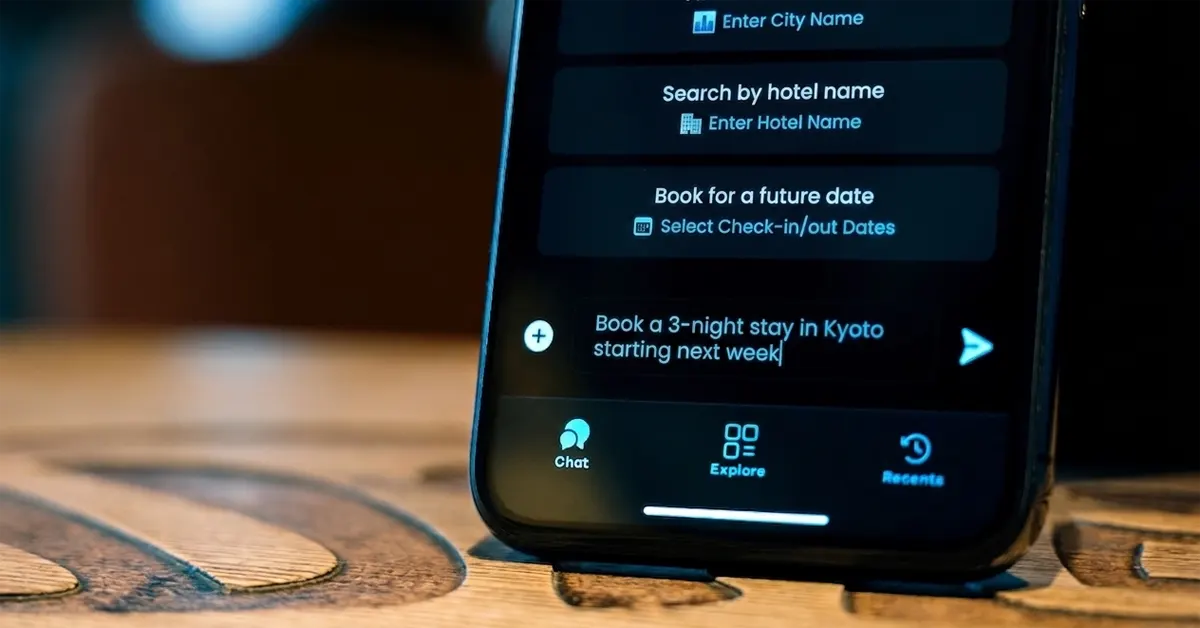
AI is not just changing where travellers look for hotels. It is changing the machinery that sits between a traveller’s question and a confirmed booking — and that machinery now largely belongs to someone else.
Generative AI is reshaping hotel distribution faster than most operators realise, and the commercial consequences are already showing up in 2025 booking data. The shift is not about chatbots or automated guest messaging. It is about who controls the moment a traveller decides where to stay — and how that decision now reaches a hotel’s reservation system. For two decades, that moment belonged to Google Search and the OTAs. It is now being rebuilt inside AI platforms that most hotels have no direct relationship with, no data feed into, and no commission negotiation with. Understanding what is technically changing — in how bookings are discovered, routed, and completed — is no longer optional for anyone responsible for a hotel’s revenue.
Table of Contents
1. The Booking Path Has Been Rebuilt Without Hotels at the Centre
For twenty years, the path from “I need a hotel” to a confirmed reservation ran through a predictable set of stops. A traveller typed something into Google. Google returned a list of links. The traveller clicked through to Booking.com, Expedia, or directly to a hotel website. They compared options, read reviews, and booked.
Hotels understood this path. They invested in it. They paid for Google Ads to appear at the top of the results page. They paid Booking.com or Expedia a commission — typically between 15% and 25% — to appear on their platform. They built loyalty programmes to pull travellers away from OTAs and onto direct channels. The whole commercial logic of hotel distribution for the past two decades was built around winning visibility in that search-and-click sequence.
That sequence is being replaced.
When a traveller today types “quiet hotel near the Messe Frankfurt with a desk, fast Wi-Fi, and underground parking” into ChatGPT, Google’s AI Mode, or Perplexity, they do not receive a page of links. They receive an answer. The AI system reads the query, understands the intent — not just the keywords — processes thousands of data points about available properties, and surfaces a shortlist or a single recommendation. The traveller never sees page two. They often never see a list at all.
This is not a marginal shift in user behaviour. Phocuswright research cited by Cloudbeds shows that the share of US travellers using traditional search engines for travel planning fell from 51% in late 2024 to 36% in the second half of 2025. Use of AI platforms for the same purpose more than doubled over the same period. Adobe Analytics data shows that traffic from AI sources to US travel and hospitality websites surged 3,500% year-on-year in July 2025 — admittedly from a low base, but the trajectory is not in doubt.
The commercial consequence is direct: if an AI system is now the first point of contact between a traveller and a hotel recommendation, then the entity that controls the AI system controls the top of the distribution funnel. That entity is not, today, the hotel.
2. What AI Systems Actually Do — and Why It Matters for Visibility
To understand why this shift changes hotel economics, it helps to understand, at a basic level, what an AI recommendation system actually does when it answers a travel query.
Traditional search engines index web pages by scanning their text for keywords. A hotel that uses the phrase “free parking Frankfurt” on its website can rank for that search term. The logic is mechanical: keyword in, keyword out.
AI systems work differently. They do not match keywords — they interpret meaning. When a traveller asks for a “quiet hotel with a desk and fast Wi-Fi,” the AI is not looking for pages that contain those exact words. It is looking for structured information — across property descriptions, review text, amenity data, and live availability — that allows it to assess whether a given property genuinely matches those requirements. A hotel whose website says “ideal for business travellers” is not the same, to an AI system, as a hotel that has structured data confirming it has in-room desks, documented fibre broadband speeds, and reviews that specifically mention quiet rooms.
The practical implication: a hotel with an incomplete, unstructured digital footprint is not ranked lower in AI results — it is simply absent. The AI cannot make a recommendation it cannot justify from available data.
Cloudbeds conducted the hospitality industry’s first structured study of AI hotel recommendations in June 2025, running hundreds of automated queries across ChatGPT, Gemini, and Perplexity — the three platforms that together account for 98% of AI-driven traffic to websites — across six international destinations including Bangkok, Barcelona, and London. The finding was stark: more than two in three hotels recommended by AI were branded properties or hotels affiliated with a large group. Independent hotels were significantly underrepresented. The reason is not that AI systems are biased toward brands. The reason is that branded properties tend to have richer, more structured data, higher review volumes, and more consistent information across platforms. They are more legible to the AI. Hotels that are not legible to the AI do not appear.
For independent operators, this is not a future problem. It is a 2025 problem. OTA share of independent hotel bookings rose to 63.4% in 2025, up from 61.3% in 2024, according to Cloudbeds’ 2026 State of Independent Hotels report, drawn from 90 million bookings across 180 countries. The cost of customer acquisition at independent hotels increased 25% between 2019 and 2025, while RevPAR grew only 19% over the same period. The margin squeeze is already happening. AI is accelerating it, not causing it — but the mechanism is the same: properties that cannot control their own discovery are paying more to be found by someone else.
3. Why OTAs Are Winning the AI Transition, for Now
The instinctive assumption among hotel operators is that AI disruption will loosen OTA dominance. The data from 2025 does not support that assumption.
Here is what is actually happening. When a traveller asks an AI system to recommend a hotel, the AI needs two things: rich, reliable property information to make the recommendation, and a mechanism to complete the transaction. OTAs have both. Booking.com and Expedia have spent years building structured property data, collecting tens of millions of reviews, and building booking infrastructure that AI systems can query programmatically. When ChatGPT or Perplexity recommends a hotel today, it most frequently directs the traveller to book through an OTA — not because OTAs have negotiated preferred status with the AI platforms, but because OTAs have the data infrastructure and the transaction machinery that makes them the easiest answer.
This is why both Booking Holdings and Expedia are posting strong numbers while simultaneously being identified as potential victims of AI disintermediation. Booking Holdings reported full-year 2025 revenue of $26.9 billion, up 13% on 2024, with 1.235 billion room nights booked for the year — the fourth consecutive year of double-digit revenue growth. Expedia reported full-year 2025 gross bookings growth of 8%, with lodging gross bookings up 13% in Q4 specifically. Both companies are growing faster than the underlying hotel market, and both are investing heavily in AI — not to change what they do, but to ensure they remain the default answer when an AI system needs to complete a hotel transaction.
What that investment looks like in practice: Booking Holdings has embedded conversational trip-planning tools directly into its interface, so a traveller who starts planning a trip via AI ends up inside the Booking.com ecosystem rather than being redirected elsewhere. Expedia has used AI to make its platform 30% faster and to reduce the time it takes to onboard a new hotel property by 70% — meaning it can expand its inventory faster and keep its data more current than independent properties can match. The goal in both cases is to be the platform that AI agents route transactions through, not the platform that gets bypassed.
For a hotel operator, the commercial consequence is this: the commission structure has not changed. The mechanism that produces the commission payment has changed. In the old model, the OTA earned its commission by getting a traveller to click on your listing in their search results. In the emerging model, the OTA earns the same commission because the AI system — ChatGPT, Gemini, Perplexity — routed the traveller to the OTA’s booking infrastructure to complete a transaction the AI initiated. The hotelier pays the same 15–25%. The OTA did less visible work. The AI did the discovery. The commission persists.
OTA financial performance and AI investment, full-year 2025
| Company | FY 2025 Revenue | YoY Growth | What the AI investment actually does |
|---|---|---|---|
| Booking Holdings | $26.9bn | +13% | Embeds AI trip-planning in Booking.com interface so transactions stay within its ecosystem; early agentic features show higher conversion and lower cancellations per Q4 2025 SEC filing |
| Expedia Group | ~$10.1bn | +8% | Platform 30% faster; property onboarding 70% faster via AI; expanding inventory breadth to stay current at scale per Q4 2025 SEC filing |
4. What Google Is Actually Building — and Why It Is Different
Google’s position in this transition is structurally distinct from the OTAs, and for hotel operators it is arguably the more consequential development.
Google built the old distribution machine. For twenty years, Google Search was the top of the funnel through which virtually every hotel booking — direct or OTA — originated. Hotels paid Google for paid search placement. OTAs paid Google for even more paid search placement. The entire distribution ecosystem was, in effect, a tax paid to Google at the awareness stage, with a second tax paid to OTAs at the transaction stage.
Google is now building the machine that replaces that model. Google’s AI Mode — launched in 2025 and now available in over 200 countries — answers travel queries inside the search interface rather than sending the traveller to a third-party website. In November 2025, Google confirmed it is working directly with Booking.com, Expedia, IHG, Marriott International, Choice Hotels, and Wyndham to enable hotel bookings to be completed inside AI Mode without the traveller ever leaving Google. The booking would be initiated by an AI-generated recommendation and completed through a booking interface embedded in Google’s own product.
For OTAs, this is an existential threat dressed as a partnership. If a traveller books a hotel through Google’s AI Mode, Google captures the transaction relationship. The OTA becomes a back-end inventory and payment processor, not the customer-facing platform. The commission economics shift accordingly.
For hotels, the picture is more nuanced — but also more urgent. Google is also testing, as of May 2026 per Search Engine Roundtable, a version of AI Mode that surfaces direct hotel booking links rather than OTA links for properties that have active Google Hotel Ads integrations. This would, for the first time, give a major AI discovery platform a structural preference for direct bookings over OTA bookings. If that model scales, a hotel with a functioning direct booking infrastructure and an active Google Hotel Ads feed could, in principle, receive AI-referred bookings at a lower acquisition cost than the OTA commission rate.
The critical word is “could.” What Google has not yet published is the commission or cost-per-booking structure for AI Mode hotel transactions. Google’s history in hotel search — which includes the evolution of Google Hotel Ads from a free metasearch tool to a paid placement product — warrants caution about assuming that AI Mode direct booking links will remain costless for hotels. The commercial terms have not been disclosed.
What is clear is that Marriott is not waiting to find out. On the company’s Q4 2025 earnings call, CEO Anthony Capuano confirmed Marriott is among the initial partners working with Google on the AI Mode travel product, and is simultaneously running an early-stage advertising pilot with OpenAI. Capuano stated that the company is “optimising its content for generative AI technologies, so our properties are well-positioned wherever and however consumers are searching.” Marriott’s Bonvoy loyalty programme, which added 43 million new members in 2025 to reach a total of 271 million, provides a first-party data asset — verified guest preferences, stay history, spend patterns — that no AI intermediary can replicate from public data alone. That data is what allows Marriott to populate an AI recommendation with specificity that an OTA listing cannot match.
Operators without that data infrastructure are in a different position.
5. The Three Systems That Need to Work Differently
The AI transition is not, at its core, a marketing problem. It is a technology infrastructure problem. Three systems that already exist in every hotel — the property management system, the central reservation system, and the property data layer — need to function differently to remain competitive in an AI-mediated distribution environment. Here is what each of them does, what AI requires of them, and what happens if they cannot deliver it.
The Property Management System (PMS)
The PMS is the operational core of a hotel — it manages room availability, reservations, check-in and check-out, and billing. When a traveller makes a booking through any channel, that booking eventually lands in the PMS.
The problem AI creates for most PMS systems is not about the booking itself. It is about what happens before the booking: the query traffic. When a traveller searches for hotels on Booking.com or Google, each search triggers a handful of availability checks against the hotel’s reservation system. A busy afternoon might generate hundreds of such queries across all channels. A human traveller searches, considers, and books at human pace.
AI agents do not work at human pace. When an AI system responds to a query like “find me the best-value business hotel in Amsterdam for Tuesday to Thursday next week,” it may query availability and rates across dozens or hundreds of properties simultaneously before surfacing a recommendation. The ratio of availability queries to actual bookings — what the industry calls the look-to-book ratio — inflates dramatically. Legacy PMS systems built for human-paced search behaviour are not designed to handle this volume of automated traffic. The practical consequence is system slowdown, rate-feed errors, or cached rates that no longer reflect actual availability — all of which result in the hotel being deprioritised or excluded from AI recommendations that require live, reliable data.
The Central Reservation System (CRS) and Live Data Connectivity
Connected to the PMS, the CRS manages rate distribution across channels. For a hotel to appear with accurate live rates in an AI recommendation, it needs a data connection — a feed of live availability and pricing — that the AI platform can query in real time.
The technical standard that is emerging for this connection is called Model Context Protocol (MCP). Without going into the underlying engineering, MCP is an open standard that allows AI agents to query live data sources — including hotel reservation systems — directly and in real time, without having to go through a third-party aggregator. A hotel whose CRS supports an MCP connection can, in principle, allow a traveller’s AI assistant to check availability, confirm rates, and initiate a booking directly with the hotel’s own system. A hotel whose CRS does not support this connection will only appear in AI results via whatever OTA or aggregator the AI happens to route through — which means the OTA earns the commission on a transaction the AI initiated.
Cloudbeds’ 2026 forward-looking analysis explicitly named MCP as one of two foundational technical requirements for AI readiness in independent hotels. The other is Retrieval-Augmented Generation (RAG) — a mechanism that ensures an AI system answering a query about a specific hotel draws on accurate, current property information rather than outdated or synthesised data. In plain terms: RAG is what stops an AI from recommending a hotel’s spa when the spa has been closed for renovation, or citing a room type that was discontinued two years ago.
For operators evaluating their current tech stack: the questions to ask a PMS or channel manager provider are whether they support MCP integration and whether they have a live data feed to Google Hotel Ads. Neither is a guarantee of AI visibility, but both are now prerequisites for it.
The Property Data Layer
This is the least discussed and arguably the most important infrastructure requirement. It refers to the completeness, accuracy, and machine-readability of a hotel’s property information across every platform where AI systems collect data: Google Business Profile, Tripadvisor, Booking.com and Expedia listings, the hotel’s own website, and any structured data markup on that website.
AI systems that recommend hotels are, in effect, performing an automated due diligence on every property in scope. They cross-reference review sentiment, amenity data, location attributes, accessibility information, and rate competitiveness. A property whose digital information is incomplete, inconsistent across platforms, or described only in promotional language rather than factual attributes will score poorly in that due diligence. It will not be recommended.
To give a concrete example: if a hotel has EV charging on site, and that fact is listed on the hotel’s own website but not updated on its Booking.com amenity list, not verified on its Google Business Profile, and not referenced in any guest reviews, an AI asked to find a hotel with EV charging near a specific address will not recommend it — even if it is the closest property with that facility.
This is not a future requirement. The Cloudbeds AI recommendations study, and the wave of technology acquisitions that followed it, confirm it is a current one. In May 2026, Lighthouse — the commercial intelligence platform used by over 80,000 hotels globally — acquired Hotelrank.ai, a Paris-based platform founded in 2025 specifically to measure hotel visibility in AI recommendations. The Lighthouse/Hotelrank combination allows hotels to track, in real time, whether AI agents are directing travellers to book direct or through an OTA for their property, and how their AI visibility ranking compares to their competitive set. The fact that this category of software did not exist two years ago, and now has sufficient commercial demand to generate an acquisition, is a reliable indicator of where operator attention has shifted.
6. The Adoption Gap — and What It Costs
Not all hotels are equally exposed to the disruption described above. But the gap between those who are prepared and those who are not is widening faster than most operators appreciate.
The H2c report published in October 2025 found that only 41% of independent hotels are using AI in any operational capacity, compared to almost 80% of hotel chains. Research from Canary Technologies, drawn from 400 hospitality IT decision-makers, found that 52% of hotel operators identify AI-driven search visibility as a priority area for AI investment — but only half are actively deploying anything today. The stated intention and the current capability are not aligned.
The financial consequences of that gap are already visible in 2025 performance data. Cloudbeds’ full-year data shows global RevPAR declining 5.4% at independent hotels in 2025. Ultra-luxury RevPAR grew 10.6% over the same period. US economy hotels experienced 18 consecutive months of RevPAR declines. The market is not moving uniformly — it is moving in a K-shape, where well-capitalised, data-rich properties pull away from the rest. AI readiness is not the only variable in that divergence, but it is one of them, and it reinforces the others.
There is, however, a signal worth monitoring on the demand side. The Expedia Group consumer survey conducted across more than 5,700 adults in the UK, US, and India in early 2026 found that 66% of respondents said they would not trust an AI assistant to book travel on their behalf, and only 8% said they would be comfortable booking through an AI platform. Consumer trust in AI-completed transactions is low. This matters because it means the AI discovery-to-direct-booking path — where a traveller finds a hotel through AI and then completes the booking on the hotel’s own website — is still a realistic outcome. The traveller is comfortable using AI to identify the hotel. They are not yet comfortable letting the AI transact on their behalf.
That creates a window. A hotel that is discoverable in AI-generated recommendations, but routes the transaction back to its own direct booking channel rather than to an OTA, captures the demand without paying the commission. SiteMinder data published in 2026 found that 18% of travellers who begin their search on an OTA ultimately convert to a direct booking — a 3.3 percentage-point improvement year-on-year. The appetite to book direct exists. The question is whether the hotel is visible enough, at the AI discovery stage, to be the property the traveller decides to book direct.
7. What the Structural Picture Looks Like Going Into 2026
The distribution landscape entering 2026 is not the one most hotel operators expected when AI entered the mainstream conversation two years ago. The anticipated scenario — that AI would democratise hotel discovery, bypass OTA intermediaries, and reduce acquisition costs — has not materialised, at least not yet.
What has materialised is a more complex rearrangement. OTAs are using AI to reinforce their position. Big Tech is using AI to build a new position that may ultimately be more disruptive to OTAs than to hotels. And hotels — particularly independent ones — are largely watching from a disadvantaged position, lacking the data infrastructure to participate actively in the transition.
Phocuswright’s UK market data for 2025 is instructive as a forward indicator: UK OTA gross bookings reached a record £10.3 billion in 2025, while OTA market share fell for the third consecutive year. The supplier-direct share is projected to grow from 78% to 81% by 2029. That is a real shift, but a slow one. What AI does to that trajectory — whether it accelerates the move to direct or reverses it by creating a new intermediary layer between the hotel and the traveller — will depend on decisions being made in technology and commercial strategy right now, by hotel groups, OTAs, and platform companies simultaneously.
What is not in dispute: the operators who will have the most options in that transition are the ones whose systems can feed live, accurate, structured data to AI platforms today — because those are the properties that appear in AI recommendations today, while the transition is still early enough to shape.
Data sources:
- Booking Holdings Inc. SEC Form 8-K, Q4 and Full Year 2025 financial results (filed February 18, 2026);
- Expedia Group Inc. SEC Form 8-K, Q4 and Full Year 2025 financial results (filed February 12, 2026);
- Marriott International Inc. Q4 2025 earnings call transcript (February 10, 2026), as reported by PhocusWire;
- Cloudbeds, 2026 State of Independent Hotels Report (March 26, 2026), drawn from 90 million bookings across 180 countries;
- Cloudbeds, The Signals Behind Hotel AI Recommendations (June 2025);
- Cloudbeds and Lighthouse, Six Forces Reshaping Independent Hotels in 2026 (April 2026);
- Phocuswright, US traveller AI adoption data, as cited by PhocusWire (March and April 2026);
- Lighthouse acquisition of Hotelrank.ai press release (May 28, 2026);
- Google AI Mode travel announcements and confirmed hotel partnerships (November 2025), as reported by TravelAge West and TechCrunch;
- Phocuswright UK market 2025 data, as published on Phocuswright.com;
- Expedia Group consumer trust survey, 5,700+ adults UK/US/India, as reported by PhocusWire (April 2026);
- H2c independent hotel AI adoption report (October 2025), as cited by PhocusWire;
- Canary Technologies survey of 400 hospitality IT decision-makers (2026), as cited by PhocusWire.
All OTA financial figures are as reported to the US Securities and Exchange Commission.