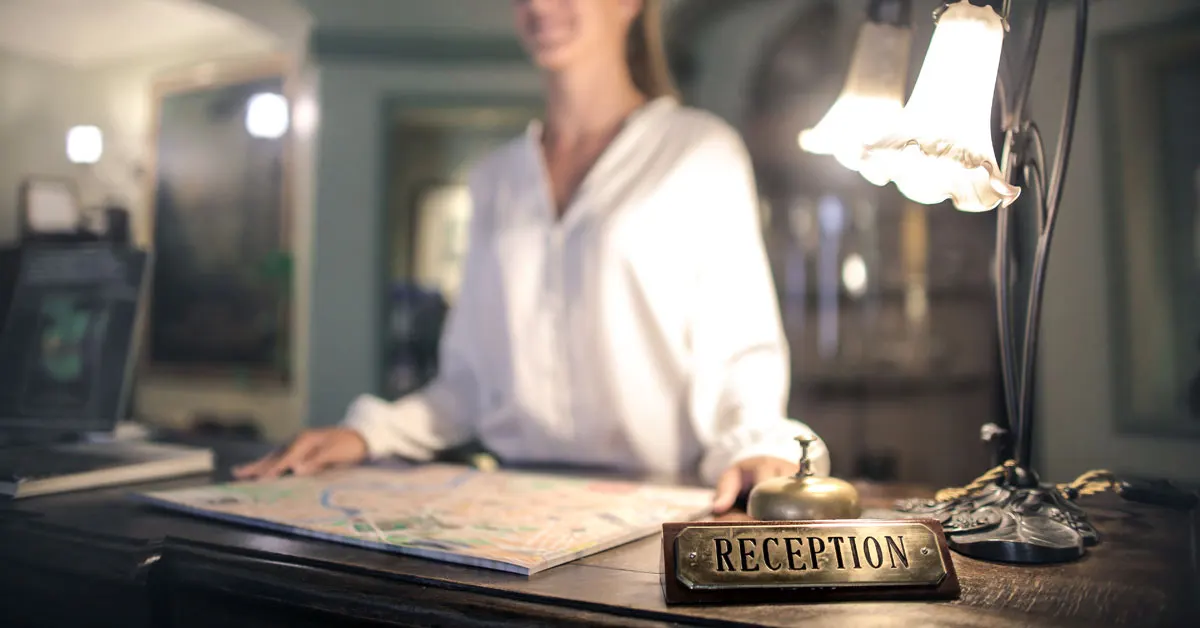



It’s 7:15 a.m. A guest walks up to the front desk straight from an overnight flight. She’s exhausted, her official check-in time is 3:00 p.m., and she’s hoping — without much confidence — that a room might already be ready.
What happens in the next thirty seconds depends on something the guest will never see. It depends on whether the front desk agent already knows which rooms were cleaned first thing that morning, whether housekeeping flagged a specific room as guest-ready, and whether anyone told engineering that the air conditioning unit in that room was fixed the night before. If those three pieces of information reached the front desk before the guest did, she gets a room. If they didn’t, she gets an apology and a seat in the lobby.
That small moment — three departments, one guest, one decision — is interdepartmental collaboration in its most ordinary form. It has no dedicated meeting, no formal name on a whiteboard, and yet it’s one of the most consequential things happening in the hotel at that moment.
Table of Contents
1. What Interdepartmental Collaboration Actually Means
Interdepartmental collaboration is the ongoing coordination between two or more departments in a hotel so that information, resources, and responsibilities move smoothly enough for the hotel to function as one operation rather than a collection of separate businesses sharing a building.
That last part is worth sitting with, because it’s easy to think of a hotel as a single business with different jobs inside it. In practice, a hotel behaves more like several distinct businesses operating under one roof: a lodging business (front office and housekeeping), a food business (restaurants, bars, room service), an events business (banquets and meetings), a retail and technical business (engineering and maintenance), and a back-office business (finance, human resources, sales). Each of these has its own daily rhythm, its own priorities, its own vocabulary, and often its own manager. Left alone, each would optimize for its own goals — housekeeping wants enough time to clean rooms properly, sales wants to book as many events as possible, front office wants to check guests in and out efficiently — and those goals don’t automatically align.
Interdepartmental collaboration is the connective tissue that keeps those separate goals pointed in the same direction. It shows up as a housekeeping supervisor calling the front desk to say a room is ready ahead of schedule, a banquet manager sending the kitchen a final guest count two hours before a wedding dinner, or a maintenance technician logging a broken elevator so that front desk staff know not to send guests toward it. None of these actions are glamorous. Almost none of them appear in a hotel’s marketing materials. But collectively, they are the reason a guest experiences their stay as one seamless service rather than a string of disconnected interactions with strangers who don’t talk to each other.
It’s also worth distinguishing collaboration from simple communication. Two departments can exchange information constantly and still not be collaborating — if the front desk sends housekeeping a list of rooms to clean and housekeeping cleans them with no further interaction, that’s a handoff, not a partnership. Real interdepartmental collaboration involves shared responsibility for an outcome: both departments have a stake in whether the guest actually gets what they need, and both adjust their own work based on what the other is doing.
2. Why Hotels Depend on This So Heavily
To understand why this matters as much as it does, it helps to compare a hotel to almost any other type of business. A software company can often let its engineering team, marketing team, and sales team work largely on their own schedules, syncing up periodically. A hotel doesn’t have that luxury, for a simple reason: a hotel sells a single, live experience that multiple departments produce simultaneously, in real time, for the same customer, and that experience cannot be paused, redone, or shipped as a fix later.
Think about what a single guest’s stay actually requires. Sales negotiated the corporate rate months ago. Reservations booked the room. Front office is checking the guest in right now. Housekeeping cleaned that specific room this morning. Engineering serviced the air conditioning last week. Room service will deliver breakfast tomorrow. Security is monitoring the hallway cameras tonight. Finance will process the payment when the guest checks out. Every one of those departments touches the same guest’s experience, often without ever meeting the guest or each other. If any single link in that chain doesn’t pass along the right information at the right time, the guest notices — not as an abstract inefficiency, but as a real, specific inconvenience: a cold breakfast, a room that smells like paint, a rate that doesn’t match what they were quoted.
This is different from most industries because the product and the delivery happen at the same moment. A factory can inspect a product before it ships. A hotel is “shipping” a room, a meal, and a service interaction the instant the guest experiences it, with no chance to intercept a mistake beforehand. That reality is what makes interdepartmental collaboration less of a nice-to-have and more of a structural necessity. Hotels don’t coordinate departments because it looks good in a training manual — they coordinate because the alternative is a guest discovering the gap in real time.
There’s a second, quieter reason coordination matters: hotels run on shared, finite resources. There is one inventory of rooms, one set of banquet spaces, one kitchen, one team of housekeepers, one set of parking spots. When the sales department books a 200-person conference, it isn’t just making a sale — it’s committing housekeeping’s staffing plan, the kitchen’s food order, the banquet team’s setup schedule, and potentially the availability of rooms for other guests that same week. If sales makes that commitment without looping in the departments that have to deliver on it, the hotel doesn’t have a sales win — it has a scheduling crisis with a signed contract attached.
Finally, hotels run 24 hours a day, seven days a week, with staff working in shifts that rarely overlap perfectly. A night auditor closing out the day’s finances at 2:00 a.m. may never speak directly to the sales manager who negotiated a group rate at 10:00 a.m. the previous day. Without deliberate systems for passing information across these gaps — shift logs, briefings, shared software — critical details simply fall through the cracks between shifts, not because anyone made a mistake, but because no formal handoff existed.
3. The Building Blocks That Make Collaboration Work
Interdepartmental collaboration isn’t a single tool or a single meeting — it’s built from several recurring elements that, together, create a functioning system. Understanding these pieces makes it much easier to recognize collaboration when you see it, and to spot when it’s missing.
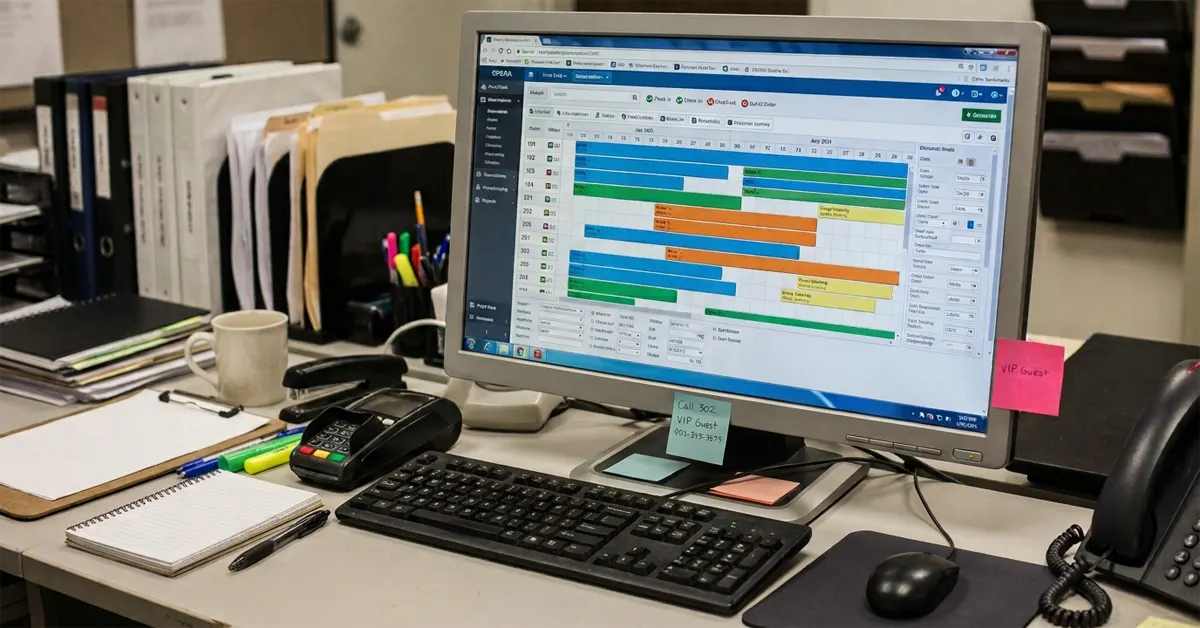
A shared source of truth. Most hotels rely on a central piece of software called a Property Management System, usually shortened to PMS. This system tracks which rooms are occupied, which are being cleaned, which are out of service, what each guest has booked, and what they’ve been charged. The PMS matters for interdepartmental collaboration because it gives every department the same picture of reality at the same time. When a housekeeper marks a room as clean in the system, the front desk sees it instantly, without needing a phone call. Without a shared system like this, departments end up working from different — and often outdated — versions of the truth, which is where miscommunication starts.
Standard operating procedures. Often abbreviated as SOPs, these are written, agreed-upon steps for how a recurring task should happen, including who does what and in what order. An SOP for a VIP guest arrival, for example, might specify that sales notifies front office 24 hours in advance, front office blocks a specific room category, housekeeping inspects that room personally rather than relying on a routine clean, and food and beverage — often shortened to F&B, referring to restaurants, bars, and room service — prepares a welcome amenity. SOPs matter because they turn collaboration from something that depends on individual goodwill into something that happens reliably, regardless of who’s on shift.
Regular touchpoints. Many hotels run a short daily meeting, often called a morning briefing or a stand-up, where department heads or supervisors share what’s happening that day: arrivals, departures, VIPs, events, maintenance issues, staffing gaps. These meetings are usually brief — fifteen to thirty minutes — but they’re one of the few moments where every department hears the same information at the same time, in the same room.
Defined escalation paths. Not every issue can be solved at the front line. A clear escalation path specifies who gets contacted, and how, when a problem is bigger than the person who first noticed it — a broken pipe flooding a guest room, for instance, needs to reach engineering, housekeeping, and often a manager within minutes, not whenever someone happens to walk by.
A shared vocabulary. Every hotel has its own internal shorthand, and part of what makes coordination possible is that departments understand each other’s terms. A “walk” means relocating a guest to another hotel because their room isn’t available. A “turn” refers to cleaning and resetting a room between guests. An “OOO” room is out of order and can’t be sold. When departments share this vocabulary, communication is faster and less prone to misunderstanding — a two-word phrase can convey what would otherwise take a full sentence to explain.
Mutual accountability. Perhaps the least visible but most important building block is a sense that departments succeed or fail together on guest-facing outcomes, rather than viewing a guest complaint as automatically “someone else’s problem.” A front desk agent who sees a maintenance issue and reports it immediately, even though it’s not their department, is demonstrating this kind of accountability.
Feedback loops. Collaboration works best when it isn’t one-directional. If front office asks housekeeping to prioritize a batch of rooms, and later tells housekeeping how that decision actually played out — whether it solved the problem or created a new one elsewhere — housekeeping can make better judgment calls the next time a similar request comes in. Without that loop, departments end up repeating the same friction over and over, because no one ever confirms whether a given adjustment actually helped.
4. What This Looks Like Day to Day
Abstract principles are easier to understand with concrete situations. Here are some of the most common, recurring forms interdepartmental collaboration takes inside a hotel — the routine ones, not the dramatic exceptions.
Front office and housekeeping. This is probably the most frequent collaboration in any hotel, because these two departments jointly control the hotel’s core product: a clean, available room. Every morning, housekeeping works from a list generated by the PMS showing which rooms need cleaning, in what priority order — rooms with early check-in requests or VIP guests typically get cleaned first. Throughout the day, as housekeepers finish rooms, they update the system, and front office uses that real-time information to check guests in. When a guest requests late checkout, front office has to check with housekeeping before confirming, since a late checkout changes when that room can be cleaned and re-sold. This back-and-forth happens dozens of times a day, largely invisible to guests, but if it breaks down, guests either wait in a lobby or get placed in a room that isn’t ready.
Front office and engineering. When something in a guest room breaks — a leaking faucet, a television that won’t turn on, a thermostat stuck on one temperature — front office is usually the first to hear about it, but engineering (sometimes called maintenance) is the department that actually fixes it. The collaboration here involves logging the issue clearly, prioritizing it correctly (a broken lock is more urgent than a flickering lamp), and communicating back to the guest once it’s resolved. Engineering also flags rooms as “out of order” when repairs will take time, which removes that room from the sellable inventory front office and reservations are working from — a step that, if missed, can lead to a guest being assigned a room that isn’t actually usable.
Sales, events, and food and beverage. When a company books a hotel for a conference, the sales team negotiates the contract, but delivering the event requires close coordination with several other departments. A document called a Banquet Event Order, or BEO, is typically used to communicate the details — guest count, room setup, meal times, audiovisual needs — from sales to the banquet team, the kitchen, and often housekeeping and engineering. If the guest count changes two days before the event, that update has to reach the kitchen in time to adjust food orders, or the hotel either wastes food or runs short in front of a room full of paying attendees.
Revenue management and front office. Revenue management is the department responsible for deciding how much to charge for rooms on a given night, based on demand, competitor pricing, and how full the hotel already is. Front office deals directly with the consequences of those decisions — for instance, when a hotel is intentionally overbooked (a common industry practice based on the statistical likelihood that some guests won’t show up), front office is the department that has to manage a guest whose room isn’t available if the hotel guessed wrong. Coordination here means revenue management explaining its strategy and thresholds clearly, and front office feeding back real-time information about how bookings and no-shows are actually playing out.
Food and beverage and purchasing or kitchen operations. Restaurants and bars inside a hotel need ingredients delivered on a predictable schedule, in the right quantities — not so much that food spoils, not so little that dishes run out. This requires ongoing communication between the kitchen, the purchasing team (or whoever manages supplier relationships), and even sales, since a large banquet booked with little notice can require an emergency order that wouldn’t normally be part of the routine schedule.
Security and essentially every department. Security doesn’t operate as an isolated function — it depends on other departments reporting what they see. A housekeeper who notices an unfamiliar person wandering a guest floor, a front desk agent who spots a fraudulent credit card, or an engineer who finds a propped-open emergency exit are all part of the hotel’s security system, even though none of them work in a department called “security.” This is collaboration in its most informal form: everyone is a sensor, and the flow of that information to the right place is what keeps the building safe.
Human resources and every department. HR rarely interacts with guests directly, but its work — hiring, training, scheduling, handling workplace issues — shapes whether every other department has enough properly trained staff to do their jobs. A housekeeping department that’s short-staffed because HR hasn’t filled open positions doesn’t just have an HR problem; it has rooms that won’t get cleaned on time, which becomes a front office problem, which becomes a guest problem.
Finance and operations. The finance or accounting department depends on every guest-facing department to record charges accurately — a restaurant charge that isn’t posted correctly, a room rate that’s entered wrong, or a group billing arrangement that isn’t communicated clearly can all turn into disputes, refunds, or awkward conversations with guests weeks after they’ve checked out.
Front office and the spa or recreation team. In hotels with a spa, pool, or fitness facility, front office is often the first point of contact for guests booking treatments or asking about hours, even though a separate team runs that facility day to day. When a spa appointment runs long, or a treatment room needs maintenance, that information has to reach front office quickly enough that they’re not promising availability that no longer exists. The same pattern applies to golf courses, tour desks, and other on-property amenities: front office frequently acts as the guest’s first contact point for a service another department actually delivers, which only works smoothly if the two are talking to each other continuously.
What ties all of these examples together is that none of them are unusual or dramatic. They’re the ordinary texture of a hotel’s operating day — happening constantly, mostly without formal recognition, and almost entirely invisible to the guest when they work well.
5. How Hotels Build This Deliberately
Because so much of interdepartmental collaboration is informal — a phone call, a hallway conversation, a quick note in a shared system — it can be tempting to assume it just happens naturally if you hire good people. In practice, hotels that coordinate well have usually built specific habits and systems to make it happen reliably, rather than leaving it to chance.
Daily briefings with real content, not just a status update. The most effective morning meetings don’t just list what’s happening — they flag where departments need to lean on each other. A well-run briefing might specifically say, “We have a VIP arriving at 11 a.m. in room 412, front office and housekeeping please coordinate on early access,” rather than simply reading a list of arrivals.
Shared logs and centralized systems. Beyond the PMS, many hotels use shared digital logbooks where any department can post an issue that other departments need to see — a broken ice machine, a guest complaint pattern, a supply shortage — so that information doesn’t rely on the right two people happening to run into each other.
Cross-training. Some hotels rotate staff, or at least managers, through different departments so people understand what their colleagues’ jobs actually involve. A front desk agent who has spent a shift shadowing housekeeping tends to have a much more realistic sense of how long a room turnover actually takes, and communicates requests accordingly.
Clear, written escalation procedures. Rather than leaving staff to guess who to call during a crisis, well-run hotels document exactly who gets contacted for specific situations — a fire alarm, a medical emergency, a major system outage — so that under pressure, people aren’t improvising a communication chain for the first time.
Regular cross-departmental forecast meetings. Many hotels hold weekly meetings specifically to look ahead — upcoming groups, VIPs, maintenance projects, staffing gaps — so departments aren’t only reacting to what’s already happening today, but preparing for what’s coming in the next one to two weeks.
There are also common mistakes that undermine collaboration even in hotels that are trying to get it right. One is treating information-sharing as optional rather than routine — for instance, a sales manager who books a large group without formally notifying the departments that will deliver it, assuming “someone will figure it out.” Another is relying entirely on informal relationships between specific individuals, which works until that person goes on vacation, changes shifts, or leaves the company, at which point the informal channel disappears with them. A third is a culture where departments default to blaming each other when something goes wrong, rather than treating a guest issue as a shared problem — this tends to make staff less willing to flag problems early, since raising an issue starts to feel like inviting blame rather than preventing a bigger one.
6. Why This Reaches Beyond Daily Operations
The day-to-day examples above explain what interdepartmental collaboration looks like, but its consequences extend well past any single guest interaction — into how a hotel performs financially, how it’s staffed, and how it’s measured.
Guest experience and guest satisfaction scores. Most hotels track guest satisfaction through post-stay surveys and public review platforms, often summarized into a single score. What’s easy to miss is that a large share of the complaints that lower these scores — a late check-in, a maintenance issue that wasn’t resolved, an incorrect charge — trace back not to any one department failing at its job, but to information that didn’t pass between departments. A maintenance team might fix an issue perfectly, but if no one tells the guest it’s been resolved, the guest still leaves a negative review about being ignored.
Operational efficiency and labor cost. Coordination directly affects how efficiently a hotel uses its staff’s time. If housekeeping doesn’t know which rooms are priorities, they may clean rooms in an order that leaves early arrivals waiting unnecessarily, or spend time deep-cleaning a room that won’t be sold that night while a needed room sits unfinished. Multiplied across dozens of rooms and an entire staff, poor coordination doesn’t just create occasional guest friction — it wastes paid labor hours that could have been used more productively, which matters because labor is typically one of the largest costs in running a hotel.
Revenue impact. Interdepartmental coordination has a more direct effect on revenue than it might first appear. A front desk agent who knows a guest recently celebrated something special (information passed along by sales or a previous stay note) can offer a relevant upgrade or amenity, generating additional revenue that wouldn’t have otherwise been captured. On the group and events side, smooth coordination between sales and operations is often the single biggest factor in whether a group rebooks the following year — a poorly executed event, even if the sales terms were excellent, tends to lose future business, while a well-run one, delivered through tight coordination between sales, banquets, and the kitchen, tends to generate repeat bookings and referrals.
Risk and compliance. Certain forms of interdepartmental collaboration exist specifically to manage risk. Security incidents, food safety issues, and workplace injuries all require rapid, accurate communication across departments — often within timeframes set by law or by insurance requirements. A hotel where staff don’t know how or when to escalate a safety issue isn’t just running inefficiently; it’s exposed to legal and financial liability that a well-coordinated hotel would have caught and addressed earlier.
Staff retention and morale. Employees generally don’t enjoy working in an environment where they’re constantly cleaning up messes created by another department’s lack of communication, or where they’re blamed for problems outside their control. Hotels with strong interdepartmental habits tend to report lower staff turnover, in part because the day-to-day experience of work is simply less frustrating — problems get solved instead of bounced between departments, and staff feel like they’re part of one team rather than competing silos.
Key performance indicators, or KPIs. Hotels track a range of metrics to measure how well they’re running, and several of them are, in effect, downstream measurements of how well departments are coordinating. Guest satisfaction scores capture whether the guest experience felt seamless. Labor cost as a percentage of revenue captures whether staff time is being used efficiently. Employee turnover rate captures whether the working environment is sustainable. None of these metrics have a line item that says “interdepartmental collaboration,” but all of them move when collaboration improves or breaks down — which is part of why experienced hotel operators pay close attention to it, even though it’s hard to measure directly.
7. The Takeaway
Interdepartmental collaboration in hotels isn’t a formal program or a single system — it’s the accumulated set of habits, tools, and relationships that let a building full of separately-run departments function as one coherent operation for the guest standing in front of them. It happens in daily briefings and shared software systems, but just as often in a quick hallway conversation or a note passed along a shift change.
It matters because a hotel sells a live, real-time experience assembled by multiple departments simultaneously, with no opportunity to fix a mistake before the guest notices it. When that coordination works, it’s invisible — the guest simply has a smooth stay. When it doesn’t, the gaps show up exactly where guests feel them most: a room that isn’t ready, a charge that’s wrong, a request that gets forgotten between shifts. Understanding interdepartmental collaboration, in other words, is really understanding how a hotel works at all — not as a single business, but as several businesses that have to move in sync, every single day, for every single guest.