

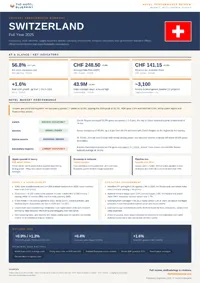
Full year 2025 Switzerland hotel performance review. Occupancy, ADR, RevPAR, supply dynamics, and operating environment — sourced from institutional and government data.
This review draws exclusively on data published by government statistical offices, official tourism bodies, and major hospitality associations. All sources are cited.
Available to registered members – Create an account here
Table of Contents
1. Economic and Tourism Context
Data published by the State Secretariat for Economic Affairs (SECO) in its Gross Domestic Product statistical release confirms that real gross domestic product in Switzerland increased by 1.6 percent in 2025 at previous year’s prices, up from 1.5 percent recorded in 2024. Domestic demand served as the primary growth vector, expanding by 2.5 percent across the twelve-month period. Gross fixed capital formation recorded an expansion of 3.5 percent, providing a structural tailwind to broader commercial activity despite macroeconomic tightening across key European trading partners.
The KOF Swiss Economic Institute (KOF) noted in its KOF Economic Forecast that domestic macroeconomic performance moderately outpaced early-year institutional projections. Initial forecasts framed 2025 GDP growth nearer to 1.4 percent, but stronger private consumption spending, underpinned by low inflation and positive real wage gains, insulated the domestic service sector. In contrast, equipment investment stagnated and export-oriented manufacturing faced operational resistance from global trade adjustments and currency strength. Value added within the aggregate trade, transport, and hospitality sector posted a notable expansion of 4.2 percent in 2025.
Official tourism statistics from the Federal Statistical Office (FSO) published under the HESTA dataset reveal that total demand for accommodation established a historical peak. The Swiss hotel sector recorded 43.9 million overnight stays in full-year 2025, representing an increase of 2.6 percent, or 1.1 million additional nights, relative to 2024 figures. Both domestic and international volume metrics registered all-time records across the period.
Domestic travel demand grew by 1.4 percent year-on-year to reach 21.1 million overnight stays, surpassing the previous record set in 2022. Domestic demand expanded across ten of twelve calendar months, peaking in July at 2.2 million overnights. Temporary contractions were isolated to February (-6.3 percent domestic) and November (-0.7 percent domestic).
International inbound volume expanded by 3.7 percent over 2024 levels to reach 22.8 million overnight stays, representing an absolute volume increase of 803,000 nights. Long-haul arrivals and core European source markets maintained stable expansion curves across both seasonal peaks. The 2024/2025 winter season (November to April) and the 2025 summer season (May to October) generated record totals of 18.6 million and 25.2 million overnight stays respectively.
Swiss Tourist Accommodation Performance in 2025
| Accommodation Indicator | 2024 Total | 2025 Total | Year-on-Year Change (%) |
| Domestic Overnight Stays | 20,804,000 | 21,100,000 | +1.4% |
| International Overnight Stays | 21,997,000 | 22,800,000 | +3.7% |
| Total Hotel Overnight Stays | 42,800,000 | 43,900,000 | +2.6% |
Figures compiled by the Federal Statistical Office under the HESTA Tourist Accommodation 2025 statistical release.
2. Hotel Market Performance
Data published by the Federal Statistical Office (FSO) in its HESTA 2025 statistical release confirms that the net room occupancy rate across Swiss commercial accommodation reached 56.8 percent for full-year 2025. This performance reflects an increase of 1.7 percentage points compared to the 55.1 percent recorded in 2024, surpassing the previous peak of 55.2 percent recorded in 2019. Measured on a gross room occupancy basis, the national annual average stood at 51.1 percent, up from 49.4 percent in 2024 and 48.8 percent in 2023.
Primary data from the FSO highlights significant geographic variation across urban, alpine, and secondary sub-markets. Major metropolitan centres led the national performance ranking, driven by consistent corporate movement and strong long-haul leisure demand. Zurich Region and Geneva registered the highest gross room occupancy rates in the country, both averaging 65.0 percent over the twelve-month period. Within urban sub-markets, Zurich and Lucerne recorded peak annual gross room occupancy levels of 75.0 percent and 69.0 percent respectively. Urban destinations maintained high performance during summer periods, achieving gross room occupancy rates between 60.0 percent and 70.0 percent, though winter performance in secondary cities such as Montreux, Lugano, and Ascona fell below 30.0 percent.
Alpine and rural destinations demonstrated sharp seasonal volatility. While the core winter (January to March) and summer (July to August) months delivered elevated volume, shoulder periods in April, May, October, and November routinely recorded gross room occupancy rates beneath 30.0 percent. Regionally, Eastern Switzerland posted a full-year gross room occupancy rate of 40.0 percent, whereas the Jura & Three-Lakes region recorded the lowest national average at 36.0 percent.
Secondary commercial data provided by STR/CoStar indicates that top-line financial yield tracked positively alongside room volume expansion. The Swiss national Average Daily Rate (ADR) reached CHF 248.50 in 2025, representing a 2.8 percent expansion over 2024 levels. Driven by concurrent gains in occupancy and room rates, national Revenue Per Available Room (RevPAR) increased by 5.9 percent year-on-year to reach CHF 141.15.
Segment-level tracking from secondary market sources demonstrates structural outperformance within high-tier assets. Premium, luxury, and upper-upscale properties in prime Alpine locations—specifically St. Moritz, Zermatt, and Gstaad—and major financial hubs maintained strong pricing power, elevating average daily rates above broader market averages. Conversely, economy and midscale establishments faced tighter margin expansion due to cost-sensitivity among domestic and short-haul European guest segments.
Gross Room Occupancy Rates by Selected Swiss Tourist Region in 2025
| Tourist Region | 2024 Gross Occupancy Rate (%) | 2025 Gross Occupancy Rate (%) | Year-on-Year Change (Percentage Points) |
| Geneva | 63.2% | 65.0% | +1.8 |
| Zurich Region | 63.5% | 65.0% | +1.5 |
| Eastern Switzerland | 38.8% | 40.0% | +1.2 |
| Jura & Three-Lakes | 34.9% | 36.0% | +1.1 |
Figures compiled by the Federal Statistical Office under the HESTA Tourist Accommodation 2025 dataset.
3. Supply and Development
Data published by the Federal Statistical Office (FSO) in its Establishments and Capacity in the Hotel Sector dataset shows that the Swiss commercial accommodation sector comprised 3,894 active open establishments during full-year 2025, providing a total operational capacity of 144,204 available bedrooms. This capacity represents a minor net increase of 0.4 percent in total room inventory relative to 2024, confirming a pattern of structural supply stability across the country.
Because federal administrative authorities do not track forward development pipelines or unbuilt commercial construction projects, forward pipeline metrics rely on secondary industry data published by Lodging Econometrics (LE) in its Europe Hotel Construction Pipeline Trend Report. Lodging Econometrics tracking indicates that Switzerland maintains a low-density pipeline relative to surrounding European markets, reflecting strict local planning regulations, land scarcity in urban zones, and protective zoning mandates in Alpine resorts.
Secondary tracking from Lodging Econometrics indicates that 22 hotel projects totalling approximately 3,100 rooms were active across various stages of planning and construction at the end of 2025. Of this forward total, 9 projects representing 1,350 rooms were under active construction. Projects scheduled to commence construction within 12 months accounted for 7 properties (950 rooms), while early planning comprised 6 properties (800 rooms).
New inventory delivered during full-year 2025 totalled 6 newly built commercial hotels adding approximately 720 rooms. Supply expansion remained concentrated in established primary hubs, led by Zurich, Geneva, and the Lake Geneva region, alongside selective high-tier alpine developments. Brand conversions and major property repositionings served as the dominant vector for room transformation during 2025. Driven by high replacement costs and elevated borrowing rates, institutional owners prioritised the refurbishment and reflagging of existing physical structures over ground-up real estate developments.
According to Lodging Econometrics development tracking, chain scale distribution within the active pipeline remains heavily weighted toward the upper-tier segments. Upscale and Upper Upscale developments account for over 60 percent of active rooms in the forward Swiss pipeline, while Luxury assets represent an additional 20 percent. Economy and Midscale projects account for less than 20 percent of total planned room supply. Over the next 12 to 24 months, secondary industry projections forecast the delivery of 8 properties (1,150 rooms) in 2026 and 7 properties (1,050 rooms) in 2027.
Swiss Hotel Establishments and Room Capacity in 2025
| Indicator | 2024 Total | 2025 Total | Net Change |
| Open Establishments | 3,912 | 3,894 | -18 |
| Available Bedplaces | 279,850 | 281,200 | +1,350 |
| Total Available Bedrooms | 143,630 | 144,204 | +574 |
Figures compiled by the Federal Statistical Office under the Establishments and Capacity in the Hotel Sector dataset.
4. Operating Environment
Data published by the Federal Statistical Office (FSO) in its Swiss Consumer Price Index release confirms that headline inflation in Switzerland averaged 0.2 percent during full-year 2025. This represents a deceleration from the 1.3 percent recorded in 2024 and 2.1 percent registered in 2023, placing Swiss price growth substantially below broader European averages. Lower import prices and stabilized domestic energy costs served as the primary drivers of disinflation across the twelve-month period.
Price growth within the accommodation and food service sector maintained a distinct upward trajectory relative to headline inflation. Data from the Swiss Consumer Price Index indicates that prices within the Restaurants and Hotels sub-index rose by 1.0 percent year-on-year in 2025. Catering services registered a price growth rate of 1.1 percent, reflecting sustained pressure on operational menu pricing and room rate adjustments to offset elevated structural input costs.
Figures from the FSO Swiss Wage Index demonstrate that average nominal wages across the national economy expanded by 1.8 percent in 2025. Because headline inflation was contained at 0.2 percent, real wages across all sectors increased by 1.6 percent, representing the highest real wage growth rate recorded in Switzerland since 2009. Within the accommodation and food service activities sector, nominal wage growth rose by 1.7 percent, driven by collective bargaining agreement adjustments covering hospitality workers across the cantons.
Labour market conditions remained structurally constrained throughout 2025. Data from the Swiss Labour Force Survey published by the FSO confirms that the national unemployment rate calculated under International Labour Organization criteria averaged 4.8 percent for the full year, compared to 4.3 percent in 2024. Despite this uptick in headline unemployment, operational labor shortages persisted in non-metropolitan tourism areas and alpine resorts, placing continued pressure on wage floors and recruitment expenditure.
Commercial energy costs stabilized throughout 2025 following extreme volatility in previous periods. FSO pricing indices show that commercial gas and electricity tariffs declined modestly relative to 2024 peak levels, assisting in stabilizing hotel property utility expenses. However, fixed occupancy costs remained elevated, driven by high commercial rent indexation and increased expenditure on building maintenance and operational services.
Swiss Price and Labour Cost Indicators in 2025
| Economic Indicator | 2024 Value (%) | 2025 Value (%) | Year-on-Year Change |
| Swiss Consumer Price Index (Headline Inflation) | 1.3% | 0.2% | -1.1 percentage points |
| Restaurants and Hotels Price Index | 1.8% | 1.0% | -0.8 percentage points |
| National Nominal Wage Growth | 1.8% | 1.8% | 0.0 percentage points |
| National Real Wage Growth | 0.7% | 1.6% | +0.9 percentage points |
| Hospitality Sector Nominal Wage Growth | 1.7% | 1.7% | 0.0 percentage points |
Figures compiled by the Federal Statistical Office under the Consumer Price Index and Swiss Wage Index statistical releases.
5. Outlook and Risk Factors
Institutional economic forecasts project a moderation in growth momentum for Switzerland during the immediate post-2025 period. Data published by the State Secretariat for Economic Affairs (SECO) in its Economic Forecasts release projects real GDP growth to decelerate to 0.9 percent in 2026, down from the 1.6 percent recorded in 2025, before recovering to 1.6 percent in 2027. In parallel, the KOF Swiss Economic Institute (KOF) lowered its forecast in the KOF Economic Forecast to 0.9 percent for 2026 and 1.5 percent for 2027. Projections from the International Monetary Fund (IMF) World Economic Outlook Update align with a decelerating environment, forecasting Swiss GDP growth of 1.3 percent in 2026.
Headline inflation is expected to remain contained, with SECO projecting an annual CPI increase of 0.4 percent in 2026 and 0.5 percent in 2027. The IMF similarly projects average consumer price inflation at 0.5 percent for 2026. Despite low price pressure, labor market constraints are forecast to persist. SECO projects the national unemployment rate to rise moderately to an annual average of 3.0 percent in 2026 before contracting to 2.8 percent in 2027, maintaining operational wage pressure across service sectors.
Demand catalysts for the Swiss hotel sector remain structurally tethered to major international events and sports business volume. The 2026 UEFA Women’s European Championship, hosted across eight Swiss cities in July 2026, represents a primary near-term demand driver for commercial accommodation, particularly within urban host centers including Zurich, Geneva, Basel, and Bern. Additionally, recurring international events—such as the World Economic Forum Annual Meeting in Davos—continue to provide high-ADR compression windows for top-tier alpine and transit hubs.
Institutional risk assessments published by SECO and KOF highlight three primary headwinds facing the accommodation sector. First, geopolitical volatility and Middle East conflicts pose direct risks to international energy pricing and global trade stability, threatening to increase operating transport and utility costs. Second, persistent real appreciation of the Swiss franc against the euro and US dollar elevates the relative cost of Swiss hotel stays for foreign source markets, compressing price elasticity and international leisure length of stay. Third, subdued economic growth across key European source economies—most notably Germany—presents a structural constraint on short-haul inbound volume expansion.
Swiss Economic and Inflation Projections for 2026 and 2027
| Economic Metric | 2026 Forecast (%) | 2027 Forecast (%) |
| Real GDP Growth | 0.9% | 1.6% |
| Consumer Price Index (Inflation) | 0.4% | 0.5% |
| National Unemployment Rate | 3.0% | 2.8% |
Figures compiled by the State Secretariat for Economic Affairs under the June 2026 Economic Forecasts publication.
Data Source
Available to registered members – Create an account here
- State Secretariat for Economic Affairs (SECO) — Gross Domestic Product: https://www.seco.admin.ch/en/newnsb/mFIgs3127AHFrl1muFg2i
- Federal Statistical Office (FSO) — Tourist Accommodation in 2025 (HESTA): https://www.bfs.admin.ch/news/en/2026-0340
- Federal Statistical Office (FSO) — Tourist Accommodation Summer Season: https://www.bfs.admin.ch/bfs/en/home.gnpdetail.2025-0442.html
- KOF Swiss Economic Institute (KOF) — KOF Economic Forecast: https://kof.ethz.ch/en/forecasts-and-indicators/forecasts/kof-economic-forecast.html
- Federal Statistical Office (FSO) — Swiss Consumer Price Index: https://www.bfs.admin.ch/bfs/en/home/statistics/prices/consumer-price-index.html
- Federal Statistical Office (FSO) — Swiss Wage Index: https://www.bfs.admin.ch/bfs/en/home/statistics/work-earnings/wages-working-expenses/swiss-wage-index.html
- Federal Statistical Office (FSO) — Establishments and Capacity in the Hotel Sector: https://www.bfs.admin.ch/bfs/en/home/statistics/tourism/tourist-accommodation.html
- Lodging Econometrics (LE) — Europe Hotel Construction Pipeline Trend Report: https://lodgingeconometrics.com/
- STR / CoStar — Hotel Performance Reports: https://www.str.com/
- International Monetary Fund (IMF) — World Economic Outlook: https://www.imf.org/en/Publications/WEO