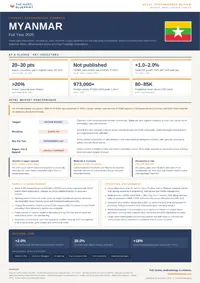
Full year 2025 Myanmar hotel performance review. Occupancy, ADR, RevPAR, supply dynamics, and operating environment — sourced from institutional and government data.
This review draws exclusively on data published by government statistical offices, official tourism bodies, and major hospitality associations. All sources are cited.
Available to registered members – Create an account here
Table of Contents
1. Economic and Tourism Context
Data for this chapter are drawn from institutional assessments published by the International Monetary Fund (IMF), the World Bank (WB), and the United Nations World Tourism Organization (UN Tourism). Following the suspension of regular Article IV consultations with Myanmar by the IMF following the February 2021 military takeover, macroeconomic tracking relies upon IMF World Economic Outlook (WEO) staff estimates and the World Bank Myanmar Economic Monitor (MEM) December 2025 edition. Comprehensive, independently audited national accounts and consumer confidence indicators for full-year 2025 have not been published by the Central Statistical Organization (CSO) of Myanmar, rendering this a partial data assessment constrained by institutional monitoring limitations.
Real GDP growth for Myanmar during calendar year 2025 remained severely depressed, reflecting structural dislocations, localized armed conflict, acute electricity generation deficits, and persistent foreign exchange shortages. IMF WEO projections estimated marginal real GDP growth hovering between 1.0 percent and 2.0 percent for 2025, representing a stark divergence from pre-crisis historical averages of 6.0 to 7.0 percent. The World Bank MEM noted that economic activity remained well below 2019 pre-pandemic baselines. Agricultural production, manufacturing output, and construction sectors experienced severe contractions due to rising input costs, transport bottlenecks, and supply chain fragmentation. Business and consumer confidence indicators, tracked via institutional business sentiment surveys cited by the World Bank, remained pessimistic, driven by currency depreciation, high inflation, and regulatory unpredictability.
Domestic travel volume during 2025 was characterized by significant regional bifurcation. While essential commercial travel between major economic hubs such as Yangon, Mandalay, and Nay Pyi Taw persisted at constrained volumes, leisure domestic travel remained heavily depressed by reduced disposable incomes, inter-state security checkpoints, and elevated fuel prices. Inter-city bus and rail networks operated at reduced frequencies, and scheduled domestic aviation capacity remained restricted due to high aviation turbine fuel costs and foreign currency constraints on aircraft maintenance and leasing.
International inbound arrivals for full-year 2025 failed to achieve pre-2020 recovery trajectories. According to regional tracking data from UN Tourism and reporting via the Ministry of Hotels and Tourism (MoHT), total international visitor arrivals remained a fraction of historic highs, which peaked at over 4.3 million visitors in 2019. Inbound travel was dominated predominantly by regional business travelers, official delegations, and expatriate personnel from select Asian economies, notably China, Thailand, and regional ASEAN neighbors. Leisure tourism from Western source markets remained negligible, suppressed by ongoing government travel advisories, safety and security concerns, and the cessation of commercial carrier routes by major international airlines. Actual international arrivals recorded during 2025 diverged materially from early official MoHT forecasts, which had anticipated a broader recovery contingent upon bilateral visa relaxations and cross-border tourism initiatives that ultimately failed to materialize at scale.
2. Hotel Market Performance
Data for this chapter are critically constrained by the absence of audited, standardized national hospitality key performance indicators from official sources. Neither the Ministry of Hotels and Tourism (MoHT) nor the Myanmar Hotelier Association (MHA) publishes comprehensive, verifiable full-year 2025 datasets covering Average Daily Rate (ADR) or Revenue Per Available Room (RevPAR) across national or sub-market classifications. Secondary benchmarking from CoStar / STR is limited by low institutional reporting participation outside primary urban centers and lacks verifiable public full-year 2025 disaggregation. Accordingly, this chapter constitutes a partial data assessment restricted to documented directional trends and verified operational disclosures.
National occupancy across Myanmar remained substantially depressed throughout 2025 relative to regional Southeast Asian peers and pre-2020 domestic baselines. Industry reporting synthesized from CoStar / STR regional Asia-Pacific summaries indicated that while Myanmar registered localized year-over-year occupancy gains off an exceptionally low base entering early 2025, absolute occupancy levels remained far below regional averages—lagging regional peers by roughly twenty to thirty percentage points during the first quarter. Rate performance experienced persistent downward compression. In US dollar terms, ADR declined year-over-year as operators discounted room inventory heavily to capture thin corporate, diplomatic, non-governmental, and domestic demand pools. Parallel depreciation of the Myanmar kyat against major foreign currencies further eroded real US dollar-equivalent RevPAR for properties collecting revenues in local currency, even where nominal kyat tariffs were adjusted upward to offset domestic cost inflation.
Disaggregated performance by hotel class cannot be verified from official MoHT or MHA publications, though operational disclosures from publicly listed domestic hospitality entities, such as Amata Holding Public Company Limited, confirm acute margin compression and revenue contraction across upscale and upper-upscale tiers during the fiscal period ending in 2025. Upper-tier properties built prior to 2020 for international leisure and corporate travelers suffered from severe structural oversupply, forcing multiple properties to suspend operations on entire floors or temporarily close underperforming assets to stem operating losses. Midscale and economy properties fared marginally better in occupancy terms due to lower operating breakeven thresholds and reliance on essential domestic commercial transit, though real yield remained minimal.
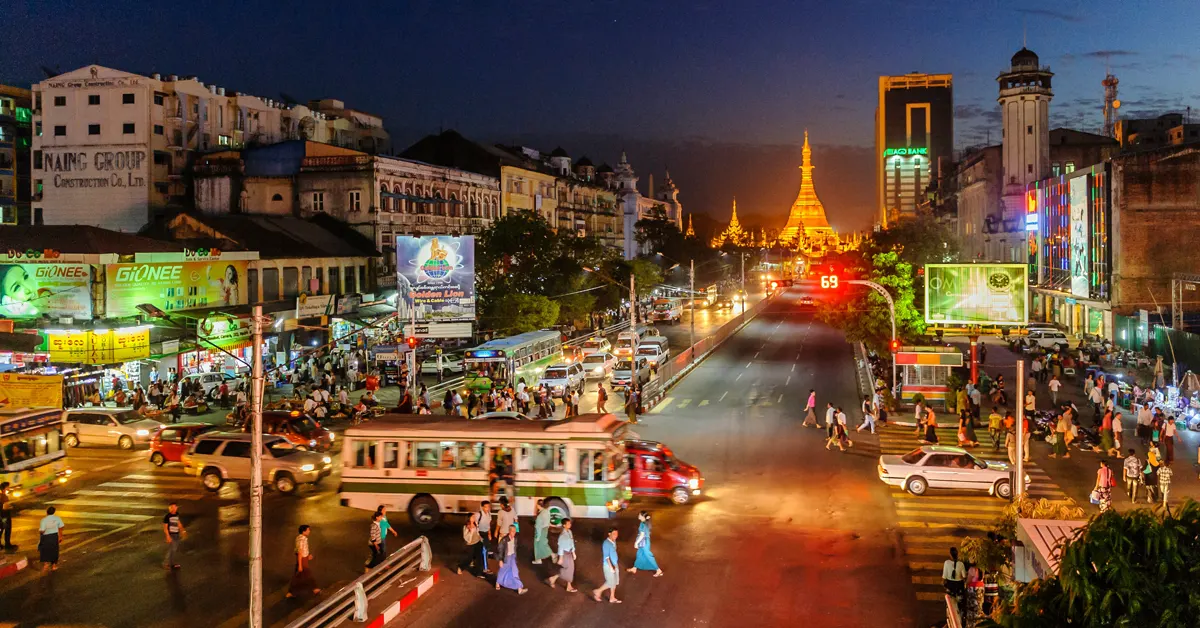
Sub-market performance exhibited pronounced geographic divergence across the country. Yangon functioned as the primary anchor for institutional hospitality demand, capturing the majority of remaining international commercial, diplomatic, and regional business arrivals through Yangon International Airport, yet remained burdened by chronic room oversupply that capped rate recovery. Mandalay and surrounding central dry zone markets experienced severe operational disruption following the major earthquake in 2025, which damaged physical infrastructure, curtailed commercial transit, and suppressed hotel utilization across central Myanmar. Nay Pyi Taw continued to rely almost exclusively on administrative, government, and state-affiliated delegation demand, generating sporadic occupancy spikes around official events amid prolonged troughs. Traditional leisure sub-markets—specifically Bagan, Inle Lake in Shan State, and coastal resorts at Ngapali Beach in Rakhine State—remained acutely distressed. Active armed conflict in Rakhine State and transit restrictions across Shan State severed air and road access for both domestic and international leisure segments, leaving resort inventory largely dormant throughout 2025.
3. Supply and Development
Data for this chapter are constrained by incomplete official registry disclosures and limited institutional tracking of active construction projects. The Directorate of Hotels and Tourism under the Ministry of Hotels and Tourism (MoHT) maintains cumulative lists of licensed accommodation establishments by regional zone, while Lodging Econometrics (LE) tracks the regional Asia-Pacific development pipeline. Neither body has published an audited, standalone national room supply reconciliation or a country-specific Myanmar pipeline breakdown for full-year 2025, establishing this chapter as a partial data assessment grounded in verified structural baselines and documented development constraints.
Registered room inventory in Myanmar remained concentrated within primary urban and cultural zones, specifically Yangon, Mandalay, Nay Pyi Taw, Shan State, and Bagan, which together historically accounted for the substantial majority of the country’s approximately 2,000 licensed hotels and roughly 80,000 to 85,000 rooms registered with MoHT prior to recent operational suspensions. Effective operational room supply during 2025, however, diverged significantly from nominal registered totals. Severe demand contraction, chronic electricity deficits, and physical infrastructure damage caused by the 2025 central Myanmar earthquake forced numerous licensed properties in Mandalay, Sagaing, Rakhine State, and Shan State into temporary suspension or permanent closure, reducing active sellable inventory across secondary markets.
New hotel openings during 2025 were minimal and restricted almost entirely to small-scale, locally financed economy and midscale establishments catering to domestic commercial transit. International brand expansion remained dormant throughout the period. Following the post-2021 suspension or termination of management agreements by global hospitality groups including Accor, Marriott International, Hilton, and Rosewood, no major international hotel operators debuted new-build properties in Myanmar during 2025. While LE reported in its Q4 2025 Construction Pipeline Trend Report that the broader Asia-Pacific excluding China pipeline reached a record 2,323 projects and 433,241 rooms, Myanmar registered negligible institutional pipeline volume due to international financial sanctions, foreign exchange controls, and sovereign risk assessments documented by the World Bank (WB) in the Myanmar Economic Monitor (MEM).
Brand conversions and capital-intensive renovation activity remained severely curtailed by foreign currency restrictions and elevated import costs for mechanical, electrical, and plumbing equipment. Where conversions occurred, they consisted predominantly of distressed or exited international-standard assets transitioning to domestic independent management or regional Asian operators. Capital expenditure among existing operators focused primarily on essential structural remediation—most notably seismic repairs in Mandalay and Nay Pyi Taw—and decentralized power generation installations, such as industrial diesel generators and solar-battery hybrid systems, rather than aesthetic repositioning or brand-standard upgrades.
The forward development pipeline for the 12 to 24 months following 2025 exhibits near-total stagnation in institutional greenfield construction. Large-scale mixed-use and luxury hospitality developments initiated in Yangon prior to 2020 remain stalled or indefinitely deferred due to financing freezes and unresolved ownership disputes. Any incremental supply additions anticipated through 2026 and 2027 are projected to consist exclusively of localized domestic guest houses and small-format commercial hotels, leaving Myanmar’s upper-upscale and luxury inventory structurally fixed at pre-2020 levels.
4. Operating Environment
Data for this chapter are constrained by the absence of regular, disaggregated hospitality wage and operating cost releases from the Central Statistical Organization (CSO) of Myanmar. Consequently, this assessment draws upon statutory compensation directives issued by the National Committee for Setting the Minimum Wage under the Ministry of Labour (MoL), macroeconomic inflation and energy assessments published by the World Bank (WB) in the Myanmar Economic Monitor (MEM), and workforce monitoring from the International Labour Organization (ILO), constituting a partial data chapter.
Labor market conditions in Myanmar’s hospitality sector deteriorated markedly throughout 2025, characterized by acute structural skill shortages and high staff attrition. Following the enforcement of the Public Military Service Law, conscription mandates affecting men aged 18 to 35 and women aged 18 to 27 triggered widespread outward migration of working-age hospitality personnel to neighboring Thailand, Malaysia, and the Gulf states. Operators across Yangon, Mandalay, and secondary resort zones reported persistent vacancies in technical engineering, food and beverage service, and middle management, forcing properties to dilute service standards or extend shift schedules for remaining staff. On the statutory wage front, the National Committee for Setting the Minimum Wage issued Notification No. 1/2025 on October 14, 2025, retroactive to October 1, 2025, granting private-sector workers in enterprises with ten or more employees an additional daily allowance of 1,000 Myanmar kyat (MMK). Combined with the base daily wage of MMK 4,800 and prior supplementary allowances introduced in 2023 and 2024, the statutory minimum daily remuneration rose to MMK 7,800. While this adjustment increased nominal payroll obligations, institutional tracking by the WB and ILO confirmed that real household wages continued to contract due to double-digit consumer price inflation, prompting larger urban hotels to implement supplementary cost-of-living stipends and staff meal provisions to curb turnover.
Inflationary pressures remained an acute drag on hotel operating margins throughout 2025. According to the WB MEM June 2025 edition and subsequent price monitoring, annual consumer price inflation remained above 20 percent, driven by import licensing restrictions, parallel foreign exchange market premiums, and supply chain disruptions following the March 28, 2025 earthquake. Food and beverage procurement costs escalated sharply, compressing gross operating profit margins in properties unable to pass local currency input inflation onto corporate or domestic room rates.
Energy cost trajectories represented the most severe operational burden on full-service hotels during 2025. Chronic national grid electricity deficits, exacerbated by conflict-related transmission damage and low hydropower generation, restricted state grid supply in major urban centers to scheduled rotational blackouts of four to eight hours per day. Furthermore, administrative revisions to commercial electricity tariffs raised baseline grid utility rates, while foreign exchange rationing constrained the import and distribution of refined diesel fuel. As documented by the WB MEM, commercial enterprises relied heavily on captive diesel-powered generators to maintain continuous air conditioning, refrigeration, and vertical transport. Elevated parallel-market diesel prices and frequent generator maintenance cycles drove utility expense ratios well above pre-2020 regional industry benchmarks, eroding property-level cash flow across all chain scales.
5. Outlook and Risk Factors
Forward performance projections for Myanmar’s hospitality sector in the period immediately following 2025 indicate sluggish macroeconomic stabilization paired with prolonged international tourism underperformance. According to the International Monetary Fund (IMF) World Economic Outlook (WEO), Myanmar’s real GDP is projected to expand by 2.0 percent in 2026, while annual consumer price inflation is forecast to remain elevated at 20.0 percent. In parallel, the World Bank (WB) Myanmar Economic Monitor (MEM) June 2026 edition estimated that real GDP contracted by 2.0 percent in fiscal year 2025/26 due to conflict and seismic disruptions, projecting a modest rebound to 2.0 percent growth in fiscal year 2026/27—a downward revision from its prior 3.0 percent projection.
Sector-specific visitor forecasts confirm that Myanmar will remain detached from broader regional recovery trajectories. In its Asia Pacific Visitor Forecasts 2026–2028 Mid-Year Update, published in partnership with the Research Centre for Digital Transformation of Tourism (RCDTT) at The Hong Kong Polytechnic University, the Pacific Asia Travel Association (PATA) projected that while 27 of 39 Asia-Pacific destinations will exceed 2019 international visitor arrival volumes by 2027, Myanmar will remain firmly in recovery mode through the end of the 2028 forecast horizon.
Documented demand catalysts for 2026 and 2027 remain narrow and regionally concentrated. Official figures released by the Ministry of Hotels and Tourism (MoHT) recorded over 973,000 foreign visitors for full-year 2025 and more than 360,000 arrivals during the first four months of 2026, with China, Thailand, and South Korea constituting the primary source markets. Institutional reporting from the WB MEM indicates that modest commercial stabilization in late 2025 and early 2026 was supported by post-earthquake reconstruction activity following the March 2025 seismic event, generating localized corporate, engineering, and humanitarian agency room-night demand in Nay Pyi Taw and Mandalay. Additional demand catalysts cited by PATA include expanding intra-regional Asian outbound volumes—particularly from China, where outbound travel is forecast to grow 18 percent between 2025 and 2027—alongside bilateral visa facilitation initiatives pursued by MoHT.
Principal risk factors documented across institutional assessments are structural and acute. The WB MEM identifies ongoing armed conflict across border and central regions as a primary constraint that interrupts inter-city transport corridors, restricts labor availability, and suppresses private investment. Severe infrastructure deficits persist, including chronic national electricity shortages that force commercial enterprises to rely on expensive captive diesel generation, alongside imported fuel supply shocks that transmit directly into freight and operating cost inflation. Foreign exchange rationing and parallel currency market distortions continue to impede cross-border financial settlements, imported equipment procurement, and international airline route restoration. Furthermore, PATA notes that elevated aviation operating costs, restricted air connectivity, and persistent geopolitical and security advisories continue to deter long-haul discretionary travelers from Western source markets. Finally, both the WB and IMF emphasize severe statistical data gaps and survey coverage limitations resulting from conflict conditions, creating heightened forecasting uncertainty for asset managers and operators allocating capital in Myanmar.
Data Source
- Myanmar and the IMF (World Economic Outlook Database): https://www.imf.org/en/countries/mmr
- World Bank — Myanmar Economic Monitor, June 2026: Shock Amid Fragility: https://openknowledge.worldbank.org/entities/publication/6ad606a5-3085-47eb-a360-83fa3d38ea04
- World Bank — Myanmar Economic Monitor (Full Report PDF): https://documents1.worldbank.org/curated/en/099061526075033335/pdf/P507203-a497789a-01dd-4d79-bb47-faaf34d61123.pdf
- Pacific Asia Travel Association (PATA) — Asia Pacific Visitor Forecasts 2026–2028: Mid-Year Update: https://www.pata.org/press-release/pata-mid-year-updates-the-numbers-behind-asia-pacific-tourism-growth-china-volume-vietnam-velocity
- Lodging Econometrics — Asia Pacific Hotel Development Trends & Projections (Q4 2025 Construction Pipeline Trend Report): https://lodgingeconometrics.com/asia-pacific-hotel-development-trends-projections-winter-2025-26/
- Ministry of Hotels and Tourism (MoHT) — Myanmar 2025 Foreign Tourist Arrivals Report (via Xinhua): https://english.news.cn/20260122/56af582081ff4431af12e9a9949c85a4/c.html
- Ministry of Hotels, Tourism and Culture — Myanmar 2026 Foreign Visitor Arrivals Report (via Xinhua): https://english.news.cn/20260721/9314ce06ac034e45850d249bca28a1cb/c.html
- National Committee for Determining the Minimum Wage (Ministry of Labour) — Notification No. 1/2025 (Minimum Wage Allowance Increase): https://www.lincolnmyanmar.com/wp-content/uploads/2025/10/Minimum-wage-notification-2025.pdf
Available to registered members – Create an account here