

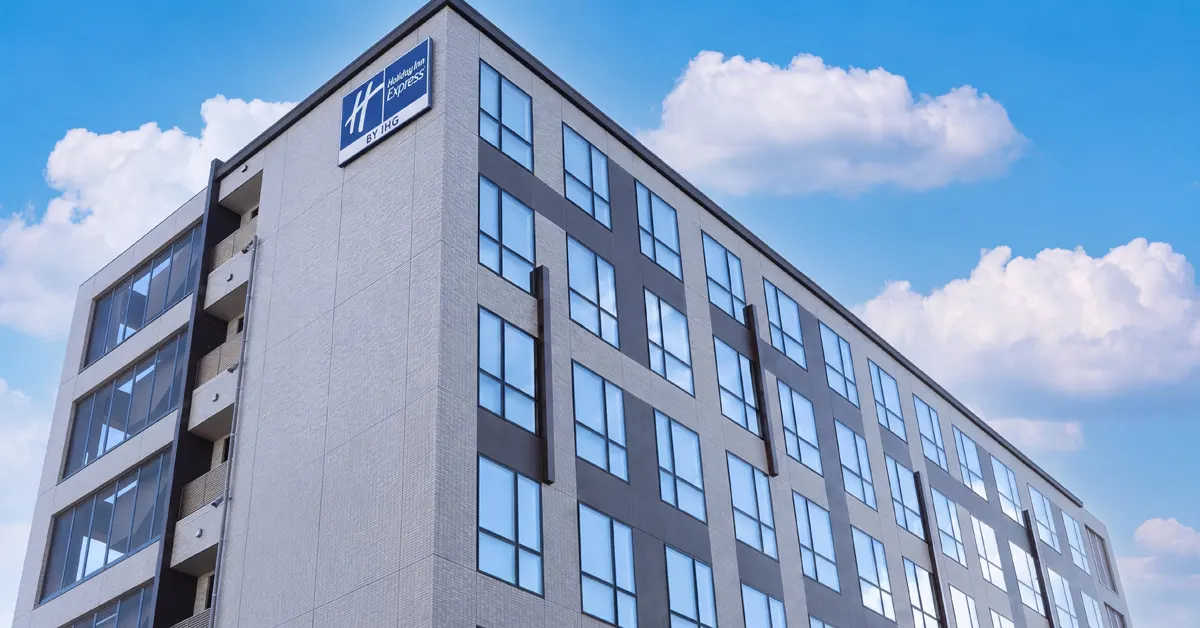
New construction has stalled under high rates and rising costs. Every major hotel company found the same answer at roughly the same time — and it’s reshaping which flag ends up over an existing building, and how fast.
Hotel conversion — re-flagging an existing building instead of constructing a new one — has quietly become the primary growth engine at every major hotel company, and 2022 to 2024 was the inflection point where that shift stopped being incremental and became structural. IHG’s agreement this week to convert 14 hotels and 1,063 rooms in Kyoto, signed with long-time partner GCP Hospitality, is the latest and largest proof point of how fast that engine now runs. But it is a symptom, not the story. The story is that Wyndham, Hilton, IHG and Marriott each launched a brand purpose-built for conversion within roughly the same three-year window, turning what used to be an opportunistic, hotel-by-hotel tactic into a coordinated, industry-wide competition for the same finite pool of independent and third-party-branded inventory. For a GM, DOSM or revenue manager watching flags change in their own market, the question is no longer whether this is happening. It is how fast it reaches their competitive set, and on what terms.
Table of Contents
1. Why conversion overtook new construction as the growth mechanism
The shift traces back to a P&L problem that hit every major company at the same time: new-build economics stopped working while conversion economics kept improving. Construction input costs rose 6.2% in the first four months of 2026 alone, faster than any comparable period over the prior three years, according to an analysis from Associated Builders and Contractors cited by real estate executives at a May 2026 Bisnow hospitality summit — pushing developers toward existing buildings even where underlying demand was strong. At the same time, U.S. hotel RevPAR fell 0.3% in 2025, the first non-recessionary annual RevPAR decline on record, according to CoStar’s STR data; occupancy slid 1.2 percentage points to 62.3% for the year. Against that backdrop, CoStar’s own February 2026 forecast update notes that with new development limited, U.S. conversion activity in 2025 was the highest since 2016, at nearly 1,900 hotels converting in the year.
The brand-level numbers show how central conversion has become to each company’s growth math, not as a side channel but as the main one. At IHG, conversions accounted for 52% of all room openings in full-year 2025 and 40% of all room signings, with conversion signings up 10% year-over-year excluding the one-off NOVUM Hospitality portfolio deal; the company’s global pipeline stood at 340,000 rooms across 2,292 hotels at year-end, equal to 33% of its current system size. At Marriott, conversions contributed roughly a third of both organic signings and gross room additions in 2025, and — a figure that matters directly to an owner’s cash flow modelling — 75% of conversion rooms began contributing to fee revenue within 12 months of signing, according to the company’s own fourth-quarter 2025 results. Hilton’s full-year 2025 net unit growth reached 6.7% on a record pipeline of more than 520,000 rooms and 3,703 hotels, and the company has said directly that increased conversion activity was a driver of that growth, alongside luxury and lifestyle demand.
For the owner on the other side of that arithmetic, the commercial consequence is a genuine trade against the alternative of a ground-up build: materially lower capital outlay and a shorter timeline to opening, set against franchise fees, a mandated property improvement plan, and a multi-year brand agreement — the same cost structure that comes with any flag change, just compressed into a faster, cheaper package. What is worth watching is how far that compression goes. IHG says some conversions under its midscale brand have moved from signing to opening in just over a month, a pace that resets what “fast” means for a market’s competitive set and shortens the window in which a nearby independent or under-branded competitor can respond.
2. What the land grab looks like on the ground
The tangible sign of this shift is the brand launches themselves, and it is worth being precise about what each one actually is, because they are not structurally identical. IHG’s Garner, launched in August 2023, is built entirely around the conversion model and has become the company’s fastest brand ever to scale, reaching 100 open hotels globally by March 2026 — a 30-month run from a standing start — with roughly 80 more hotels in the pipeline across 12 countries, from the United States and Mexico to Italy, Türkiye, the UK, Japan, Thailand and India. Hilton’s Spark, first opened in September 2023 in a former Days Inn in Mystic, Connecticut, was designed from day one as a 100%-conversion product; it passed 100 open hotels within 18 months and, per Hilton’s own brand materials, now stands at more than 200 properties. Marriott’s midscale conversion play, launched in September 2023 as Four Points Express by Sheraton and renamed Four Points Flex by Sheraton in late 2024, closed 2025 with 54 open hotels and 22 more in the pipeline, and the company describes it as the fastest-growing brand in its European business.
The exception worth flagging is Wyndham’s ECHO Suites Extended Stay, which launched in the same window — announced in 2022, first hotel opened in 2024 — and serves the same underlying purpose of adding rooms without the balance-sheet exposure of a full-service build. But by Wyndham’s own classification it is a 100% new-construction brand, not a conversion vehicle: 18 hotels were open at year-end 2025, with 282 more in the pipeline, all newly built rather than re-flagged. Treating it as a fourth conversion brand overstates what it is. The more accurate read is that Wyndham is fighting the same net-unit-growth battle through a different mechanism — new-build extended stay rather than acquiring existing buildings — and that distinction matters for any owner comparing what each company is actually proposing.
3. Kyoto as proof of how fast the land grab now moves
What makes the Kyoto signing worth reading beyond its own market is the structure of the deal, not just its size. IHG and GCP Hospitality — the hospitality arm of Gaw Capital Group and a long-standing IHG partner in Japan — agreed to convert 14 hotels totalling 1,063 rooms in a single portfolio transaction: 12 under Garner, one under Holiday Inn Express, and one still unbranded, with phased openings across the next 12 months following renovation. That is not a hotel-by-hotel sales process; it is a brand company and an owner-operator negotiating at portfolio scale, following the template of IHG’s 2024 agreement with Germany’s NOVUM Hospitality, under which Garner is converting a portfolio that will eventually total 56 open and pipeline hotels. Kyoto itself already had one open Garner hotel and three more open in nearby Osaka, all having entered the system since the brand’s 2025 debut in Japan; the 14-hotel signing multiplies that footprint many times over in a single stroke rather than through incremental one-off deals.
This is the part of the story with the most direct commercial relevance for an owner or operator managing a multi-property portfolio: brand companies are now structured and willing to negotiate re-flagging at portfolio scale, which changes both the pace and the economics of a conversion decision relative to negotiating property by property. It also means a single agreement can reshape a local competitive set faster than the market has previously had to absorb — 14 hotels changing flag and, in most cases, physical condition, within a 12-month window is a materially different shock than the gradual pace of one-off conversions. What is worth monitoring is whether portfolio-scale deals of this kind, so far concentrated in Japan and Germany, begin to appear at similar scale in other markets where a single ownership group controls a large independent or sub-scale branded estate — parts of Southeast Asia, India and Southern Europe carry that kind of ownership concentration, and all three are already showing early conversion-brand activity.
4. The unresolved question: is this additive, or is it re-flagging the same fee pool?
The debate hotel executives are actually having about this shift is not whether conversion is growing — the pipeline numbers settle that — but whether converting to one of these brands delivers revenue an owner would not otherwise have captured, or whether it mainly re-labels an existing cost base while introducing a new one. The concern is sharpest where a company’s new conversion brand sits directly alongside an established sibling targeting the same guest and, often, the same physical stock: Spark competing for the value-seeking traveller that Hampton by Hilton has served for decades; Garner sitting one rung below Holiday Inn Express in IHG’s own “Essentials” segment; Four Points Flex drawing on the same demand as Four Points itself. Kevin Davis, Americas CEO of JLL Hotels & Hospitality Group, told Hotel Dive in January 2026 that the industry is “at the point of, if not past the point of, brand saturation,” driven by public companies “under a tremendous amount of pressure for net unit growth” that pushes them “to create brands, micro brands and subsets of brands in order to expand their footprint of existing assets.” Jennifer Barnwell, president of Curator Hotel & Resort Collection, made a related point to Hotel Management in an August 2026 feature on brand economics: owners now need to see actual projections before committing, and must “carefully consider the level of brand saturation that exists in the market” before assuming a new flag will lift performance rather than simply add a fee line.
The evidence available does not resolve this either way, and that is worth stating plainly rather than glossing over. None of the four companies publishes brand-level RevPAR, occupancy or RevPAR-index data specifically for conversions under these brands, so there is no public benchmark yet for whether a converted property actually outperforms what it was earning under its previous flag, or under no flag at all, net of the new franchise and marketing fees. What is disclosed is aggregate and directional: Marriott’s reported 75% conversion-to-fee-contribution rate within 12 months speaks to how fast a conversion starts paying the parent company, not to what it nets the owner. Until brand-level performance data becomes available — through investor disclosures, STR-tracked comp sets, or franchisee-level reporting — an owner evaluating one of these brands is, in practice, relying on the same pipeline-growth and system-scale numbers the companies use to sell the brand, rather than independent evidence of what conversion actually does to their bottom line. That gap is the thing worth watching most closely over the next several quarters, particularly as the first wave of 2023–24 conversions reaches the comparable-year-over-year stage where genuine performance data should start to surface.
IHG’s conversion momentum, full-year 2025
| Metric | FY2025 |
|---|---|
| Systemwide room openings | 65,100 rooms (record, +10% year-over-year) |
| Conversions’ share of all room openings | 52% |
| Conversion signings | 306 hotels (+10% in rooms, excluding NOVUM) |
| Global development pipeline | 340,000 rooms / 2,292 hotels (33% of current system size) |
| Garner open hotels | 100 (since August 2023 launch) |
| Garner development pipeline | ~80 additional hotels |
Source: InterContinental Hotels Group PLC, “Full Year Results for the year to 31 December 2025,” and “Garner Becomes Fastest Scaling Global Brand in IHG History,” both published by IHG Hotels & Resorts.
Data Source
- InterContinental Hotels Group PLC, “Full Year Results for the year to 31 December 2025,” 17 February 2026 — company-reported FY2025 system size, conversion share of openings and signings, and global pipeline.
- IHG Hotels & Resorts, “Garner Becomes Fastest Scaling Global Brand in IHG History,” 16 March 2026 — Garner’s 100-hotel milestone, pipeline, and 2025 regional openings.
- IHG Hotels & Resorts, “IHG Hotels & Resorts signs landmark 14-hotel portfolio deal in Japan,” 24 August 2026 — the Kyoto/GCP Hospitality 14-hotel, 1,063-room conversion agreement.
- Hilton Worldwide Holdings, Inc., Fourth Quarter 2025 Earnings Release, 11 February 2026 — year-end 2025 development pipeline of 3,703 hotels and 520,500 rooms.
- Hilton, “Hilton Delivers Strong 6.7% Net Unit Growth in 2025, Closes Year with Record 520,000 Rooms Under Development,” Business Wire, 26 January 2026 — full-year 2025 net unit growth and role of conversion activity.
- Hilton, “Spark by Hilton Shines Bright: Trailblazing Premium Economy Brand Surpasses 100 Open Hotels Milestone,” 11 February 2025 — Spark’s 18-month run to 100 open hotels.
- Hilton, “New Hilton Openings in 2026,” stories.hilton.com — current Spark by Hilton open-hotel count (200+). Marriott International, “Marriott International Reports Fourth Quarter and Full Year 2025 Results,” 10 February 2026 — FY2025 pipeline, conversion share of signings/openings, and 12-month conversion fee-contribution rate.
- Marriott International, “Marriott International Announces Outstanding Global Growth and Milestone Achievements in 2025,” gcs-web.com — Four Points Flex and StudioRes year-end open/pipeline counts.
- Wyndham Hotels & Resorts, “Wyndham Hotels & Resorts Reports Fourth Quarter Results,” 18 February 2026 — FY2025 record 259,000-room pipeline and 870 development contracts.
- Wyndham Hotels & Resorts, Inc., Form DEF 14A, U.S. Securities and Exchange Commission, filed 2026 — ECHO Suites year-end 2025 open-hotel count (18) and pipeline (282).
- Wyndham Business, “ECHO Suites Extended Stay by Wyndham” brand page — confirms ECHO Suites’ classification as a 100% new-construction brand, not a conversion product.
- CoStar (STR), “U.S. Hotel Forecast Assumptions – February 2026,” 9 February 2026 — 2025 U.S. RevPAR decline (-0.3%, first non-recessionary decline on record) and conversion activity (~1,900 hotels converted, highest since 2016).
- Hotel Dive, “Top 5 hospitality industry trends to watch in 2026,” 7 January 2026 — Kevin Davis (JLL Hotels & Hospitality Group) on industry brand saturation.
- Hotel Management, “Can soft brands still justify the cost for independent hotels?,” August/September 2026 print edition — Jennifer Barnwell (Curator Hotel & Resort Collection) on owner due diligence around brand saturation and ROI.
- Bisnow, “Hotel Execs Bullish On D.C. But Opt For Conversions, Not New Builds,” 26 May 2026 — construction input cost growth cited by executives as a driver toward conversion.