


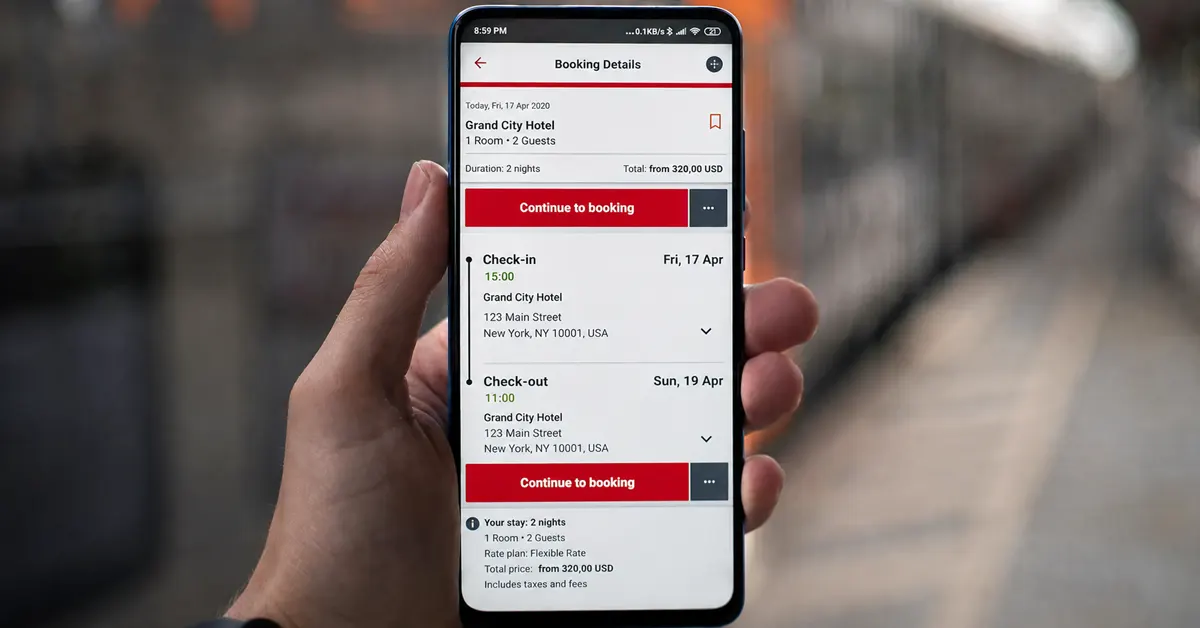
Book a flight for next month, then check the same route again a week later — the price will have moved, sometimes by a lot. Hotels work the same way, except travelers often notice it more, because they’re comparing the price of the exact same room, on the exact same dates, sometimes within the same day. Look up a downtown hotel for a Tuesday in March and it might show $139. Check again two weeks later, after a conference has booked out half the city, and the same room for the same Tuesday is now $249. Nothing about the room changed. What changed is demand.
This constant repricing has a name: dynamic pricing. It’s one of the most visible ways hotels run their business, and also one of the most misunderstood — often lumped together with a related but different practice called yield management (a topic broad enough that it deserves, and will get, its own dedicated article on this site). This piece stays focused on dynamic pricing specifically: what it is, how it actually works, and why nearly every hotel, from a 40-room boutique property to a 3,000-room resort, uses some version of it.
Table of Contents
1. What Dynamic Pricing Actually Means
Dynamic pricing is the practice of adjusting the price of a hotel room continuously, in response to real-time changes in demand and market conditions — rather than charging one fixed rate for a room type regardless of when it’s booked or how busy the hotel is expected to be.
The idea isn’t unique to hotels. It’s the same logic behind a ride-hailing app charging more during a downpour when everyone wants a car at once, or an airline seat costing more the closer you get to a flight that’s nearly full. In hotels, it means the rate for a given room type, on a given night, can move up or down based on factors like how many rooms are left unsold, how far away the date is, what’s happening in the city that week, and what nearby competitor hotels are charging for comparable rooms.
It’s worth contrasting this with how hotels used to price rooms, because the shift explains a lot about why the practice exists. For decades, many hotels worked from a rack rate — a single, printed rate per room type, often set months in advance for an entire season and rarely touched in between. A “high season” rate applied for weeks or months at a stretch, regardless of whether a particular Tuesday inside that season was nearly sold out or nearly empty. Dynamic pricing replaces that static grid with a rate that can move day by day, and on busy properties, multiple times within a single day.
One boundary worth setting early: dynamic pricing, as discussed here, applies mainly to transient bookings — individual guests booking directly through the hotel’s website or through an OTA (online travel agency, such as Booking.com or Expedia). Rates that have already been negotiated for corporate accounts or group contracts are typically fixed for an agreed period and don’t move with day-to-day demand the same way. Managing that mix of business is closer to yield management territory, which is covered in the companion article.
2. Why Hotels Rely on Dynamic Pricing
To understand why dynamic pricing exists at all, it helps to understand what makes a hotel room such an unusual product to sell: it’s perishable. An empty seat on tonight’s flight or an empty hotel room tonight cannot be sold tomorrow. Once midnight passes, that potential revenue is gone permanently — there’s no warehouse to store the unsold inventory and sell it next week. That single fact creates enormous pressure to get the price right on any given night, because there’s no second chance.
A fixed, unmoving rate fails in two directions at once:
- It leaves money on the table during high demand. If a hotel charges the same $150 for a room during a week when a major conference has sold out half the city as it does on an ordinary quiet Tuesday, it’s simply giving away revenue that guests were clearly willing to pay. Demand didn’t care about the printed rate card; the hotel just didn’t respond to it.
- It leaves rooms empty during low demand. If that same $150 rate is too high for a slow week, rooms sit unsold that could have been filled — and profitably so — at $95. An empty room earns the hotel nothing at all, while a room sold even at a discount at least covers variable costs (housekeeping, amenities, utilities) and contributes something to the bottom line.
Dynamic pricing addresses both failure modes by letting the rate track demand as it actually develops, rather than guessing at it months in advance and locking it in.
There’s also a competitive dimension. Because OTAs and price-comparison tools have made hotel pricing extremely visible to shoppers, nearly every hotel a traveler might consider is already adjusting its rates in response to demand. A property that still prices with a flat, seasonal rack rate isn’t just missing revenue opportunities — it’s often out of step with a market where comparable hotels nearby are already repricing daily, which can make it look either overpriced on quiet nights or suspiciously cheap during a local surge.
3. Dynamic Pricing vs. Yield Management: Two Different Things
Because these two terms constantly appear together — and because a separate article on this site is dedicated entirely to yield management — it’s worth being precise about the difference before going any further.
Yield management is the broader discipline of managing a hotel’s limited, perishable inventory to maximize total revenue. It works with several levers at once: which rate plans are open on which booking channels, minimum-stay requirements around high-demand dates, cancellation policies, overbooking strategy, how many rooms are allocated to which guest segment or distribution channel — and, yes, price.
Dynamic pricing is just one of those levers, isolated and examined on its own. It deals specifically with how the rate for a room moves in response to demand, without touching the other controls listed above.
A useful way to picture the relationship: yield management is the overall strategy — deciding which pieces to move, and why, across the whole board. Dynamic pricing is one specific, constantly repeated move within that strategy: adjusting the price itself. A hotel could, in theory, have very sophisticated dynamic pricing — smart, well-calibrated rate changes — while still practicing weak yield management overall, for instance by allocating too much of its best inventory to a low-value channel or failing to set sensible stay restrictions around a sold-out weekend. The reverse is also possible: a hotel with careful segmentation and channel strategy but a fairly simple, less reactive pricing engine underneath it.
The two get conflated for a practical reason: most hotels manage both through the same person — a revenue manager — and often through the same category of software, a revenue management system (RMS), because it’s efficient to make these decisions together. But conceptually, they answer two different questions:
- Dynamic pricing answers: “What should this room cost right now?”
- Yield management answers: “Given everything we know about demand, which guests should get access to which rooms, under which conditions, at which price, and through which channels, in order to maximize total revenue?”
This article stays with the first question. The second — which guests, which channels, which conditions — is a large enough topic to earn its own full treatment separately.
4. The Moving Parts Behind a Dynamic Rate
So what actually causes a rate to move? Whether the adjustment is made by software or by a person doing it manually, dynamic pricing generally draws on the same handful of signals.
- Booking pace, or “pickup.” This is the speed at which rooms for a specific future date are being reserved, compared with how that same date usually books at this point in advance. If a Friday three weeks out is filling faster than an average Friday typically does at the three-week mark, that’s an early signal that demand is running hot, and a reason to raise the rate before the hotel finds itself sold out at yesterday’s cheaper price.
- Remaining inventory. How many rooms are left unsold for that date out of the hotel’s total room count. All else being equal, fewer remaining rooms — especially close to the arrival date — tends to push the rate upward, since each remaining room becomes scarcer and more valuable.
- Booking window (lead time). How far ahead of the stay date a guest is booking. Rates commonly start lower far out and shift from there depending on how demand actually develops; it isn’t a simple straight line upward, since a hotel that isn’t selling out may also lower rates again in the final days to fill what’s left, particularly at leisure-driven properties.
- Day-of-week and seasonal baseline. Before any live signal is factored in, there’s an underlying rhythm to demand. A downtown business hotel typically peaks midweek and dips on weekends; a beach resort is usually the reverse. A seasonal cycle — summer versus winter, school holidays, local high season — sits on top of that weekly pattern. Dynamic pricing starts from this baseline and adjusts around it.
- External demand drivers. City-wide conferences, concerts, sports fixtures, festivals, and public holidays can create demand spikes that have nothing to do with a hotel’s own historical booking pattern. Hotels typically track a local events calendar precisely so that pricing can anticipate these spikes rather than only reacting once bookings have already surged.
- Competitive set (“comp set”) rates. What a defined group of comparable, nearby hotels are charging for similar dates and room types — usually gathered through rate-shopping tools that pull pricing from OTA listings. A hotel doesn’t necessarily match its comp set exactly, but the data serves two purposes: it’s a sanity check (being priced far above every comparable option nearby, with nothing extra to justify it, tends to suppress bookings) and it’s a live indicator of whether the whole local market is experiencing a demand shift, not just this one property.
- Price elasticity. Borrowed from basic economics, this describes how much demand for a room changes when the price changes. Demand is described as having low elasticity when guests keep booking even as the price rises noticeably — the last room in town on a sold-out event weekend, for example. It has high elasticity when even a modest price increase sends guests to a competitor or off the market entirely, which is common on an ordinary Tuesday in a market with fifteen similar hotels nearby. Well-built dynamic pricing tries to estimate elasticity for each date and situation, so that a price move is sized appropriately rather than applying the same flat percentage increase everywhere.
5. What Dynamic Pricing Looks Like Day to Day
These signals are easier to picture through real scenarios.
A conference fills downtown. A 220-room hotel three blocks from a convention center normally prices its standard room around $159 on a midweek night. When a major medical conference books out thousands of rooms across downtown for three nights in October, the hotel’s rate for those specific nights climbs to $219 three months out as group blocks fill and booking pace accelerates, then to $329 in the final two weeks as only a handful of rooms remain. No new contract or restriction was needed — the price alone did the work of capturing demand created by an outside event.
A quiet Tuesday in February. The same hotel, on an ordinary Tuesday with light business travel and 45% occupancy on the books, prices that same standard room at $109 — below its usual $159 baseline — specifically to attract last-minute and price-sensitive travelers who might otherwise choose a competitor down the street showing $99.
A beach resort’s weekend surge. A coastal resort’s midweek rate for an ocean-view room sits around $189, but the Friday and Saturday nights of the same week jump to $340. Part of that gap is simply the resort’s known seasonal weekend pattern; part of it is that current booking pace is confirming this particular weekend is tracking above its usual average.
A weather disruption near an airport. A snowstorm cancels hundreds of flights, and displaced travelers scramble for rooms near the airport. Occupancy across the local hotel market approaches full within hours, and pricing systems respond to the sudden spike in booking pace with sharp same-day increases. This scenario is worth remembering — it comes up again later, because rapid demand-driven pricing during emergencies is exactly where legal and reputational limits start to apply.
A marquee date booked far in advance. A hotel opens booking for New Year’s Eve 300 days out at $259, a modest premium over its typical rate. As the date approaches and rooms fill, the price rises in increments — to $450 at the three-month mark, and to $600 for the last rooms available in the final two weeks. There’s no single dramatic jump; the rate simply tracks pickup pace against how a typical New Year’s Eve has booked in past years.
A small independent doing it by hand. A 24-room boutique hotel without any dedicated software has its owner adjust prices two or three times a week, using the same signals described above: checking comp set rates on OTA listings, glancing at the local events calendar, and watching how many rooms are already booked for the coming weekends. This matters because it shows dynamic pricing isn’t a feature that only exists inside expensive software — it’s a discipline of responding to demand, which a person can do with a spreadsheet just as a system can do with an algorithm.
6. How Hotels Put Dynamic Pricing into Practice
Turning these ideas into a working rate strategy requires a few concrete building blocks.
A data foundation. At minimum, this means historical booking data from the hotel’s PMS (property management system — the core software that manages reservations, guest records, and room inventory), rate-shopping data on the comp set, and a running local events calendar. Larger or more sophisticated operations also track “look-to-book” data from their own website — how many people are searching a given date without completing a booking — as an early signal of interest before it converts into an actual reservation.
Software support. Many hotels, particularly larger or multi-property operations, use a revenue management system (RMS) — software built specifically to take in the signals described earlier and output a recommended rate for each room type and date, often refreshed several times a day. Smaller independents frequently manage the same process manually, or with lighter tools, as in the boutique example above.
Human oversight. Even where an RMS is in use, a revenue manager typically reviews its recommendations rather than letting them publish automatically without a second look. Software doesn’t always know that a group booking is about to be signed for a date it’s currently pricing aggressively, or that a returning guest has a standing relationship with the hotel, or that a brand standard sets a minimum rate regardless of what the algorithm suggests. Treating the system’s output as a recommendation, not a final answer, is considered good practice rather than a sign of distrust in the technology.
Guardrails. Before day-to-day adjustments even begin, hotel leadership typically sets a price floor (the lowest rate the hotel will accept, protecting against selling too cheaply and damaging brand positioning or margin) and a price ceiling (the highest rate it will charge, protecting against guest backlash or the appearance of price gouging). Dynamic pricing then operates inside that range rather than without any limit.
Rate parity. This is the practice of keeping the same publicly available rate for the same room type and date across every distribution channel — the hotel’s own website and every OTA it works with. It matters for two reasons: many OTA contracts require it, and guests who spot a cheaper rate on a different channel tend to lose trust in whichever channel quoted the higher price, often the hotel’s own site. Because dynamic pricing changes rates frequently, it has to update across every channel at once — usually through a channel manager or a direct connection between the RMS and each distribution partner — not just on one website while the others lag behind.
Update frequency. How often rates actually change varies by property. A high-volume urban hotel may adjust several times a day; a smaller property might update once daily or a few times a week. Genuine minute-by-minute repricing, closer to what some airline systems do, is uncommon in hotels — guest booking behavior generally doesn’t demand that level of granularity, and overly frequent changes can look erratic to a guest who happens to be comparing rates across multiple visits to the same page.
A handful of mistakes show up repeatedly:
- Racing competitors to the bottom. Dropping the rate every time a nearby competitor drops theirs, without checking whether there’s genuine excess supply to justify it, tends to erode profitability across the whole local market rather than winning any lasting advantage.
- No price floor. Chasing high occupancy by pricing so low that the hotel is full but barely profitable, once the real cost of servicing each occupied room is factored in.
- Erratic or oversized swings. Large, frequent jumps can alienate repeat guests or corporate travelers who expect some rate consistency, and can create a sense that the hotel is opportunistically “gouging” rather than simply responding to genuine demand.
- Ignoring rate parity. Letting rates drift apart across channels invites OTA penalties and damages guest trust in the hotel’s own direct booking channel.
- Treating the system output as final. Publishing algorithmic recommendations without any human review of context — a pending group block, a brand-mandated minimum, a VIP relationship — that the software simply doesn’t know about.
7. What Changes When Dynamic Pricing Works — and When It Doesn’t
Zooming out from day-to-day mechanics, a few metrics and effects show whether dynamic pricing is actually delivering value, and where the risks sit if it’s handled poorly.
Three figures come up constantly in this conversation, and it’s worth defining each plainly:
- ADR (Average Daily Rate) is total room revenue collected over a period, divided by the number of rooms actually sold. It tells you how much guests paid on average — but nothing about how full the hotel was.
- Occupancy rate is the percentage of available rooms that were sold on a given night. High occupancy achieved through rock-bottom rates isn’t automatically a success.
- RevPAR (Revenue per Available Room) combines the two, calculated as ADR multiplied by occupancy rate (equivalently, total room revenue divided by all available rooms, including the ones that went unsold). RevPAR is generally considered the most honest measure of whether pricing decisions are actually working, because it accounts for both how much guests paid and how many rooms were filled. A hotel can raise its ADR by pricing more aggressively, but if occupancy falls too far as a result, RevPAR — and real revenue — can drop even while the headline rate looks stronger. Navigating exactly that trade-off, informed by the price elasticity concept introduced earlier, is the constant balancing act at the center of dynamic pricing.
Hotels also commonly compare their own RevPAR against the average RevPAR of their comp set, sometimes expressed as a RevPAR index — a simple ratio where 100 means the hotel is performing exactly at the local market average, above 100 means it’s outperforming its comparable competitors, and below 100 means it’s underperforming them. This is one of the clearest ways a hotel can tell whether its pricing approach is gaining ground in its own market, independent of whether the whole market is up or down that season.
The financial logic underneath all of this comes back to perishability: because an unsold room tonight is lost forever rather than simply carried over to sell later, dynamic pricing is really an attempt to close the gap between a hotel’s theoretical revenue ceiling — every room sold at whatever the market would genuinely bear on any given night — and what it actually collects.
There are real risks and softer costs on the other side of the ledger, though. Guests are increasingly used to prices moving, much as they are with flights, but backlash is still common when a change feels arbitrary — a guest who sees a lower rate minutes after booking is a familiar source of frustration, and a guest who feels priced opportunistically during a personal emergency is a familiar source of real reputational damage. This is also where compliance enters the picture directly: many jurisdictions have price-gouging laws that cap or restrict rate increases during declared states of emergency, echoing the airport snowstorm scenario described earlier. Hotels running dynamic pricing need policies — and often hard rules built into the system itself — that respect those caps automatically, rather than assuming an algorithm should always chase the maximum price the market will bear.
There’s a staffing dimension too. Running dynamic pricing well typically requires a revenue manager, or in smaller properties a GM or owner filling that role, with a different skill set than pricing once a season used to demand — closer to data literacy than to simply setting a seasonal rate card and moving on. Front desk and reservations staff also benefit from understanding, at least at a basic level, why rates differ from day to day, since they’re often the ones fielding a guest’s question about why their neighbor paid less for the same room last week.
Finally, there’s a market-wide risk worth naming: if enough nearby hotels use dynamic pricing reactively — matching each other’s moves rather than pricing to genuine, independent demand signals — the result can be a downward spiral that leaves the whole local market worse off, not just one property.
8. The Bottom Line
At its core, dynamic pricing is simply the discipline of letting a hotel room’s price respond to real, current demand, rather than sitting fixed on a printed rate card set months in advance. It exists because hotel rooms are perishable and demand is genuinely uneven — night to night, season to season, event to event — and it works best when it’s grounded in real signals like booking pace, remaining inventory, comp set data, and price elasticity, rather than guesswork or simply copying whatever the hotel across the street just did.
It’s a powerful tool, but not an unlimited one. Guardrails, human judgment, guest trust, and in some situations the law all shape how far a rate can realistically move. And it’s only part of a larger picture: dynamic pricing decides what a room costs right now. The broader question — which guests get access to which rooms, under what conditions, through which channels, in order to maximize total revenue across the whole hotel — belongs to yield management, and that’s a story for another article on this site.