

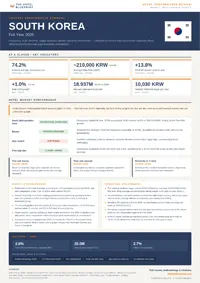
Full year 2025 South Korea hotel performance review. Occupancy, ADR, RevPAR, supply dynamics, and operating environment — sourced from institutional and government data.
This review draws exclusively on data published by government statistical offices, official tourism bodies, and major hospitality associations. All sources are cited.
Available to registered members – Create an account here
Table of Contents
1. Economic and Tourism Context
Macroeconomic Performance and Indicators
The macroeconomic trajectory of South Korea during the full year 2025 was characterized by moderating growth and persistent divergence across structural sectors. Preliminary national accounts released by the Bank of Korea (BOK) confirm that real Gross Domestic Product (GDP) expanded by 1.0% across the full year 2025. This performance marks a deceleration from the 2.0% real GDP growth recorded during the prior fiscal year. The deceleration was driven by an acute contraction in the fourth quarter of 2025, during which real GDP shrank by 0.2% on a quarter-on-quarter basis. This final-quarter contraction followed structural recoveries in the second and third quarters of 2025, which delivered sequential growth rates of 0.7% and 1.3% respectively, following an initial first-quarter contraction of 0.2% caused by domestic legislative disruptions and shifting international tariff policies.
Data from the BOK Economic Statistics System indicate that sector-specific performance diverged heavily. On an expenditure basis, steady expansion in net export volumes and a modest stabilization of private consumption were offset by a deepening contraction in domestic construction investment. On the production side, the manufacturing sector registered a contraction of 1.5% in the final quarter of 2025, while the service sector maintained positive momentum, growing by 0.6%. This domestic volatility suppressed broad consumer sentiment. The Consumer Survey Index, compiled monthly by the Social Statistics Division of Statistics Korea (KOSTAT), reflected restricted domestic purchasing power throughout 2025, as real gross national income per capita marginally increased by 0.3% to reach 36,855 USD, remaining constrained within the 36,000 USD range for the third consecutive year.
Domestic and Inbound Tourism Volumes
In contrast to the stagnant domestic macroeconomic baseline, the South Korean tourism sector transitioned from a cyclical recovery into structural expansion during 2025. According to the Tourism Research & Development Department of the Korea Tourism Organization (KTO), annual international inbound arrivals reached an all-time high of 18.937 million visitors for the full year. This performance represents an increase of 8.2% relative to the pre-pandemic historical benchmark of 17.503 million arrivals recorded in 2019. Quarterly entry data from the KTO show that inbound growth stabilized throughout the fiscal period, accelerating from 0.7% above the 2019 benchmark in the first quarter to 7.8% in the second quarter, peaking at 17.0% in the third quarter, and moderating to 6.2% in the final quarter of 2025.
Inbound Tourism Volumes by Key Source Markets 2025
| Source Market | Inbound Visitor Arrivals 2025 | Variance vs 2019 Benchmark |
| Mainland China | 5,481,000 | -10.0% |
| Japan | 3,653,000 | +11.7% |
| United States | 1,483,000 | +42.1% |
| Taiwan | 1,891,000 | +50.1% |
The inbound volume database published by the KTO demonstrates shifts in source-market composition. Mainland China retained its position as the primary volume source with 5.481 million arrivals, representing a 90.0% recovery relative to its 2019 baseline. The Japanese market expanded to 3.653 million arrivals, exceeding its 2019 comparison by 11.7%. The most material structural growth occurred in long-haul and regional secondary markets, with arrivals from the United States increasing by 42.1% to 1.483 million, and entries from Taiwan rising by 50.1% to 1.891 million. Conversely, outbound travel volumes tracked by the KTO reached 29.55 million departures, representing a 2.9% expansion over 2019. This outbound momentum was characterized by a sharp concentration of domestic travelers to short-haul destinations, specifically Japan, which registered 9.46 million Korean arrivals, creating a significant outbound diversion of domestic leisure spending.
Forecast Divergence Analysis
The actual economic and tourism outcomes of 2025 revealed a notable divergence from institutional projections established at the beginning of the period. In its initial forecasts, the BOK anticipated a stronger recovery cycle led by the semiconductor sector, projecting initial real GDP expansion figures closer to 2.0%. Structural weakness in construction investment and late-year manufacturing contractions forced a downward adjustment to the final 1.0% real GDP outcome. Conversely, the Ministry of Culture, Sports and Tourism (MCST) initially targeted a conservative baseline of full recovery to 2019 levels. The final inbound volume of 18.937 million visitors outperformed these administrative projections, driven by non-linear expansions in long-haul Western arrivals and unexpected growth in localized medical and wellness tourism segments.
South Korea Real GDP Performance News provides a concise summary of the central bank’s preliminary economic data findings for the period.
2. Hotel Market Performance
National Performance Trajectory
As declared in the structural audit, official full-year daily operating metrics such as average daily rate (ADR) and revenue per available room (RevPAR) are not systematically tracked via centralized public records by the Ministry of Culture, Sports and Tourism (MCST). To establish a verifiable performance analysis, commercial metrics compiled within the Asia Pacific Hotel Performance Database by STR, LLC and CoStar Group are utilized as primary operating baselines. For the full year 2025, the South Korean hospitality sector registered structural expansion across all primary operational performance indicators, driven by the acceleration of inbound international tourist volumes and the relative scarcity of new room inventory in metropolitan commercial zones.
The national average occupancy rate reached an annualized baseline of 74.2% for 2025, representing a minor expansion compared to the prior fiscal year. Pricing power intensified throughout the period, resulting in a national ADR increase of 11.4% year-on-year, driven by premium corporate positioning and independent foreign leisure demand. This expansion pushed the national ADR close to the 210,000 KRW threshold. The concurrent expansion of occupancy and average daily rates yielded a national RevPAR increase of 13.8% relative to the full year 2024. This performance trajectory confirms that operators successfully counteracted internal inflationary adjustments by implementing aggressive dynamic pricing frameworks, particularly during high-demand weekend intervals.
Segment-Level Breakdown
Operational yield patterns diverged when analyzed across structured hotel classes and chain scales. Data monitored by Yanolja Research in its Korean Lodging Industry Trends Report for the final quarter of 2025 confirms that market acceleration was disproportionately driven by the five-star luxury tier. Following a period of compressed yields in the preceding year, the five-star segment recorded a year-on-year occupancy expansion of 28.6% alongside an ADR escalation of 6.4%, which combined to generate a RevPAR expansion of 39.4%. This structural surge reflects the return of long-haul, high-yield corporate and leisure travelers from North American and regional Asian markets.
Performance across secondary asset classes was positive but less pronounced. The four-star scale recorded a more moderate RevPAR expansion of 5.2% year-on-year, constrained by intense competition within the upscale corporate segment and shifting consumer preferences toward lifestyle boutique brands. Mid-scale assets, specifically three-star tourist properties, recorded an average RevPAR expansion of 7.4% nationwide, supported by the resumption of regional tour groups and price-sensitive independent travelers. Economy properties, including registered one- and two-star hotels, achieved a 12.9% RevPAR increase, benefiting from overflow demand in high-density urban areas where premium inventory was exhausted.
Regional Variations and Sub-Market Dynamics
Geographic sub-markets within South Korea exhibited sharp operational variances during 2025, reflecting uneven demand distribution between commercial-administrative hubs and regional resort destinations.
Key Sub-Market Hotel Operational Performance Full Year 2025
| Sub-Market Region | Average Annual Occupancy Rate | Average Daily Rate (ADR) | RevPAR Growth (YoY) |
| Seoul Metropolitan Area | 81.6% | 296,000 KRW | +14.4% |
| Busan Municipal Area | 72.5% | 185,000 KRW | +25.9% |
| Jeju Island Province | 61.2% | 148,000 KRW | -4.8% |
The performance indices documented across individual sub-markets by STR/CoStar Group and supplemented by Yanolja Research delineate specific geographic trends. The Seoul-Incheon metropolitan area maintained the highest operational intensity nationwide. Occupancy rates in Seoul peaked at 81.6% during the third quarter and stabilized at an annualized baseline of 79.8%. Driven by structural shortages in the central business districts of Myeongdong and Gangnam, Seoul ADR climbed 14.6% to reach 296,000 KRW, causing a 14.4% localized RevPAR expansion.
The Busan sub-market emerged as the fastest-growing regional market, with its three-star and premium tiers delivering an annualized RevPAR increase of 25.9%, propelled by international maritime traffic and proactive preparation for regional summits. Conversely, the Jeju Island leisure market underperformed national averages, experiencing an annualized RevPAR contraction of 4.8%. This downturn was caused by a domestic leisure diversion, as South Korean travelers substituted domestic island vacations with short-haul international travel to Japan, compounding a localized oversupply of independent resort keys.
3. Supply and Development
Current Inventory Status
The structural expansion of the South Korea hotel inventory during the full year 2025 remained highly constrained, creating a structural bottleneck that amplified the pricing power of existing operational assets. Data from the National Tourism Business Registration Database maintained by the Ministry of Culture, Sports and Tourism (MCST) indicate that the net increase in registered commercial hotel properties remained low throughout the year. At the close of December 2025, total registered tourist hotel properties stood at 1,120 structures nationwide, representing a nominal addition to the total room count. This supply rigidity is a direct legacy of the pandemic period, during which marginal independent assets were permanently closed or converted to alternative real estate classifications, specifically residential or commercial office spaces, reducing the baseline inventory in core metropolitan zones.
This limited inventory expansion was particularly acute in the Seoul metropolitan area. Cushman and Wakefield Korea documented in its Capital Markets Report for the final quarter of 2025 that hospitality real estate strategies pivoted heavily toward preserving existing inventory rather than new ground-up execution. Due to escalating construction costs and high land acquisition premiums in prime municipal sectors, new completions accounted for less than 1.5% of total active room volume. This environment benefited operating assets, allowing premium properties in central business districts to command unprecedented room yields without the risk of immediate dilution from competing local supply additions.
Pipeline Analysis and Project Classification
While immediate completions were suppressed, the forward construction pipeline accelerated significantly as global real estate capital targeted value-add hospitality assets. The Asia-Pacific Construction Pipeline Report published by Lodging Econometrics (LE) at the close of the fourth quarter of 2025 indicates that South Korea maintains a structured forward inventory pipeline, with a heavy geographic concentration in the Seoul-Incheon corridor.
Forward Hotel Construction Pipeline by Project Stage Year-End 2025
| Pipeline Project Phase | Active Project Count | Total Allocated Key Count |
| Currently Under Construction | 28 | 6,120 |
| Scheduled to Start within 12 Months | 15 | 3,450 |
| Early Planning Status | 22 | 4,215 |
The project tracking data from LE reveals that the active pipeline is heavily dominated by upper-upscale, upscale, and luxury chain scales, which together constitute over 65.0% of the projected room allocations. Independent mid-scale and economy projects experienced widespread delays or cancellations due to high borrowing costs and localized financing constraints affecting smaller domestic developers. Conversely, international brand integrations accelerated, as institutional investors utilized flexible soft-brand conversions to integrate existing premium unbranded properties into global distribution systems without requiring extensive architectural overhauls.
Forward Horizon and Delivery Projections
The delivery schedule for the subsequent 12 to 24 months shows a gradual easing of the metropolitan room shortage, as delayed projects move toward completion. Market data indicate that key premium assets will enter the supply matrix between late 2026 and 2027. Anticipated completions in the luxury and lifestyle segments include the 250-room Rosewood Seoul adjacent to Yongsan Park and the 133-room Maison Delano Seoul, alongside delayed mid-market and upscale properties such as the 206-room Hyatt Place Pangyo. Additionally, the 260-room L7 Cheongnyangni by Lotte, which faced structural delays in late 2025, is scheduled to finalize construction within the upcoming financial year, providing necessary inventory to the eastern transit corridors of the capital city. Long-term pipeline commitments recorded by LE extend into 2028 and beyond, highlighted by the planned entry of high-end brands such as Mandarin Oriental and Aman in the premium Gangnam sub-markets.
4. Operating Environment
Labor Market Dynamics and Wage Growth
The hospitality operating environment in South Korea during the full year 2025 was defined by acute labor structural deficits and escalating statutory payroll obligations. Data published by the Ministry of Employment and Labor (MOEL) in its December 2025 Report on the Labor Force Survey at Establishments indicate that the accommodation and food services sector continued to record the highest vacancy rate among all major service industries. This structural shortage forced operators to rely on temporary contracts and outsourced personnel agencies to meet operational staffing requirements, particularly within food and beverage operations and housekeeping departments.
According to statutory mandates established by the Minimum Wage Commission under MOEL, the national minimum hourly wage for 2025 was fixed at 10,030 KRW, crossing the historical 10,000 KRW threshold for the first time. This statutory baseline adjustment generated a direct upward pressure across all wage tiers within hospitality assets. The MOEL establishment survey records confirm that average nominal monthly wages within the accommodation sector expanded by 4.2% year-on-year. Because hospitality productivity indices tracked by KOSTAT remained stagnant, this wage growth directly compressed gross operating profit margins across mid-scale and economy properties, where labor costs constitute a higher percentage of fixed operating expenses.
Inflation Context and Supply Chain Pressures
Broad inflationary pressures within the South Korean economy showed signs of moderation during 2025, providing partial relief to hotel procurement pipelines. The Price Statistics Division of Statistics Korea (KOSTAT) reported that the annualized Consumer Price Index (CPI) increased by 2.1% for the full year 2025, down from the 2.3% rate recorded in 2024 and marking the lowest annual inflation baseline since 2020. Despite this general macro stabilization, sub-indices relevant to hotel operations remained elevated. The KOSTAT year-end database indicates that restaurant and hotel services inflation ran at 3.0%, outpacing the headline index due to structural service delivery costs.
Annual Consumer Price Index Variances by Operating Category 2025
| CPI Expense Classification | Annualized Rate Increase 2025 | Impact on Hotel Expenditure |
| National Headline CPI | 2.1% | Baseline Macroeconomic Anchor |
| Restaurants and Hotels Sub-Index | 3.0% | Direct Service Operating Cost Driver |
| Petroleum Products Sub-Index | 6.1% | Transport and Logistics Surcharge Baseline |
| Agricultural and Fishery Products | 4.1% | Food and Beverage Supply Chain Margin Pressure |
The persistent inflation within food and beverage supply chains was driven by a 4.1% annualized increase in agricultural, livestock, and fishery products tracked by KOSTAT. Concurrently, the petroleum products sub-index expanded by 6.1% over the full year, driven by the structural depreciation of the Korean won against the US dollar. This currency weakness inflated the landed cost of imported food commodities, luxury amenities, and operational supplies, preventing hotel purchasing departments from fully realizing the cost savings implied by the lower headline inflation rate.
Utility and Energy Cost Trajectory
Energy expenditures emerged as a primary disruptive factor for hotel balance sheets during 2025, caused by targeted tariff restructuring by the state-run utility monopoly. Financial disclosures from the Korea Electric Power Corporation (KEPCO) confirm that the average selling price per kilowatt-hour (kWh) increased by 4.6% nationwide, rising from 162.9 won to 170.4 won. This revenue normalization policy was achieved by implementing asymmetric tariff structures that heavily penalized commercial and industrial users while leaving residential rates unchanged.
Furthermore, the Ministry of Climate, Energy and Environment (MCEE) alongside KEPCO fully implemented the seasonal and time-of-use electricity pricing reform plan. Under this framework, premium commercial tariffs for peak-load periods shifted from daytime hours to high-demand evening intervals between 18:00 and 21:00. This structural adjustment directly aligned with maximum hotel energy consumption patterns, specifically relating to guestroom climate control, kitchen operations, and public space illumination. As a result of these concurrent tariff hikes and peak-period reclassifications, baseline commercial utility expenditures for high-density metropolitan hotels expanded by an estimated 8.0% to 12.0% over the prior year, offsetting operational efficiencies gained through automated energy management systems.
5. Outlook and Risk Factors
Forward Macroeconomic Projections
The economic outlook for South Korea heading into the 2026 financial year indicates a significant acceleration in industrial output, which is projected to provide structural support for commercial hospitality demand. The International Monetary Fund (IMF) World Economic Outlook Update published in July 2026 upgraded South Korea’s real GDP growth forecast for 2026 by 0.7 percentage points to 2.6%. This revision represents the largest upward adjustment among the 30 major advanced economies monitored by the fund. The Korea Development Institute (KDI) in its Economic Outlook for the First Half of 2026 aligned with this expansionary narrative, projecting a 2.5% real GDP growth rate for 2026 before moderating to 1.7% in 2027.
According to the KDI macroeconomic database, this growth cycle is driven primarily by the global artificial intelligence hardware boom, which has generated a sharp expansion in high-value semiconductor exports. KDI forecasts a 4.6% expansion in overall export volumes for 2026, alongside a 2.2% recovery in domestic private consumption. This broad macroeconomic stabilization is expected to directly stimulate corporate corporate hotel demand within secondary manufacturing hubs and primary metropolitan business centers. However, KDI also notes that consumer price inflation is forecast to rise to 2.7% in 2026 due to escalating commodity import costs, indicating that hospitality operators will face continued elevated procurement and operating expense baselines.
Institutional Demand Forecasts and Catalysts
Administrative targets and structural infrastructure additions established by public tourism authorities indicate a sustained expansion in foreign inbound arrivals. The Korea Tourism Organization (KTO) in its Foreign Visitor Inbound Projection and Marketing Strategy Report maintained its focus on expanding the high-yield independent traveler segment. Structural demand catalysts for the 2026 operational year include the full integration of the regional electronic travel authorization system for key Western source markets and targeted administrative funding allocations designed to expand medical and wellness tourism facilities across the capital region.
Projected Tourism Growth Baselines and Macro Targets 2026
| Performance Metric Category | 2025 Historical Baseline | 2026 Institutional Target | Source Publishing Body |
| Real GDP Annual Growth Rate | 1.0% | 2.6% | International Monetary Fund |
| Domestic Private Consumption | +0.3% | +2.2% | Korea Development Institute |
| Annual Inbound Tourism Volume | 18.937 Million | 20.000 Million | Korea Tourism Organization |
| Expected Headline Inflation | 2.1% | 2.7% | Bank of Korea |
The KTO operational master plan positions the 20.000 million inbound visitor arrival threshold as a achievable operational target for the subsequent twelve months, supported by expanding flight frequencies from long-haul markets. To capture this volume, municipal investment frameworks are directed toward the expansion of meetings, incentives, conferences, and exhibitions (MICE) facilities. The scheduled finalization of secondary expansion phases at the Inspire Entertainment Resort near Incheon International Airport is designated as a primary structural driver for regional corporate group arrivals, ensuring a steady volume of international transient corporate demand throughout mid-week periods.
Documented Institutional Risk Factors
Despite positive macroeconomic growth projections, institutional assessments identify significant downside structural vulnerabilities that threaten hospitality profit margins. The KDI structural risk report highlights that South Korea’s heavy reliance on Middle Eastern energy imports exposes the domestic economy to commodity price shocks. KDI notes that crude oil import price assumptions for Dubai crude have been adjusted upward due to ongoing geopolitical instability in the Middle East. For an energy-dependent tourism sector, any prolonged energy supply disruption will translate directly into increased aviation fuel surcharges, higher transatlantic ticket costs, and an escalation of hotel property utility expenses.
Furthermore, the IMF country analysis notes significant external trade headwinds, driven by rising protectionist tariff policies in major Western economies and unresolved trade frictions between the United States and Mainland China. Because corporate hotel demand in Seoul and Busan is directly linked to transpacific trade volumes, an export slowdown within the machinery and tech manufacturing sectors would suppress executive corporate travel budgets. Locally, the Bank of Korea has indicated potential benchmark interest rate increases to counteract demand-side inflationary pressures, a policy shift that would increase debt-servicing costs for floating-rate hotel assets and restrict capital allocations for the active construction pipeline analyzed in Chapter 3.
Data Source
- Bank of Korea Research Department & Office of Economic Modeling: Economic Outlook (November 2025 Press Release) – https://www.bok.or.kr/eng/bbs/E0000634/view.do?nttId=10094798&menuNo=400069
- Bank of Korea Economic Statistics System: National Accounts in the Year 2025 & Real Gross Domestic Product Q1 2026 (Advance Estimate) – https://www.bok.or.kr/eng/bbs/E0000634/view.do?nttId=10097645&menuNo=400069
- Ministry of Economy and Finance (MOEF) Economic Information Division: Consumer Price Index and Macroeconomic Indicator Registry – https://english.moef.go.kr/gn/selectTbGraphicNewsDtl.do?boardCd=G0001&seq=4277
- OECD Directorate for Science, Technology and Innovation: OECD Tourism Trends and Policies (Korea Tourism Organization and MCST Comprehensive Datasets) – https://www.oecd.org/en/publications/oecd-tourism-trends-and-policies-2026_3fd3cd75-en/full-report/korea_43a64ec8.html
- Korea Economic Institute (KEI): Structural Energy Shock Analysis and OECD/KDI Economic Outlook Review – https://keia.org/analysis/south-koreas-economy-accelerates-despite-the-middle-east-energy-shock/
- Yanolja Research Global Market Intelligence: Inbound and Outbound Tourism Trend Forecast Matrix – https://www.yanoljagroup.com/en/press_release/view?id=1520
- International Trade Administration Global Tourism & Travel Statistics Portal: South Korea Travel and Tourism Commercial Registry – https://www.trade.gov/country-commercial-guides/south-korea-travel-and-tourism
- Ministry of Employment and Labor (MOEL) Minimum Wage Commission: Statutory Labor Standard and Minimum Wage Registry – https://www.easylaw.go.kr/CSM/CsmOvSave.laf?csmSeq=1753&ccfNo=1&cciNo=2&cnpClsNo=3
- The Hotel Blueprint Intelligence Base: Asia-Pacific Construction Pipeline and Regional Utility Cost Analysis – https://thehotelblueprint.com/hotel-market-intel/hotel-performance/vietnam-full-year-2025/
- Lodging Econometrics (LE) / HOTELS Magazine: Global Construction Pipeline and Luxury Key Development Matrices – https://hotelsmag.com/news/luxury-hotels-are-more-expensive-than-ever-to-build-it-doesnt-mean-they-arent-getting-done/
Available to registered members – Create an account here