



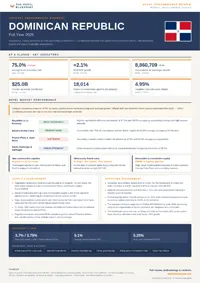
Full year 2025 Dominican Republic hotel performance review. Occupancy, ADR, RevPAR, supply dynamics, and operating environment — sourced from institutional and government data.
This review draws exclusively on data published by government statistical offices, official tourism bodies, and major hospitality associations. All sources are cited.
Available to registered members – Create an account here
Table of Contents
1. Economic and Tourism Context
The macroeconomic trajectory of the Dominican Republic during the full year 2025 was defined by moderation in productive output relative to historical trends, balanced by expansion in the international tourism segment. Data published by the Banco Central de la República Dominicana (BCRD) in its report titled Resultados Preliminares de la Economía Dominicana indicates that the real Gross Domestic Product (GDP) recorded an annual growth rate of 2.1 percent for 2025. This outcome represents a clear divergence from the macroeconomic projections established at the beginning of the fiscal period by institutions such as the International Monetary Fund (IMF), which had anticipated a GDP expansion exceeding 5.0 percent. The central bank attributed this lower-than-expected expansion to global liquidity restrictions and heightened external uncertainty, which directly impacted private fixed investment and constrained public capital expenditure. In response to this cooling domestic demand, the monetary authority systematically reduced its benchmark monetary policy rate by 50 basis points during the latter portion of the year, bringing the interest rate to 525 basis points by December 2025 to stimulate credit channels.
While domestic industrial and construction sub-sectors faced contractionary conditions, the external tourism sector provided the primary structural buffer for the national economy. According to the full-year figures compiled in the Informe del Flujo Turístico 2025 published by the BCRD, a total of 8860709 non-resident passengers arrived in the country via international air transport. This represents an absolute increase of 325008 international airline tourists compared to the prior calendar year, yielding a positive annual relative variation of 3.8 percent. Within this inbound demographic, non-resident foreign nationals accounted for 82.9 percent of the market share with 7341745 arrivals, whereas non-resident Dominican nationals returning to the country accounted for the remaining 17.1 percent with 1518964 arrivals. Geographic distribution analysis indicates that North America retained its position as the dominant source market, contributing 62.3 percent of the aggregate foreign non-resident volume, followed by South America at 18.9 percent and Europe at 12.5 percent.
Inbound Non-Resident Air Passenger Arrivals
| Year | Non-Resident Foreign Nationals | Non-Resident Dominican Nationals | Total Non-Resident Passengers | Year-on-Year Variation (%) |
| 2023 | 6751227 | 1307444 | 8058671 | 12.6 |
| 2024 | 7165479 | 1370222 | 8535701 | 5.9 |
| 2025 | 7341745 | 1518964 | 8860709 | 3.8 |
The preceding data from the BCRD statistical series demonstrates the progressive decelerating growth rate in air arrivals over a three-year timeline despite reaching absolute volume records. Beyond air transport, the total inbound tourism volume was heavily augmented by maritime cruise arrivals. Parallel reporting from the Ministerio de Turismo (MITUR) notes that when combining both air arrivals and sea-based cruise passengers, total visitor arrivals for the full year 2025 reached historical thresholds, directly correlating with a total economic contribution of approximately 25 billion dollars. This performance placed the aggregate economic weight of the tourism sector at roughly 18 percent of total Dominican GDP when incorporating the secondary impacts of foreign direct investment.
2. Hotel Market Performance
Operational indicators for the hospitality infrastructure in the Dominican Republic during the full year 2025 experienced a marginal correction in volumetric utilization, primarily influenced by the accelerated expansion of the national lodging inventory. According to the Boletín de Estadísticas Macroeconómicas y Sectoriales Enero-Diciembre 2025 compiled by the Oficina Nacional de Estadística (ONE), the national average hotel occupancy rate settled at 75.0 percent. This baseline volume represents a net negative absolute variation of 1.4 percentage points when compared to the corresponding previous fiscal year, where the consolidated national occupancy average reached 76.4 percent. Institutional analysis performed by the statistical agency indicates that this minor contraction does not correspond to a reduction in gross traveler demand, but rather identifies a temporary structural compression as the market absorbs thousands of newly commissioned hotel keys across primary resort corridors.
Granular geographic reporting managed under the Sistema de Inteligencia Turística (SITUR) by the Ministerio de Turismo (MITUR) indicates significant structural deviation between regional sub-markets, showing that established vacation corridors significantly outperformed traditional urban or secondary coastal environments. The southeastern resort enclave of Bayahíbe recorded the highest operational efficiency nationwide, maintaining annualized occupancy limits near 87.0 percent during core high-season intervals. The adjacent destination of La Romana sustained a similar operational performance at 86.0 percent. The primary tourism node of the republic, the Bávaro-Punta Cana region, which commands more than 70 percent of the absolute international visitor arrival share, registered an average occupancy rate of 82.0 percent. Conversely, secondary coastal sub-markets and urban commercial hubs reported much lower inventory utilization rates. The Juan Dolio-Boca Chica corridor recorded an average occupancy rate of 64.0 percent, whereas the northern coastal province of Puerto Plata registered 57.0 percent. Urban business centers exhibited stagnant performance metrics, with the Gran Santo Domingo area and Santiago registering identical average occupancy baselines of 55.0 percent. Emerging or specialized ecotourism zones such as Samaná-Las Terrenas and Miches recorded the lowest operational density, settling at 54.0 percent and 33.0 percent respectively.
Hotel Occupancy Rate by Tourism Zone
| Tourism Zone | Occupancy Rate (%) |
| Bayahíbe | 87.0 |
| La Romana | 86.0 |
| Bávaro-Punta Cana | 82.0 |
| Juan Dolio – Boca Chica | 64.0 |
| Puerto Plata | 57.0 |
| Greater Santo Domingo | 55.0 |
The preceding localized data published by MITUR outlines the clear operational imbalances between the dominant southeastern resort infrastructure and the rest of the domestic destination layout. In terms of financial performance indicators, including Average Daily Rate (ADR) and Revenue Per Available Room (RevPAR), official systematic datasets from government agencies remain partial or unverified for the full twelve-month period of 2025. Data provided by secondary commercial tracking institutions, specifically STR, indicates that the broader Caribbean premium tier operated within an ADR range of 180 dollars to 350 dollars, with the Dominican Republic luxury and upper upscale all-inclusive properties commanding the upper boundary of this performance scale due to strong international leisure travel demand from North American source markets.
3. Supply and Development
The hotel asset inventory of the Dominican Republic expanded during the full year 2025, maintaining its position as the primary recipient of physical hospitality investments within the Caribbean basin. According to data published by the corporate real estate intelligence firm Lodging Econometrics (LE) in its Q3 2025 Latin America Construction Pipeline Trend Report, the registered hotel construction pipeline for the Dominican Republic reached a record total of 81 active projects encompassing 17351 rooms. This volume constitutes a 37.0 percent increase in absolute project counts and a 20.0 percent expansion in available guestroom volume relative to the corresponding prior calendar period. By the conclusion of the fiscal cycle, this growth trajectory was maintained, with tracking registries from LE indicating that the nation closed the period with 84 pipeline projects representing 18014 rooms under development, establishing the country as the third largest market pipeline in Latin America behind Mexico and Brazil.
Geographic concentration indices indicate that structural deployment remains focused on the eastern coast, though significant diversification is emerging in premium and frontier ecotourism nodes. The Bávaro-Punta Cana and Cap Cana sub-markets consolidated approximately 4200 of the near-term pipeline rooms, emphasizing the continued commercial preference for established deep-water coastal corridors. In parallel, official registry monitoring from the Ministerio de Turismo (MITUR) highlights a strategic pivot toward the ultra-luxury and branded residential segments. This shift is characterized by the integration of international upscale and luxury chain scales into regions previously dominated by unbranded or regional midscale all-inclusive operations. Major international brands, including Hyatt Hotels Corporation, confirmed pipeline expansions targeting late 2026 execution, such as the 500-room Hyatt Vivid Punta Cana and the 406-room Secrets Macao Beach Punta Cana. Furthermore, institutional reports from MITUR indicate the formal entry of premium global luxury footprints, including St. Regis, Ritz-Carlton, and Four Seasons, into the national development grid.
Hotel Construction Pipeline Structure — Q3 2025
| Development Indicator | Project Count | Room Volume | Year-on-Year Project Variation (%) |
| Dominican Republic | 81 | 17351 | 37.0 |
| Mexico | 264 | 40412 | — |
| Brazil | 123 | 16272 | 19.0 |
The preceding localized matrix derived from the LE regional construction database positions the relative scale of the Dominican hospitality pipeline against major Latin American economies during the second half of 2025. Beyond new structural foundations, asset management strategies within the territory relied heavily on property modernizations and corporate brand conversions. Institutional registries noted that combined Latin American renovation and conversion activity reached 173 projects accounting for 29200 rooms by the final quarters of 2025, with major Dominican operations executing high-capital asset upgrades to sustain premium Average Daily Rates. Notable projects completed during the period include the 52 million dollar infrastructure modernization and segment repositioning of the Grand Palladium Bávaro, alongside a 48 million dollar comprehensive structural renovation of the Globalia hotel asset located in the Santo Domingo metropolitan perimeter. Forward-looking pipeline projections issued by LE analysts indicate a sustained commissioning cycle, with 104 new properties totaling 17934 rooms forecast to enter physical operations across the broader regional sector during the immediate 12-month horizon.
4. Operating Environment
The structural conditions dictating the hospitality operational footprint in the Dominican Republic throughout the full year 2025 were characterized by rising service-sector input inflation paired with tightening conditions within the domestic labor market. Data derived from the monthly Índice de Precios al Consumidor (IPC) framework published by the Banco Central de la República Dominicana (BCRD) indicates that the annualized consumer price inflation rate closed the year 2025 at 4.95 percent. While the general macroeconomic inflation basket remained marginally within the central bank long-term target boundary of 4.0 percent plus or minus 1.0 percent, the localized sector inflation for the Restaurants and Hotels division experienced pronounced upward variance. The annualized inflation index for the accommodation and food service segment accelerated to 6.52 percent by December 2025. Statistical updates published subsequently by institutional aggregators confirm this momentum continued immediately into the opening weeks of the next cycle, with segment price levels climbing to 6.97 percent by January 2026. This trend was primarily driven by consecutive price increases in core intermediate agricultural goods, including fresh poultry and starch inputs, alongside escalating utility fees.
Labor utilization frameworks during the identical fiscal cycle reflected significant operational pressures for corporate employers, driven by expanding physical asset capacities across resort corridors. According to the Encuesta Nacional Continua de Fuerza de Trabajo (ENCFT) issued within the Boletín Trimestral del Mercado Laboral by the BCRD, the aggregate national unemployment rate dropped to an annualized average of 5.09 percent for 2025, down from the 5.31 percent metric registered at the close of 2024. During the mid-year operational expansion, total employed headcount across the combined formal and informal markets reached a historic threshold of 5123548 individual workers. A comparative analysis of this labor expansion shows an asymmetric structural shift toward formal employment contracts. During the second quarter of 2025, formal enterprise payrolls absorbed 164598 new workers nationwide, whereas informal employment channels contracted by 43434 positions, compressing the net national informality rate down to 54.0 percent of the active workforce relative to the 56.1 percent mark from the parallel prior period.
Quarterly Evolution of the Labor Market and National Employment
| Measurement Period | Total Employed Population | Open Unemployment Rate (%) | Informality Rate (%) |
| Q2 2024 | 5002384 | 5.3 | 56.1 |
| Q2 2025 | 5123548 | 5.0 | 54.0 |
The preceding localized data points from the ENCFT systematic series highlight the expanding scale of formal employment structures against a dropping open unemployment baseline during the peak construction cycles of 2025. This structural transition toward formalized labor registries, combined with legal indexation requirements, placed upward pressure on corporate labor outlays. Institutional adjustments enacted by the Comité Nacional de Salarios under the Ministerio de Trabajo pushed minimum wage baselines across private-sector categories, driving the regulated minimum wage threshold to 16993.20 Dominican Pesos per month by early 2026. This legislative change forced hotel asset managers to adjust entry-level compensation matrices to maintain retention margins within competitive tourism provinces like Altagracia and La Romana.
5. Outlook and Risk Factors
Forward performance matrices for the hospitality asset class in the Dominican Republic point toward a measured stabilization of the wider macroeconomic container, framed by persistent exogenous and domestic operating vulnerabilities. Projections released by the International Monetary Fund (IMF) within its World Economic Outlook database outline a central real Gross Domestic Product (GDP) growth forecast of 3.7 percent for the country. This systemic expectation aligns directly with the official consensus frameworks established by the Ministerio de Hacienda and the Banco Central de la República Dominicana (BCRD) in their joint publication titled Panorama Macroeconómico 2026-2030, which positions expected real GDP expansion within a band of 3.5 percent to 4.0 percent, settling on a central baseline projection of 3.75 percent.
Macroeconomic Indicator Projections — Forecast Horizon
| Institutional Indicator | Estimate (%) | Information Source |
| Real GDP Growth | 3.7 | International Monetary Fund |
| Real GDP Growth | 3.75 | Ministry of Finance / BCRD |
| Average Inflation Rate | 5.1 | International Monetary Fund |
The structural forecasts compiled in the preceding cross-institutional ledger indicate a partial rebound in domestic fixed investments following the liquidity cooling observed during the previous twelve-month period. Parallel monitoring parameters detailed in the Informe de Política Monetaria issued by the BCRD indicate that the monetary authority intends to maintain its benchmark policy reference rate at 5.25 percent to ensure the eventual convergence of consumer prices back toward the permanent target corridor of 4.0 percent plus or minus 1.0 percent. The IMF, however, anticipates average consumer price growth to hover around 5.1 percent during the immediate projection period, reflecting the lingering pressure of pass-through supply chain costs into localized commercial operations.
Risk matrices structured by institutional observers highlight multiple documented hazards that could disrupt the projected operational margins of domestic hotel portfolios. Analysis published by the BCRD notes that the primary downside risks to economic growth include heightened regional geopolitical conflicts—specifically centering on instability in the Middle East and energy corridors—which threaten to generate secondary supply shocks on fuel structures and global air transport logistics. On the domestic front, institutional evaluations touch on the complex operational balance concerning fiscal frameworks. Structural reviews from regional financial analysts note that foreign investor and lender confidence remains tied to the execution of long-debated domestic fiscal changes, including targeted spending revisions and revenue optimization measures, which were previously deferred by administrative planners. For hotel operators, these documented risk factors are anticipated to manifest as sustained overhead costs across the energy and logistics layers, making strict cost-containment frameworks critical for protecting gross operating profit per available room metrics across primary coastal and metropolitan destinations.
Data Source
- Informe del Flujo Turístico (Enero – Diciembre 2025): https://cdn.bancentral.gov.do/documents/publicaciones-economicas/informe-del-flujo-turistico/documents/informe_turistico2025-12.pdf
- El flujo turístico hacia RD sumó 25,000 millones de dólares a la economía en 2025: https://www.mitur.gob.do/noticias/el-flujo-turistico-hacia-rd-sumo-25000-millones-de-dolares-a-la-economia-en-2025
- Boletín de Estadísticas Macroeconómicas y Sectoriales Enero-Diciembre 2025: https://www.one.gob.do/publicaciones/2026/boletin-de-estadisticas-macroeconomicas-y-sectoriales-enero-diciembre-2025/?altTemplate=publicacionOnline
- Boletín Trimestral del Mercado Laboral / Encuesta Nacional Continua de Fuerza de Trabajo (ENCFT): https://cdn.bancentral.gov.do/documents/publicaciones-economicas/boletin-trimestral-del-mercado-laboral/documents/Boletin_Trimestral_Mercado_Laboral_abr-jun_2025.pdf
- Panorama Macroeconómico 2026-2030 (Edición Junio 2026): https://www.hacienda.gob.do/wp-content/uploads/2026/06/Panorama-Macroeconomico-2026-2030-junio-2026_compressed.pdf
- World Economic Outlook Database, April 2026: https://www.imf.org/en/publications/weo/issues/2026/04/14/world-economic-outlook-april-2026
- Resultados Preliminares de la Economía Dominicana al cierre de 2025: https://www.bancentral.gov.do/a/d/6492-resultados-preliminares-de-la-economia-dominicana-al-cierre-de-2025
- Sistema de Inteligencia Turística (SITUR) – Ocupación Hotelera Consolidada: https://situr.mitur.gob.do/#/archivos/ocupacion
- Resolución sobre Salario Mínimo del Sector Privado No Sectorizado: https://mt.gob.do/transparencia/index.php/resoluciones-comite-nacional-de-salarios
- Latin America Hotel Construction Pipeline Trend Report (Lodging Econometrics): https://lodgingeconometrics.com/latin-america-hotel-construction-pipeline-trend-report-q3-2025/
- Global Hospitality Performance Registries and Caribbean Industry Insights (STR / CoStar): https://str.com/press-release/str-caribbean-hotel-performance-analysis-full-year
Available to registered members – Create an account here