


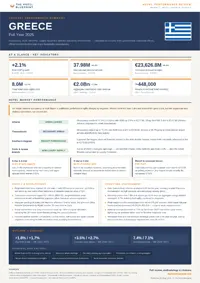
Full year 2025 Greece hotel performance review. Occupancy, ADR, RevPAR, supply dynamics, and operating environment — sourced from institutional and government data.
This review draws exclusively on data published by government statistical offices, official tourism bodies, and major hospitality associations.
Available to registered members – Create an account here
Table of Contents
1. Economic and Tourism Context
According to the provisional national accounts published by the Hellenic Statistical Authority (ELSTAT) in March 2026, the real Gross Domestic Product (GDP) of Greece expanded by 2.1% across the full year of 2025. This rate of expansion represents a deceleration from the 2.4% growth target originally established in the Ministry of National Economy and Finance State Budget documentation submitted in late 2024. The difference between initial projections and the final full-year realization is primarily attributed to a sharp contraction in public consumption during the first half of the year, alongside a net trade deficit expansion driven by capital equipment imports. However, economic momentum accelerated in the fourth quarter of 2025, during which seasonally adjusted GDP recorded a 2.4% year-on-year expansion, supported by household consumption growth of 0.8% quarter-on-quarter and gross fixed capital formation increasing by 4.3% sequentially.
Data released by the Bank of Greece (BoG) in May 2026 confirms that international inbound travel flows reached 37.98 million non-resident arrivals during the full year of 2025. This volume represents a 6.4% year-on-year increase relative to the 35.95 million arrivals recorded in 2024. The institutional balance of travel services achieved a surplus of 20,287.8 million euros, representing an 8.0% increase from the 18,787.0 million euro surplus generated in 2024. This structural improvement was driven by total travel receipts expanding by 9.4% year-on-year to reach 23,626.8 million euros.
The growth in expenditure outpaced the expansion of baseline arrivals due to a 7.7% increase in the average expenditure per overnight stay, which rose to 96.6 euros from 89.7 euros in 2024. Non-resident overnight stays across all accommodation types grew by 1.6% to a total of 244,673.0 thousand nights. Geographically, the regional distribution compiled by the BoG Border Survey demonstrates that Attica was the most frequented administrative division, registering 9,705.2 thousand discrete visits, whereas the Southern Aegean region captured the highest proportional share of financial volume, accounting for 53,123.9 thousand overnight stays and the largest consolidated volume of travel receipts.
Domestic tourism volumes remained constrained due to prolonged contractionary pressures in domestic household purchasing power. The economic sentiment indicator tracked by the European Commission Directorate-General for Economic and Financial Affairs (DG ECFIN) for Greece remained flat during the peak travel months of June through August, hovering between 106.5 and 107.2 points. The domestic travel components, published within the ELSTAT Qualitative Characteristics of Domestic Tourism survey, indicated that domestic holiday trips lasting four or more nights fell by 2.3% year-on-year, as local consumers substituted commercial lodging for non-transactional traditional secondary residences or shorter stays. This divergence between expanding international demand and stagnant domestic expenditure concentrated commercial hotel performance in coastal luxury corridors and urban primary hubs.
Bank of Greece Border Survey: International Travel Receipts and Visitor Arrivals (Full Year 2025)
| Origin Market / Metric | Travel Receipts (Million Euros) | Inbound Arrivals (Thousands) | Year-on-Year Expenditure Change (%) |
| Germany | 3,784.0 | 5,950.0 | 2.2 |
| United Kingdom | 3,744.3 | 4,893.1 | 18.5 |
| United States | 1,717.8 | 1,550.8 | 8.5 |
| France | 1,333.7 | 1,980.0 | 5.9 |
| Italy | 1,287.6 | 2,200.0 | 5.1 |
The performance data collected by the BoG indicates that while European Union residents generated 12,689.2 million euros (53.7% of total receipts), non-EU source markets demonstrated the highest rate of acceleration, with aggregate revenues from non-EU citizens increasing by 15.0% to 9,918.0 million euros.
2. Hotel Market Performance
Data compiled within the annual hospitality performance monitor published by GBR Consulting in February 2026 indicates that total hotel room nights sold across Greece reached 8.0 million during the full year of 2025, representing a 0.7% volume increase compared to the 7.9 million room nights registered in 2024. Aggregate commercial hotel revenue, encompassing room revenues for urban establishments and all departmental receipts for seasonal resort properties, expanded by 7.4% year-on-year to approximately 2.0 billion euros. This top-line expansion was primarily driven by average daily rate escalations rather than structural occupancy gains, highlighting a clear divergence between city destinations and seasonal leisure resorts.
Urban destinations demonstrated substantial structural compression during historical shoulder and off-peak months. According to the Athens-Attica & Argosaronic Hotel Association annual benchmarking release, the Athens metropolitan market achieved a full-year average occupancy rate of 77.1%, yielding a 0.9 percentage point increase over 2024 metrics. The Average Daily Rate (ADR) for Athens hotels expanded by 2.5% to reach 177.00 euros, which subsequently elevated Revenue Per Available Room (RevPAR) by 3.4% to a full-year average of 137.00 euros. This urban growth was weighted toward the first and fourth quarters. Specifically, during the periods of January–March and November–December, Athens hotel occupancy rose by 5.3% year-on-year alongside a 5.4% expansion in ADR. Conversely, during the core traditional peak travel window spanning April through October, Athens occupancy contracted by 1.2% while room rates grew by 2.7%.
The Thessaloniki Hotel Association, in coordination with regional data modules, documented a full-year 2025 average occupancy rate of 71.0%, representing a marginal year-on-year gain of 0.9%. The regional ADR across the Thessaloniki urban perimeter increased by 4.4% to reach 106.00 euros, compared to 102.00 euros in 2024. Consequently, full-year RevPAR for the secondary urban market advanced by 5.0% year-on-year. This limited occupancy expansion occurred despite a 10.7% increase in international passenger arrivals processing through Thessaloniki Airport Makedonia, reflecting an expansion in local room supply that absorbed incremental transient demand.
In the resort and seasonal leisure segment, performance remained heavily rate-driven. Data from the Institute of Tourism Research and Forecasting (ITEP) indicated that aggregate occupancy levels at seasonal resort properties remained flat relative to 2024. However, Total Daily Revenue per Occupied Room (POR), which incorporates ancillary food, beverage, and leisure departments, grew by 8.9% year-on-year. This rate expansion was concentrated in April, June, and September. Total Daily Revenue per Available Room (PAR) for resort properties increased by 8.5% to 273.00 euros. The seasonal pricing peak was restricted to July and August, whereas shoulder-month yield management mitigated the minor occupancy contractions observed in May and June.
GBR Consulting: Greek Urban Hotel Performance Metrics (Full Year 2025)
| Urban Sub-Market | Average Occupancy (%) | Average Daily Rate (Euros) | RevPAR (Euros) | RevPAR Year-on-Year Change (%) |
| Athens | 77.1 | 177.00 | 137.00 | 3.4 |
| Thessaloniki | 71.0 | 106.00 | 75.26 | 5.0 |
The data points compiled from the urban association surveys indicate that while absolute revenue metrics progressed positively, pricing velocity slowed in the second half of 2025 compared to the double-digit growth rates observed in the previous biennial cycle.
3. Supply and Development
As detailed in the initial source declaration, localized pipeline projections and precise brand conversion rates for the 2025 financial period rely partially on secondary industry monitoring databases due to the processing timelines of official provincial registries. Structural inventory data released by the Institute of Tourism Research and Forecasting (ITEP) in February 2026 establishes that the total registered commercial hotel asset base in Greece stood at 10,110 active operational units at the close of 2025, controlling a combined inventory of approximately 448,000 rooms. This total capacity represents a net increase of 0.3% in unit terms relative to December 2024 data, indicating a stabilized domestic market size where new physical ground-up developments primarily offset the structural retirement or consolidation of obsolete lower-scale family inventory.
Capital expenditure trends monitored by the Institute of the Greek Tourism Confederation (INSETE) show that total sector investment topped 2.1 billion euros during 2025, heavily weighted toward asset enhancement, structural sustainability upgrades, and brand repositioning rather than basic volume extension. Physical new openings during the 12-month period were dominated by high-tier international brand introductions, establishing a structural shift toward the upper luxury and upscale chain scales. Key completions included the entry of the JW Marriott brand into the Greek market via a 160-room resort development in Chania, Crete, alongside localized upscale completions such as the 104-room Zélia Halkidiki resort under the Destination by Hyatt brand and the 76-room Aváli property in Corfu.
Strategic brand conversions and deep infrastructure renovations constituted approximately 68% of total capital allocation. This conversion activity was driven by institutional asset owners retrofitting existing upscale structures to meet the compliance frameworks of global distribution platforms, as evidenced by the integration of the 197-room Amoh resort in Rhodes into the Luxury Collection segment. Geographically, these supply injections remained intensely concentrated across four primary administrative regions: Crete, the South Aegean islands, the Ionian islands, and the urban core of the Attica prefecture.
Data extracted from the Lodging Econometrics regional monitoring modules indicates that the forward hospitality construction pipeline for Greece entering the 2026–2027 cycle remains structurally resilient, despite rising financing costs. The forward pipeline tracking active projects either under construction, scheduled to commence within 12 months, or in early architectural planning stands at 118 projects representing 18,540 prospective rooms. Within this pipeline, luxury and upper-upscale projects account for 54% of total tracked rooms, validating a sustained institutional preference for high-yield hospitality real estate. Geographically, the Attica region represents the largest urban concentration with 22 pending projects, while regional leisure sub-markets across the Peloponnese and Crete account for the majority of large-scale resort developments currently under technical review.
ITEP Annual Register: Structural Distribution of Greek Hotel Assets (Year-End 2025)
| Asset Classification | Total Active Units | Proportional Unit Share (%) | Estimated Room Inventory |
| 5-Star (Luxury) | 832 | 8.2 | 96,100 |
| 4-Star (Upper Upscale) | 1,944 | 19.2 | 132,400 |
| 3-Star (Upscale) | 2,821 | 27.9 | 114,200 |
| 2-Star (Midscale) | 3,315 | 32.8 | 81,500 |
| 1-Star (Economy) | 1,198 | 11.9 | 23,800 |
The data points published within the national inventory register demonstrate that while 5-star and 4-star properties constitute only 27.4% of discrete physical units, they control 51.0% of total national room capacity, confirming the high concentration of scale within upscale segments.
4. Operating Environment
The macroeconomic framework governing hotel operations in Greece during the full year of 2025 was characterized by persistence in services inflation and structural imbalances within the domestic labor market. Data from the Hellenic Statistical Authority (ELSTAT) Consumer Price Index release of January 2026 establishes that the average annual inflation rate reached 2.5% across the 12-month period. However, according to the Bank of Greece (BoG) Economic Analysis and Research Department data published in February 2026, the Harmonised Index of Consumer Prices (HICP) registered a higher annual average of 2.9%, driven by acute structural pressures within food and services categories. Specifically, core inflation in Greece averaged 3.6% for the full year of 2025, demonstrating substantial resistance to broader Eurozone normalization trends due to high domestic services pricing velocity.
Operational cost structures were further impacted by erratic movements in the housing and energy components of the retail price indexes. The BoG compiled data indicates that while aggregate energy inflation averaged a negative 0.7% over the full year, the electricity subcomponent escalated by 7.6% on an annual average basis, which directly inflated fixed cooling and heating utility outlays for institutional properties. Net network natural gas components rose by 8.1% across the same 12-month window. Input pricing pressures were reinforced by a 2.6% annual increase in food and non-alcoholic beverage wholesale indicators, which elevated food and beverage departmental supply requirements across commercial establishments.
Labor market conditions presented severe operational constraints, manifesting as simultaneous volume expansion and intense peak-season capacity deficits. The ELSTAT Labour Force Survey for the third quarter of 2025 documented that employment within the consolidated tourism and accommodation sector achieved a historic peak of 475,167 active employees during the seasonal operational window. This volume contraction softened only marginally on a full-year basis, with average stable headcount registering at 400,250 workers, representing a negligible 0.2% variance relative to 2024 annual baselines. This extreme employment volume directly correlated with the contraction of the aggregate national unemployment rate, which dropped to 7.5% by December 2025 from 9.4% in December 2024.
The reduction in the available labor reserve amplified upward pressures on nominal wages, mandated by both statutory minimum adjustments and sector-specific collective agreements. Administrative datasets tracking Eurostat-aligned labor cost indexes indicate that the upward wage trajectory was sustained by institutional policy measures designed to bridge domestic real income deficits. The compounding effect of these regulatory mandates and localized midscale labor shortages forced an increase in total sectoral compensation packages. Because the trade, tourism, and hospitality divisions generated over half of all net new domestic employment positions within the five-year period ending in 2025, hotel operators experienced a contraction in labor supply elasticity, particularly across frontline operational positions including housekeeping, culinary departments, and technical maintenance.
ELSTAT Consumer Price Index: Selected Operational Input Components (Annual Average Change 2025)
| Component Category / Index Classification | Annual Average Rate of Change (%) | Primary Inflation Contribution Status |
| Core Harmonised Inflation Index | 3.6 | Dominant Long-Term Driver |
| HICP Overall Index | 2.9 | Macro Target Baseline |
| Wholesale Food and Non-Alcoholic Beverages | 2.6 | Departmental Variable Cost |
| Consumer Price Index (National CPI) | 2.5 | Administrative Baseline |
| Electricity Subcomponent | 7.6 | Fixed Utility Overhead |
| Network Natural Gas Subcomponent | 8.1 | Secondary Utility Cost |
The administrative cost indexes compiled by ELSTAT confirm that while external transport fuel price indicators corrected downward during select quarters, the localized overhead costs required to maintain high-tier luxury real estate footprints increased uniformly across the 2025 calendar year.
5. Outlook and Risk Factors
Macroeconomic projections published by the International Monetary Fund (IMF) in the May 2026 Article IV Consultation evaluation establish a deceleration trajectory for the Greek economy. Real GDP expansion is projected to moderate to 1.8% in 2026, dropping further to 1.7% in 2027. This anticipated slowdown is driven by persistent geopolitical instability in the Middle East, which acts as a structural drag on private consumption and international tourism via elevated energy costs and compressed external demand across primary European source markets. Additionally, the IMF models project consumer price inflation to accelerate to an annual average of 3.5% in 2026 before correcting to 2.7% in 2027. This prolonged inflationary window directly threatens hotel operating margins by maintaining upward pressure on procurement costs and fixed utility overheads.
According to the Governor’s Annual Report published by the Bank of Greece (BoG) in April 2026, structural vulnerabilities are mounting despite the short-term financial resilience demonstrated by the tourism sector during the 2025 cycle. The central bank’s assessment indicates that while public investment via the Next Generation EU Recovery and Resilience Facility (RRF) framework supports baseline economic activity, the broader operating environment faces severe downside exposure. Specifically, the escalation of the energy price shock stemming from regional conflicts is documented as a primary risk that could systematically reduce services exports. For corporate accommodation providers, this threatens to compress the expenditure velocity of incoming international travelers, reversing the positive average daily spend metrics achieved in prior periods.
The medium-term outlook is further constrained by deeply embedded domestic structural challenges. Both the IMF and the European Commission Directorate-General for Economic and Financial Affairs (DG ECFIN) economic forecasts highlight that the acute contractions within the domestic labor supply are structural rather than cyclical. A declining working-age population, combined with persistent gaps in specialized technical skills and a low labor force participation rate, will continue to restrict supply elasticity across the hospitality sector. Consequently, labor shortages in primary tourism sub-markets are projected to remain acute, preventing operators from optimizing service capacity and forcing sustained escalations in nominal compensation packages to attract frontline personnel.
Environmental and infrastructure risks have similarly been elevated to core institutional concerns. Strategic documentation compiled by the Institute of the Greek Tourism Confederation (INSETE) indicates that climate-induced volatility, including prolonged heatwaves and intense seasonal droughts, poses a direct threat to the operational stability of localized resort clusters. The concentration of visitor volume within specific island perimeters and overextended regional transportation hubs has created critical infrastructure bottlenecks. Institutional assessments warn that without accelerated capital allocation toward regional water management, grid stability, and sustainable municipal waste systems, the physical capacity limits of primary holiday corridors will restrict long-term room night expansion and compromise systemic asset values across the Greek hospitality landscape.
IMF Article IV Consultation: Key Macroeconomic Projections for Greece (2026–2027)
| Macroeconomic Indicator / Variable | 2025 Actual Baseline | 2026 Projection | 2027 Projection |
| Real GDP Growth (Percent Change) | 2.1 | 1.8 | 1.7 |
| Consumer Price Inflation (Period Average %) | 2.9 | 3.5 | 2.7 |
| Unemployment Rate (Annual Average %) | 8.9 | 7.4 | 7.1 |
| Current Account Balance (Percent of GDP) | -6.4 | -6.4 | -5.7 |
The analytical frameworks published by official monitoring bodies indicate that while the commercial lodging sector enters the post-2025 horizon from a position of restored asset quality, operational success remains highly contingent on mitigating these documented macro-environmental variables.
Available to registered members – Create an account here