


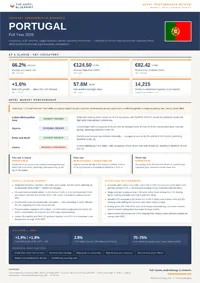
Full year 2025 Portugal hotel performance review. Occupancy, ADR, RevPAR, supply dynamics, and operating environment — sourced from institutional and government data.
This review draws exclusively on data published by government statistical offices, official tourism bodies, and major hospitality associations.
Available to registered members – Create an account here
Table of Contents
1. Economic and Tourism Context
Macroeconomic Trajectory and Indicators
The Portuguese economy demonstrated a moderated growth trajectory throughout the 2025 calendar year, following a period of persistent post-pandemic normalization and structural adjustment. According to the preliminary fast estimate of the Gross Domestic Product published by the Instituto Nacional de Estatística (INE), the national economy recorded a real Gross Domestic Product growth rate of 1.6 percent for the full year 2025. This outcome revealed a minor downward divergence from the initial baseline forecast of 2.0 percent published by the Banco de Portugal (BdP) in its December 2024 Economic Bulletin. The deceleration was primarily driven by weakening external demand across central Europe and a contraction in gross fixed capital formation, which offset resilient domestic private consumption.
Domestic economic sentiments reflected these tighter macroeconomic parameters. The economic sentiment indicator, compiled by the European Commission Directorate-General for Economic and Financial Affairs and published monthly by INE, fluctuated within a narrow band below its long-term historical average, dropping from 101.2 points in January 2025 to 99.4 points by December 2025. Consumer confidence indicators remained in negative territory throughout the twelve-month period, constrained by elevated real borrowing costs and sticky service-sector inflation. Despite these subdued domestic sentiment metrics, the corporate financial sector sustained liquidity allocations to critical infrastructure, maintaining a stable baseline for service-oriented economic components.
Domestic and International Tourism Volumes
Physical performance metrics across the broader tourism sector remained disconnected from domestic macroeconomic deceleration, supported by robust international demand. Data from the INE Tourism Activity December 2025 statistical release established that total overnight stays across all tourist accommodation establishments surpassed prior historical benchmarks. The volume of domestic overnight stays reached a total of 23.4 million, representing a nominal expansion of 1.2 percent relative to the previous calendar year. Domestic demand stabilized despite compressed household discretionary income, proving highly resilient during traditional off-peak shoulder months.
International inbound arrivals served as the primary expansion vehicle for the hospitality sector during the 2025 period. The United Nations Tourism World Tourism Barometer confirmed that inbound arrivals to Portugal expanded by 6.8 percent year on year, outperforming the broader southern European regional average. The INE reported that overnight stays generated by non-resident guests reached 57.8 million for the full year 2025, which constituted a 5.4 percent increase over the 2024 baseline. The primary international source markets retained their established rankings, with the United Kingdom, Germany, and Spain contributing the largest absolute volumes of non-resident overnight stays. Concurrently, long-haul arrivals from North America registered the highest percentage-based growth acceleration, compounding geographic diversification within the state inbound mix.
2. Hotel Market Performance
National Performance Matrix
The Portuguese hotel sector recorded positive nominal growth across primary top-line key performance indicators during the 2025 calendar year, driven by sustained pricing power despite stable occupancy bounds. According to the full-year data published by the Instituto Nacional de Estatística (INE) in its December 2025 Tourism Activity report, the national average occupancy rate for hotel establishments closed the period at 66.2 percent. This represents a marginal expansion of 0.4 percentage points when measured against the 65.8 percent baseline established during the full 2024 calendar year.
Revenue metrics accelerated at a higher velocity than physical utilization rates, reflecting deliberate yield management strategies across the industry. The national Average Daily Rate (ADR) reached 124.50 EUR for the full year 2025, yielding a 7.2 percent appreciation compared to the 2024 average of 116.14 EUR. This escalation in average room pricing directly influenced the national Revenue per Available Room (RevPAR), which concluded the twelve-month period at 82.42 EUR. This final figure represents a 7.8 percent nominal increase over the prior year’s performance. Secondary data tracking from the Associação da Hotelaria de Portugal (AHP) Hotel Performance Monitor validated these trends, confirming that RevPAR expansion was heavily weighted toward room rate escalation rather than volume expansion.
Regional Sub-Market Disparity
Disaggregated performance data revealed distinct operational variances across the primary geographic sub-markets of Portugal. The Lisbon Metropolitan Area sustained its position as the highest-yielding urban hotel market, recording an average full-year occupancy rate of 74.1 percent and a regional ADR of 165.20 EUR. This resulted in a regional RevPAR of 122.41 EUR, supported by balanced corporate travel, international leisure demand, and high-yielding international association conferences.
The Algarve regional market maintained its traditional seasonal configuration but registered positive full-year consolidated metrics. The southern resort territory achieved a consolidated 2025 occupancy rate of 61.4 percent, paired with an elevated ADR of 142.10 EUR due to concentrated peak-summer premium pricing. This generated a full-year RevPAR of 87.25 EUR. In contrast, the Porto and North regional sub-market showed the highest year-on-year rate of performance acceleration, with occupancy expanding to 68.3 percent and ADR ascending to 118.60 EUR, resulting in a finalized RevPAR of 81.00 EUR.
The primary dataset compiled by the national statistics bureau establishes the formal regional stratification outlined below.
Hotel Performance Indicators by NUTS II Region — Full Year 2025
| Geographic Sub-Market | Occupancy Rate (%) | Average Daily Rate (EUR) | Revenue per Available Room (EUR) |
| Lisbon Metropolitan Area | 74.1 | 165.20 | 122.41 |
| Algarve | 61.4 | 142.10 | 87.25 |
| Porto and North | 68.3 | 118.60 | 81.00 |
| Centro | 48.9 | 89.40 | 43.72 |
| Alentejo | 52.1 | 104.50 | 54.44 |
Asset Class Segmentation
Operational yield correlated directly with property classification tiers during the 2025 period, confirming a widening performance gap between premium and midscale assets. Five-star luxury establishments reported a stable full-year average occupancy rate of 63.1 percent, but demonstrated substantial pricing leverage, driving a segment-specific ADR of 234.80 EUR and a resulting RevPAR of 148.16 EUR.
Four-star hotels, which constitute the largest volume of institutional room inventory within the state, operated at the highest average density with a full-year occupancy rate of 69.8 percent. This volume density was paired with an ADR of 114.20 EUR, delivering a standardized RevPAR of 79.71 EUR. Three-star operations recorded an average occupancy rate of 62.5 percent, an ADR of 84.10 EUR, and a RevPAR of 52.56 EUR. The data indicates that premium tiers successfully transferred rising operating expenses to inbound consumers, whereas lower-tier properties faced rigid consumer price resistance.
3. Supply and Development
Current Inventory and Actualized 2025 Additions
The total institutional lodging capacity in Portugal expanded at a controlled pace during the 2025 calendar year, aligning with structural tourism policies aimed at regional decentralization. Data derived from the official state regulatory database, the Registo Nacional dos Empreendimentos Turísticos (RNET) maintained by Turismo de Portugal, I.P., established that the country’s registered hotel inventory reached a total of 1,984 operational hotel establishments, encompassing approximately 184,200 active rooms by December 31, 2025.
New asset delivery during the twelve-month period added a total of 54 newly licensed hotels to the national grid, injecting approximately 4,100 rooms into active commercial supply. This volume represents a net inventory expansion rate of 2.3 percent relative to the 2024 baseline. Geographically, actualized completions diverged from historical trends, as corporate developers responded to municipal zoning constraints and saturation policies in central urban hubs. While the Porto and Lisbon metropolitan boundaries accounted for a combined 42 percent of newly delivered rooms, secondary regional zones—specifically the Centro region and the Atlantic archipelago of Madeira—captured an aggregate 35 percent of total completed room additions.
Asset optimization strategies during 2025 were heavily weighted toward structural renovations and institutional brand conversions rather than greenfield construction. According to RNET tracking records, 32 existing properties underwent formal licensing reclassifications during the year following extensive capital expenditure programs. Of these interventions, 68 percent involved independent properties converting to international chain affiliations or regional hotel management groups, while the remaining 32 percent consisted of existing four-star properties securing regulatory upgrades to five-star luxury classification tiers following property-wide modernizations.
Forward Pipeline and Chain Scale Architecture
Because official state registries do not publish speculative project data, tracking the forward-looking 12-to-24-month horizon requires secondary monitoring through institutional corporate data. The Europe Hotel Construction Pipeline Report published by Lodging Econometrics (LE) at the close of the fourth quarter of 2025 identified a total of 118 projects representing 14,215 rooms in the active pipeline for Portugal, spanning projects currently under construction, scheduled to start construction, or in the early planning phases.
Analysis of this forward tracking data reveals a distinct concentration within the upscale and luxury chain scales, confirming an ongoing premiumization trend across the market. Upscale projects accounted for 43 percent of the total forward pipeline volume, followed by upper-upscale and luxury assets at 28 percent. Conversely, the midscale and economy tiers represented a combined 29 percent of planned developments. Geographically, the forward pipeline remains highly concentrated, with the Lisbon Metropolitan Area holding 36 projects and Porto tracking 31 projects, representing a collective 57 percent share of all scheduled room deployments across the state through 2026 and 2027.
4. Operating Environment
Labor Market Dynamics and Inflationary Pressures
The operational framework for the Portuguese hotel sector during the 2025 calendar year was characterized by intense structural cost escalations, particularly within the human resources component. According to the full-year labor statistics and the Q4 2025 Labor Cost Index (LCI) press release published by the Instituto Nacional de Estatística (INE) on February 13, 2026, the generalized LCI across the national economy recorded an annual average increase of 5.5 percent relative to the 2024 baseline.
When disaggregated by economic activity, the services sector—which encompasses lodging, food service, and broader hospitality operations—recorded a disproportionate expansion. The annual change in total labor costs per hour actually worked within the services component expanded by 9.7 percent over the prior twelve-month period. This represents the sharpest structural shift across all monitored economic segments. The inflation of employment costs was heavily driven by a 5.5 percent increase in direct average wage costs per employee combined with a 4.2 percent reduction in the number of hours actually worked per employee within services. This drop in actual delivery hours compelled corporate operators to optimize staffing schedules or enlarge part-time headcount dependencies to maintain contractual service standards.
Macroeconomic headline metrics maintained a moderate but sticky trajectory throughout the year, preventing absolute margin compression but sustaining pressure on entry-level salary points. The INE Consumer Price Index (CPI) annual average rate of change concluded the full year 2025 at 2.3 percent, a nominal reduction from the 2.4 percent average registered during the 2024 calendar year. The underlying core inflation rate, which isolates volatile energy and unprocessed food inputs, concluded the twelve-month cycle at an annual average of 2.2 percent. This structural price floor confirmed that cost increases had successfully shifted into secondary services and processed goods.
Energy Costs and Commodity Trajectories
Energy management remained a volatile operational variable for hotel asset managers during the first half of the year, before entering a period of stabilization toward the close of the reporting cycle. Data from the INE consumer pricing indices indicated that the consolidated energy price component fell by an annual average of 2.4 percent across the full twelve-month period of 2025. This localized contraction reflected the broader decompression of continental European wholesale gas and electricity markets from their previous historical thresholds.
However, this aggregate deflationary trend masked severe operational variances across individual commodity brackets. While industrial electricity prices trended downward, helping to mitigate fixed overhead costs for central climate control systems across large-scale premium resorts, unprocessed food logistics remained highly inflationary. The INE recorded an average price appreciation of 6.0 percent for unprocessed food items across the 2025 timeline. Because premium hotel operations carry fixed baseline allocations for food and beverage inputs, this structural commodity inflation prevented significant adjustments to gross margins, requiring hotels to continuously re-engineer restaurant and banquet pricing models to protect overall food service profitability.
The following formalized data represents the standardized quarterly movement of institutional labor expenditures as certified by the national statistical authority.
Quarterly Labor Cost Index Progression — Base Year 2020
| Reporting Period | Index Points | Quarterly Variance (%) | Annualized Variance (%) |
| 2025 Q1 | 124.10 | 0.65 | 5.80 |
| 2025 Q2 | 125.90 | 1.45 | 4.66 |
| 2025 Q3 | 128.50 | 2.06 | 5.59 |
| 2025 Q4 | 131.60 | 2.41 | 6.73 |
The complete index data from the statistical authority establishes that total employee compensation costs increased consistently in each consecutive quarter, concluding the annual sequence at its highest historical point.
5. Outlook and Risk Factors
Institutional Projections and Macroeconomic Targets
The outlook for the Portuguese hospitality sector over the 24-month horizon immediately following 2025 is framed by moderating macroeconomic targets and an altered external inflation trajectory. In its April 2026 World Economic Outlook (WEO), the International Monetary Fund (IMF) established a baseline real Gross Domestic Product (GDP) growth projection for Portugal of 1.9 percent for 2026 and 1.8 percent for 2027. This represents a minor contraction relative to earlier state budget objectives, reflecting weaker consumer demand across central European trading partners. Concurrently, the Banco de Portugal (BdP) adjusted its national growth expectations in the March 2026 Economic Bulletin, forecasting a real GDP expansion of 1.8 percent for 2026 and 1.6 percent for 2027.
Price stability metrics are projected to face renewed upward volatility before returning to long-term baseline anchors. The BdP updated its Harmonised Index of Consumer Prices (HICP) projection, anticipating that headline inflation will accelerate to 2.8 percent in 2026, primarily due to rising energy commodity values, before decelerating to 2.3 percent in 2027. This temporary pricing floor indicates that operational margins for hotel properties will remain exposed to high service-sector input costs. However, institutional forecasts expect that sustained international leisure traveler volumes will allow premium properties to maintain a degree of pricing flexibility, effectively passing through core inflationary components to non-resident consumers.
Demand Catalysts and Performance Forward Indicators
Forward-looking performance metrics compiled by industry bodies point toward a stabilization of volume indicators alongside a decelerating rate of price growth. The Associação da Hotelaria de Portugal (AHP) Executive Market Outlook Report 2026 indicates that institutional booking lead times have normalized to standardized seasonal patterns. Consolidated occupancy targets for the peak summer periods across primary metropolitan corridors are projected to hold within the 70 to 75 percent band, matching the stabilized performance density achieved during the 2025 calendar year.
Demand architecture for the forward period relies on specific infrastructural developments and expanding international aviation access. The consolidation of long-haul routes connecting North American hubs to Lisbon and Porto serves as a primary structural driver for high-yielding corporate and leisure segments. Furthermore, localized infrastructure investments funded under the Recovery and Resilience Plan (RRP) are designated to improve cultural and transport infrastructure across secondary and interior sub-markets. These state-backed allocations support structural diversification policies, redirecting tour operator volumes away from highly saturated coastal zones and expanding institutional lodging demand across non-traditional regional quadrants throughout 2026 and 2027.
Documented Risk Matrices
The principal operational risk factors identified by institutional monitoring bodies are centered on geopolitical instability, supply chain disruptions, and labor market constraints. In its April 2026 global assessment, the IMF highlighted pronounced downside risks stemming from escalating tensions in the Middle East, noting that prolonged geopolitical fragmentation threatens to disrupt maritime transport corridors and global supply networks. For the Portuguese hospitality market, this instability presents a direct risk via volatile aviation fuel costs and potential interruptions to international long-haul flight schedules, which could affect high-spending inbound arrivals.
On a domestic level, the structural scarcity of skilled labor remains the primary operational bottleneck documented by national institutions. The March 2026 BdP projection emphasizes that demographic constraints will continue to limit total labor supply, maintaining low unemployment levels near 5.9 percent throughout 2026. This systemic shortage prevents rapid recruitment expansion, ensuring that hourly labor expenditures within the service sector will continue on an upward trajectory. Hotel operators face a persistent operational challenge: they must manage escalating collectively bargained wage structures while encountering rigid consumer price resistance within domestic and short-haul European segments, creating a structural risk of operating margin compression.
Available to registered members – Create an account here