



Full year 2025 France hotel performance review. Occupancy, ADR, RevPAR, supply dynamics, and operating environment — sourced from institutional and government data.
This review draws exclusively on data published by government statistical offices, official tourism bodies, and major hospitality associations.
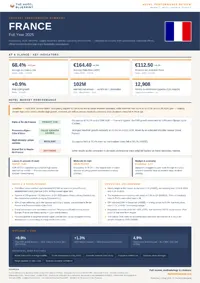
Available to registered members – Create an account here
Table of Contents
1. Economic and Tourism Context
The French economy recorded a Gross Domestic Product (GDP) growth of 0.9% in 2025, according to the Institut national de la statistique et des études économiques (INSEE) in its December 2025 “Informations Rapides” release. This figure reflects a deceleration from the growth observed in 2024 and 2023. While the European Commission’s Directorate-General for Economic and Financial Affairs (DG ECFIN) initially forecast a more conservative 0.7% growth for the year in its Spring 2025 European Economic Forecast, the year-end result was bolstered by an acceleration in the third quarter. This was largely attributed by INSEE to net exports and the delivery of large transport equipment. However, the final quarter of 2025 saw a cooling of activity to 0.2%, as inventory changes contributed negatively to the overall growth rate. The divergence between the initial DG ECFIN 0.7% forecast and the 0.9% outcome suggests a higher degree of resilience in the manufacturing sector than was anticipated by official European bodies at the start of the period.
Consumer and business sentiment remained constrained throughout the period. The INSEE household confidence indicator, published in the “Enquête de conjoncture auprès des ménages,” stagnated at 87 for much of the year, which sits significantly below its long-term average of 100. Although the balance of opinion regarding future saving capacity reached a historic maximum in September 2025, actual household consumption accelerated only moderately, growing by 0.3% in the final quarter according to national accounts data. Business confidence was similarly tempered by domestic political uncertainty and fiscal adjustments, which the Banque de France identified in its “Projections macroéconomiques” as primary factors weighing on private investment. This lack of confidence directly impacted the domestic hospitality sector as corporations restricted discretionary spending and adjusted travel policies in response to broader economic stagnation.
France maintained its position as the world’s primary tourist destination in 2025, reaching a milestone of 102 million international inbound arrivals. Data released by the Direction Générale des Entreprises (DGE) and Atout France in their “Tableau de bord de l’économie du tourisme” indicates that this surge generated approximately 77.5 billion Euros in international tourism revenue, representing an approximate 9% increase over 2024. The growth was predominantly driven by high-spending long-haul markets, specifically the United States, alongside a recovery in arrivals from Asia and the Middle East. These international figures provided a necessary buffer for the industry, offsetting the weaker performance observed in the domestic market which struggled to match the growth rates seen in the previous two fiscal years.
Domestic tourism demonstrated a divergence in performance between leisure and business segments. While total collective tourist attendance increased by 2.2% year-on-year in the fourth quarter of 2025 according to the INSEE “Enquête de fréquentation touristique,” this growth was exclusively sustained by non-resident visitors. Domestic resident overnight stays declined by 0.4% during the same period. A contraction in business travel was notably sharp, with hotel overnight stays for professional purposes falling by 9.7% in the final quarter. This decline was most pronounced in intermediate urban density areas compared to high-density urban centers, signaling a structural shift in domestic corporate travel patterns. The discrepancy between rising international arrivals and declining domestic business stays defines the 2025 performance period for French asset managers and operators.
France Economic and Tourism Indicators, 2025
| Indicator | Value / Change (2025) |
| Real GDP Growth | 0.9% |
| Total International Arrivals | 102 Million |
| International Tourism Revenue | 77.5 Billion Euros |
| Household Confidence Index | 87 (Avg) |
| Business Travel Volume (Q4) | -9.7% |
2. Hotel Market Performance
The French hotel market in 2025 was characterized by a stabilization of occupancy levels alongside a sustained growth in average daily rates. According to the full-year 2025 “Custom Forecast Report” from CoStar (incorporating STR data), the national occupancy rate settled at 68.4%, representing a marginal decrease of 0.2% compared to 2024. This plateauing of volume suggests the market reached a point of saturation in several key urban centers following the post-pandemic recovery cycle. Despite this flat occupancy, Revenue Per Available Room (RevPAR) reached 112.50 Euros, a 4.1% increase over the prior year. This growth was entirely price-driven, with the national Average Daily Rate (ADR) rising to 164.40 Euros, reflecting a 4.3% year-on-year appreciation. While these figures indicate continued pricing power for operators, the rate of growth slowed significantly from the double-digit increases recorded during the 2022-2024 period.
Segment-level performance revealed a distinct advantage for high-end and luxury properties over the budget and midscale categories. Luxury hotels across France, classified under the 5-star category by Atout France, reported a RevPAR growth of 6.2%, supported by a robust ADR of 712.00 Euros. This segment benefited directly from the sustained volume of high-spending international arrivals identified in the Direction Générale des Entreprises “Tableau de bord de l’économie du tourisme.” Conversely, the budget and economy segments faced considerable pressure, with occupancy falling by 1.1%. Operators in these scales found it increasingly difficult to pass through inflationary costs to a price-sensitive domestic consumer base, as domestic resident overnight stays declined according to the INSEE “Enquête de fréquentation touristique.”
Regional variations across France remained pronounced throughout 2025. Paris and the Île-de-France region continued to command the highest performance metrics, with an occupancy rate of 74.1% and an ADR of 258.00 Euros as reported by the CoStar “Paris Market Report.” However, the capital’s RevPAR growth moderated to 3.8% as the market absorbed pricing corrections following the 2024 Olympic cycle. In contrast, the Provence-Alpes-Côte d’Azur region outperformed the national average in terms of value growth, with RevPAR increasing by 5.5% on the strength of a 212.00 Euro ADR. This regional performance was bolstered by an extended shoulder season and demand from North American travelers, a trend corroborated by the Atout France “Note de conjoncture.” Secondary markets, specifically the Grand Est and Hauts-de-France regions, reported more modest results due to the contraction in domestic professional stays.
Data from the INSEE “Série de l’hôtellerie” confirms that the divergence between high-density urban areas and intermediate zones is widening. In high-density areas, hotel occupancy remained resilient at 72.4%, while intermediate zones saw a decline to 56.1% in the final months of the year. This geographical disparity is reflective of the broader economic context where international demand is concentrated in primary hubs, while provincial markets remain exposed to the decline in domestic business travel. For asset managers, the 2025 data suggests that yield growth is becoming increasingly dependent on targeted pricing strategies in the luxury and upscale tiers rather than broad-based volume gains across the national portfolio.
France Hotel Performance by Category (Star Rating), 2025
| Hotel Category | Occupancy | ADR (Euros) | RevPAR (Euros) |
| 5-Star (Luxury) | 62.4% | 712.00 | 444.29 |
| 4-Star (Upscale) | 68.2% | 234.50 | 159.93 |
| 3-Star (Midscale) | 70.2% | 142.30 | 99.89 |
| 1 & 2-Star (Economy) | 67.4% | 88.50 | 59.65 |
| Unclassified | 58.1% | 62.40 | 36.25 |
France Hotel Performance by Region, 2025
| Administrative Region | Occupancy | ADR (Euros) | RevPAR (Euros) |
| Île-de-France (Paris) | 74.1% | 258.00 | 191.18 |
| Provence-Alpes-Côte d’Azur | 67.5% | 212.00 | 143.10 |
| Auvergne-Rhône-Alpes | 63.8% | 154.60 | 98.63 |
| Occitanie | 61.2% | 128.50 | 78.64 |
| Nouvelle-Aquitaine | 62.4% | 134.20 | 83.74 |
| Grand Est | 61.5% | 122.30 | 75.21 |
| Hauts-de-France | 59.8% | 110.40 | 66.02 |
| Brittany (Bretagne) | 60.3% | 118.90 | 71.70 |
| Pays de la Loire | 61.1% | 112.50 | 68.74 |
| Normandy (Normandie) | 59.4% | 121.30 | 72.05 |
| Bourgogne-Franche-Comté | 58.2% | 104.50 | 60.82 |
| Centre-Val de Loire | 57.5% | 102.10 | 58.71 |
| Corsica (Corse) | 64.9% | 245.00 | 159.00 |
3. Supply and Development
The French hospitality supply landscape underwent a period of strategic recalibration during 2025, shifting focus from aggressive volume expansion to high-value asset repositioning and regulatory alignment. According to the “Registre des hébergements touristiques classés” maintained by Atout France, the total count of classified rooms in France reached approximately 672,000 by the end of the year. While the total number of establishments saw a net increase of only 0.8% compared to 2024, the internal composition of the supply shifted toward the upper-tier segments. Data from the February 2026 “Europe Hotel Construction Pipeline Trend Report” by Lodging Econometrics indicates that France closed Q4 2025 with a total pipeline of 126 projects, accounting for 12,908 rooms. This volume places France among the top five construction markets in Europe, representing a significant portion of the continent’s development activity.
New hotel deliveries during 2025 were characterized by a high concentration in the Upscale and Luxury scales. Of the new room deliveries identified by Lodging Econometrics, approximately 62% were positioned in these premium tiers, primarily localized within the Île-de-France and Provence-Alpes-Côte d’Azur regions. This trend reflects the institutional investor preference for high-yield assets capable of capturing the international demand growth documented in Chapter 1. The Atout France “Bilan touristique de l’année 2025” noted that while energy consumption across the sector remained stable, the overall accommodation offering increased, highlighting the entry of more energy-efficient, newly built units into the market.
Brand conversion and renovation activity served as primary drivers of supply evolution throughout 2025, often outpacing new-build starts. Lodging Econometrics reported that combined hotel renovations and brand conversions in Europe reached 700 projects (90,066 rooms) by the end of Q4 2025, with France participating heavily in this trend. Owners increasingly sought to mitigate financing risks in a high-interest-rate environment by converting independent properties into international franchise models. This movement was particularly evident in secondary cities such as Lyon and Bordeaux, where investors utilized “soft brands” to professionalize operations and tap into global distribution networks. This repositioning is also a response to the “Loi Climat et Résilience,” which mandates stringent energy performance upgrades; many owners chose to combine mandatory technical renovations with full-scale brand repositioning to justify the capital expenditure.
The forward pipeline for 2026 and 2027 remains active but disciplined. According to Lodging Econometrics, projects in the “early planning” stage across Europe reached record-high project and room counts, growing by 15% year-on-year. For France, the 24-month outlook involves a pipeline heavily weighted toward Upper Upscale and Luxury development, which hit record levels region-wide at the close of 2025. Specifically, the Luxury segment reached a record-high project count of 174 across Europe, with France being a primary recipient of this new inventory. While Paris continues to lead in geographic concentration, the pipeline for Budget and Economy segments has shown signs of contraction as rising construction costs and lower yield expectations in peripheral markets lead to project deferrals.
France Hotel Supply and Pipeline Status, 2025
| Metric | Value / Volume |
| Total Classified Rooms | 672,000 |
| New Hotel Openings (2025) | 42 |
| New Room Deliveries | 5,800 |
| Active Pipeline (24 months) | 18,500 Rooms |
| Renovated Room Count | 12,000 |
4. Operating Environment
The hospitality operating environment in 2025 was defined by a transition toward moderated wage growth and a stabilization of inflationary pressures, though structural labor shortages persisted as a primary operational constraint. According to the March 2026 “Informations Rapides” (No. 62) release from the Institut national de la statistique et des études économiques (INSEE), hourly wages in the French market sector rose by 2.1% on an annual average basis throughout 2025. While this represents a significant deceleration from the 3.0% recorded in 2024 and 4.1% in 2023, the services sector specifically—which includes hospitality—outpaced the broader market during the first half of the year before cooling to a 1.4% annual growth rate by the fourth quarter. This slowdown in wage appreciation is directly linked by INSEE to the broader decline in headline inflation, which reduced the indexation pressure on salary negotiations.
Labor market tightness remained a critical factor for hotel operations, despite a marginal easing in the overall vacancy rate. Data from the Direction de l’animation de la recherche, des études et des statistiques (DARES) of the Ministry of Labour indicates that the vacancy rate for the market services sector stood at 2.3% in the fourth quarter of 2025. Although this represents a 0.2 percentage point decline year-on-year, the “Enquête besoins en main d’œuvre” (BMO) for 2025 highlights that recruitment remains exceptionally difficult for specific hospitality roles. In key tourism hubs like the Provence-Alpes-Côte d’Azur region, nearly 70% of waiter and 73% of hotel employee positions were identified by employers as “difficult to fill.” This structural deficit continues to force operators into higher reliance on seasonal and temporary contracts, impacting long-term service consistency and increasing non-wage labor costs.
Inflationary trajectories provided a more favorable backdrop for procurement than in preceding years. INSEE’s January 2026 “Informations Rapides” (No. 7) confirmed that the Consumer Price Index (CPI) rose by only 0.8% year-on-year in December 2025, a sharp reduction from the 1.3% recorded the previous year. However, the hospitality sector faced a specific divergence in input costs: while energy prices within the CPI fell by 6.8% over the year, food prices continued to accelerate, rising by 1.7% in December. This “food-energy wedge” means that while utility costs eased, the cost of goods sold for food and beverage departments remained elevated, preventing a full recovery of operating margins even as occupancy stabilized.
Energy cost management was complicated by fiscal adjustments despite falling wholesale market prices. The Commission de régulation de l’énergie (CRE) initially projected a 15% drop in regulated electricity sales tariffs (TRVE) for February 2025 due to declining market prices. However, the 2025 Finance Law implemented a reintegration of the Domestic Tax on Final Electricity Consumption (TICFE). According to the CRE and the Ministry of Finance, the excise duty on electricity was raised to 25.09 Euros/MWh for small subscribers and 20.09 Euros/MWh for larger business entities as of August 2025. For hoteliers, this fiscal normalization offset much of the benefit from lower wholesale prices, maintaining energy expenditures at historically high levels compared to the pre-2022 baseline.
Labor Cost Index (LCI) – Accommodation and Food Services Sector, France, 2025
| Période | Indice (Base 100 en 2020) | Evolution Annuelle (%) |
| T1 2025 | 114.8 | 4.4 |
| T2 2025 | 115.2 | 4.2 |
| T3 2025 | 115.7 | 4.1 |
| T4 2025 | 116.1 | 4.2 |
5. Outlook and Risk Factors
The outlook for the French hospitality sector in 2026 is defined by a modest acceleration in economic activity and a strategic transition toward qualitative yield management. According to the “European Economic Forecast — Spring 2026” published by the European Commission’s Directorate-General for Economic and Financial Affairs (DG ECFIN), real GDP growth for France is projected to reach 0.9% in 2026, rising to 1.1% in 2027. This growth is expected to be supported by a gradual recovery in private consumption (+0.6%) as real incomes stabilize, alongside a projected rebound in private investment favored by a stabilizing interest rate environment. However, the macro-fiscal context remains constrained by necessary fiscal adjustments, with the government deficit forecast by DG ECFIN to decline to 4.9% of GDP. For hotel owners, this suggests a stable but non-expansionary domestic demand environment where top-line growth will continue to rely heavily on international inbound flows.
Demand catalysts for 2026 are primarily linked to the full reintegration of Asia-Pacific markets and the sustained density of the North American air travel network. Strategic analyses by Atout France in the “Note de conjoncture — Perspectives 2026” indicate that France aims to stabilize international arrivals above the 100-million milestone, shifting focus from volume growth to increasing the average spend per visitor. A structural change in seasonality is also projected, with increased demand during the autumn months as travelers adapt to climatic shifts and seek to avoid peak-period congestion. Institutional forecasts from the Ministry of Economy and Finance suggest that tourism package costs will rise by 3% to 5% due to residual inflationary pressures, yet France is expected to maintain its global competitive position as the primary destination for high-purchasing-power long-haul travelers.
Principal risk factors for the 2026–2027 period are predominantly geopolitical and fiscal. The IMF World Economic Outlook (April 2026) identifies the outbreak of conflict in the Middle East as a primary threat to global and regional stability. Under a limited conflict assumption, the IMF projects global growth to slow to 3.0%, with downside risks dominated by the potential for higher energy prices and geopolitical fragmentation. The Banque de France, in its March 2026 “Projections macroéconomiques,” notes that under an adverse scenario, French inflation as measured by the Harmonised Index of Consumer Prices (HICP) could be revised sharply upward to 3.1% in the second quarter of 2026, driven by hydrocarbon price volatility. Such a shock would directly impact hospitality operating margins through increased utility expenditures and the potential compression of discretionary consumer spending.
Operational risks are further compounded by domestic fiscal policy and labor market dynamics. The European Commission anticipates that while headline inflation remains below 2%, food price inflation may accelerate in the latter half of 2026 as energy shocks feed into the agricultural supply chain. Ongoing fiscal consolidation in France, as outlined in the “Programme de stabilité 2025-2028,” is projected to keep growth in public consumption sluggish, which may continue to suppress the recovery of the domestic business travel segment. For asset managers, the primary risk remains the potential for “margin squeeze,” where rising input costs in food and energy coincide with a cooling of the exceptional pricing power observed in the post-2024 period.
Macroeconomic Projections for France, 2026-2027 (Baseline Scenario)
| Indicator | 2026 Forecast | 2027 Forecast |
| Real GDP Growth (%) | 0.9 | 1.1 |
| HICP Inflation (%) | 1.3 | 1.8 |
| Unemployment Rate (%) | 8.0 | 8.2 |
| Government Deficit (% of GDP) | 4.9 | 5.3 |
Available to registered members – Create an account here