
Description
Strategic Asset Preservation and Lifecycle Management
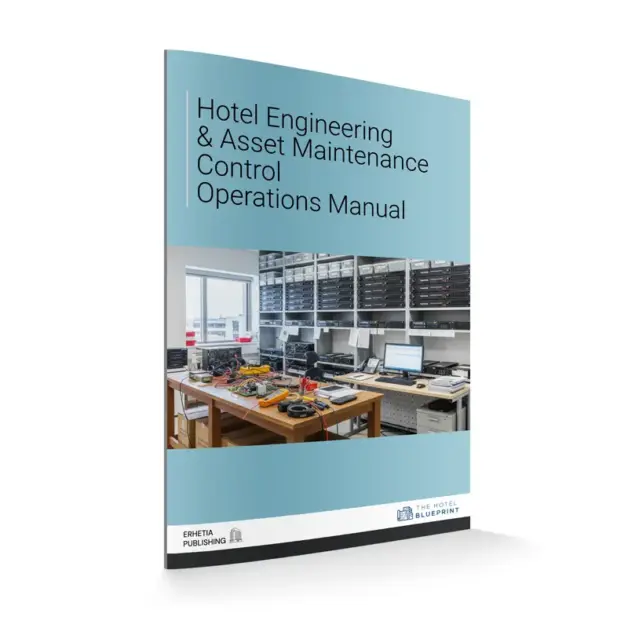
This operations manual provides a structured framework for managing a hotel’s physical plant, mechanical infrastructure, and technical workforce. Designed for engineering directors and property general managers, the document establishes clear protocols for balancing daily repair demands with long-term asset preservation. It details the entire lifecycle of maintenance workflows, establishing objective benchmarks for work order verification, preventive inspections, and technical staff scheduling across all shifts.
Beyond daily facility tasks, the manual provides a fiscal roadmap for property stewardship. It outlines systematic approaches to multi-year capital expenditure (CapEx) planning, replacement reserve budgeting, and structured vendor contract reviews. By implementing these engineering standards, properties can minimize utility waste, maintain strict compliance with safety regulations, control spare parts inventory costs, and extend the operational life of critical mechanical systems.
Preview
Procurement Standards & Spare Parts Inventory Control
| Department/Division: Maintenance | Code: MTN-010 | Total Pages: 2 |
1. Purpose
To ensure the continuous availability of critical spare parts and maintenance supplies while optimizing cash flow and maintaining high quality standards for all technical acquisitions.
2. Procurement Standards
To minimize long-term maintenance costs, all technical purchases must adhere to the “Total Cost of Ownership” principle rather than lowest initial price:
- Durability: Prioritize materials and parts with proven commercial-grade longevity.
- Standardization: Purchase identical models of motors, pumps, and fixtures across the property to reduce the variety of spare parts required in stock.
- Energy Efficiency: New equipment must meet or exceed international energy-saving benchmarks (e.g., Energy Star or equivalent) to reduce utility expenditure.
3. Inventory Categorization
Maintenance stock must be organized into three distinct categories:
- Critical Spares: Parts for which a failure would lead to room “out-of-order” status or safety risks (e.g., electronic lock batteries, HVAC sensors, specialized light bulbs). Minimum stock levels are mandatory.
- Consumables: Fast-moving items used in daily operations (e.g., filters, lubricants, gaskets, cleaning chemicals).
- Project Stock: Materials purchased specifically for scheduled redecorations or CapEx projects (e.g., specific wallpaper rolls or carpet tiles).
4. Inventory Management Protocols
- Storage: All parts must be stored in a secured, climate-controlled environment to prevent degradation.
- Minimum/Maximum Levels: A “Reorder Point” must be established for all critical spares and consumables. When stock reaches the minimum level, the system must trigger a purchase requisition.
- Issue Tracking: No item shall leave the store without being recorded against a specific Work Order or Room Number.
5. Receiving and Quality Inspection
- Verification: Upon delivery, the Maintenance Supervisor must verify that the parts match the technical specifications in the Purchase Order.
- Defective Goods: Substandard or incorrect items must be rejected immediately and documented to the Purchasing Manager for vendor performance tracking.
6. Annual Audit
- A physical inventory count must be conducted annually in coordination with the Finance Department to reconcile stock levels and identify obsolete items for disposal or return.
7. Responsibility
- Maintenance Storekeeper/Supervisor: Responsible for stock accuracy and requisitioning.
- Director of Engineering: Responsible for setting technical specifications for all parts.
Purchasing Manager: Responsible for vendor negotiation and timely delivery.